Posts tagged 'golden-ratio'
Golden Rectangles of the Icosahedron
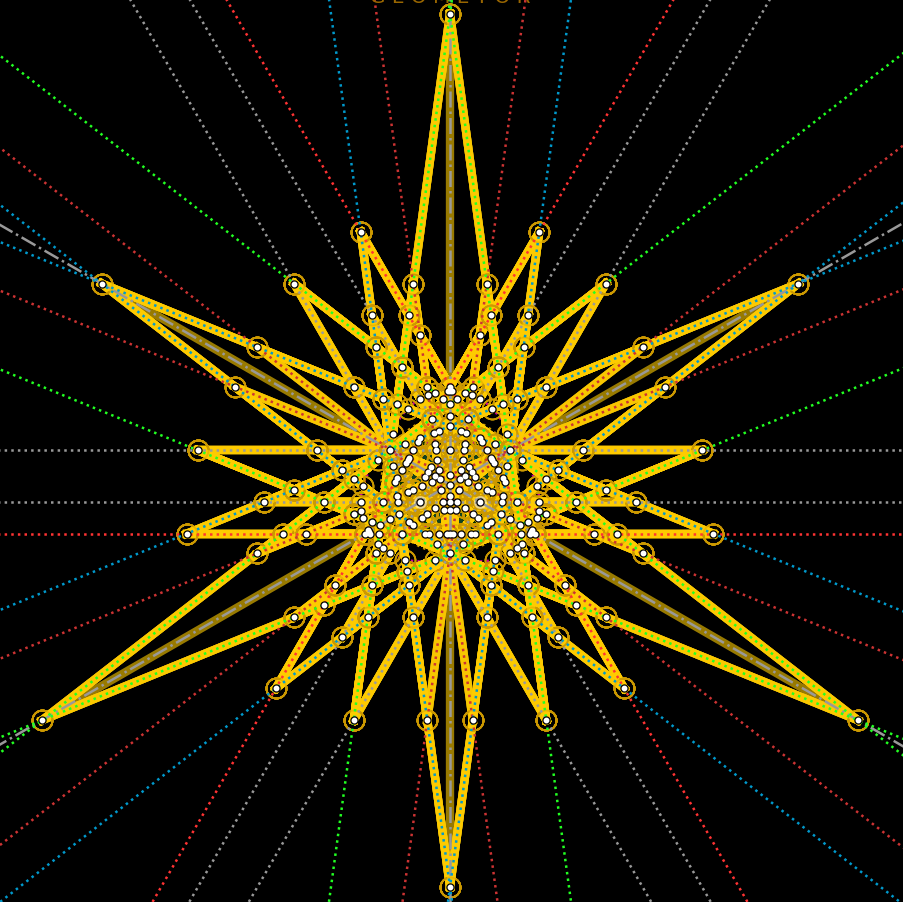
The twelve vertices of the regular icosahedron \(\{3, 5\}\) partition into three congruent, mutually orthogonal golden rectangles centered at the origin, each having aspect ratio \(1 : \phi\). The six short edges form six edges of the icosahedron, while the long edges cross the solid’s interior. Every circumradius satisfies \(Q_{\text{out}} = \phi + 2\), and the vertical side of each rectangle divides the equatorial radius in extreme and mean ratio.
P-05.01 · Kepler Golden Pyramid
The Great Pyramid profile based on the Kepler right triangle 1 : sqrt(phi) : phi satisfying Herodotus’s area law.
The 1597 Kepler Right Triangle & Golden Surface Harmony
In October 1597, Johannes Kepler synthesized the Pythagorean Theorem (\(a^2 + b^2 = c^2\)) and the Divine Proportion (\(1 + \phi = \phi^2\)) into a singular right-angled triangle whose sides form a continuous geometric progression \((1, \sqrt{\phi}, \phi)\). When this triangle serves as the meridian cross-section of a square pyramid, the square on the vertical height equals the area of each triangular face (\(A_{\text{face}} = h^2\)), fulfilling Herodotus’s ancient architectural enunciation over the quartic number field \(\mathbb{Q}(\sqrt{\phi})\).
Golden Division of the Octahedron
If each of the twelve edges of a regular octahedron of scale \(\phi^2\) is directed cyclically and divided in extreme and mean ratio (\(1 : \phi\)), the twelve division points constitute the exact twelve vertices of the regular icosahedron \(\{3, 5\}\). As the division parameter varies from \(\tau = 1/2\) to \(\tau = \phi^{-1}\), the solid smoothly morphs from the Archimedean cuboctahedron into the regular icosahedron.
P-03.02 · Rhombic Triacontahedron
A Catalan zonohedron bounded by 30 congruent golden rhombi, polar dual to the icosidodecahedron.
Squaring the Circle & the Earth–Moon Cosmogram
The Great Pyramid of Giza embodies the perimeter dual of squaring the circle: constructing a square pyramid whose square base perimeter equals the circumference of a circle whose radius is the pyramid’s vertical height (\(8a = 2\pi h \iff h/a = 4/\pi\)). Under the Kepler Golden Pyramid profile (\(h = \sqrt{\phi}\)), this relation yields the celebrated algebraic approximation \(\pi \approx 4/\sqrt{\phi} \approx 3.1446\) (\(< 0.1\%\) discrepancy), geometrically realizing the astronomical Earth–Moon tangent cosmogram.
Five Inscribed Cubes in the Dodecahedron
In Elements Book XIII, Proposition 17, Euclid demonstrates that the twenty vertices of the regular dodecahedron \(\{5, 3\}\) can be constructed by erecting hipped roof wedges upon the six faces of a central inscribed cube. The sixty diagonals of the twelve pentagonal faces partition into five mutually disjoint sets of twelve edges, defining five inscribed regular cubes whose edge quadrance ratio to the dodecahedron edge is identically \(Q_{\text{cube}} / Q_{\text{dod}} = \phi^2\), permuted by the alternating group \(A_5\).
P-05.03 · Golden Square Bipyramid
An octahedral bipyramid formed by reflecting the Kepler Golden Pyramid across its square base.
Kepler’s Rhombic Triacontahedron (1611)
In Strena Seu de Nive Sexangula (1611), Johannes Kepler united the 20 vertices of the regular dodecahedron with the 12 vertices of its dual regular icosahedron to form the 32 vertices of the Rhombic Triacontahedron. Its 30 faces are congruent golden rhombi whose long-to-short diagonal quadrance ratio is identically \(Q_{\text{long}} / Q_{\text{short}} = \phi^2\), establishing the divine proportion \(\phi = \frac{1 + \sqrt{5}}{2}\) as the diagonal aspect ratio of every face.
P-05.04 · Regular Pentagonal Pyramid (Johnson J2)
The regular equilateral pentagonal pyramid (Johnson Solid J2), forming the 6-vertex cap of the regular icosahedron.
George Odom’s Golden Construction in the Tetrahedron (1983)
In 1983, the American artist and geometer George Odom discovered that connecting the midpoints \(M_1\) and \(M_2\) of two sides of an equilateral triangular face of a regular tetrahedron and extending the segment to intersect the face’s circumcircle at \(G_2\) divides the chord in the divine proportion: \(Q(M_1, M_2) / Q(M_2, G_2) = \phi^2\), proving that \(\phi\) is an organic invariant of tetrahedral geometry.
P-02.06 · Icosidodecahedron
The Icosidodecahedron (Dodecahedron Abscisum) is the canonical quasi-regular golden ratio solid formed by edge-midpoint rectification (
rectify) of either the regular dodecahedron or regular icosahedron. Bounded by 20 equilateral triangles and 12 regular pentagons with 30 vertices and 60 edges, every vertex is surrounded by alternating triangles and pentagons (\((3 \cdot 5)^2\)).P-02.08 · Truncated Dodecahedron
The Truncated Dodecahedron (Dodecahedron Abscisum Decagonale) is an Archimedean semi-regular solid formed by truncating the twenty vertices of a regular dodecahedron at the exact golden edge depth \(t = \frac{3 - \phi}{5} = \frac{5 - \sqrt{5}}{10} \in \mathbb{Q}(\phi)\). Bounded by 20 equilateral triangles and 12 regular decagons with 60 vertices and 90 edges, every vertex is surrounded identically by one triangle and two decagons (\(3 \cdot 10^2\)).
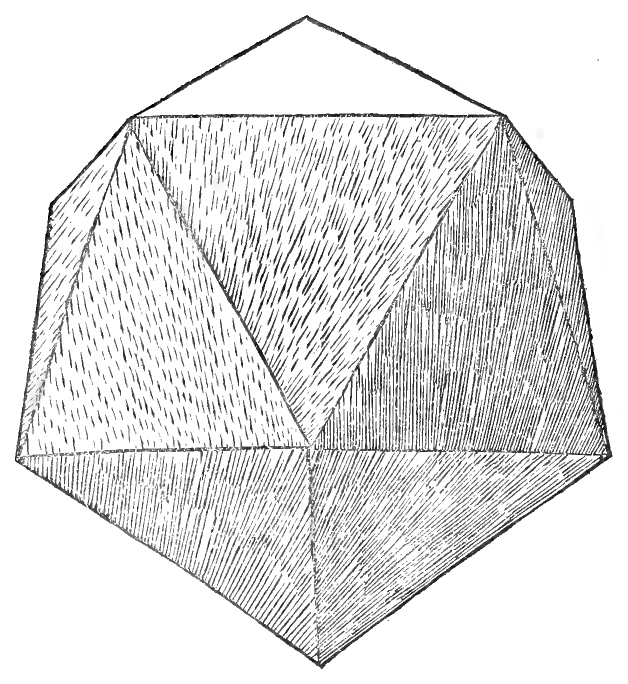
Tabulae XXI–XXII: Icosahedron Planum Solidum et Vacuum (1509)
The regular icosahedron \(\{3, 5\}\) is composed of 20 equilateral triangular faces, 30 edges, and 12 vertices defined by three mutually perpendicular golden rectangles over \(\mathbb{Q}(\phi)\). Leonardo da Vinci illustrates this Platonic solid in Tabula XXI (Folio 0231) as Icosahedron Planum Solidum and in Tabula XXII (Folio 0233) as Icosahedron Planum Vacuum. In vacuate form, the 20 triangular window apertures form a wooden framework of topological genus \(g = F - 1 = 19\), the highest among the five Platonic solids.
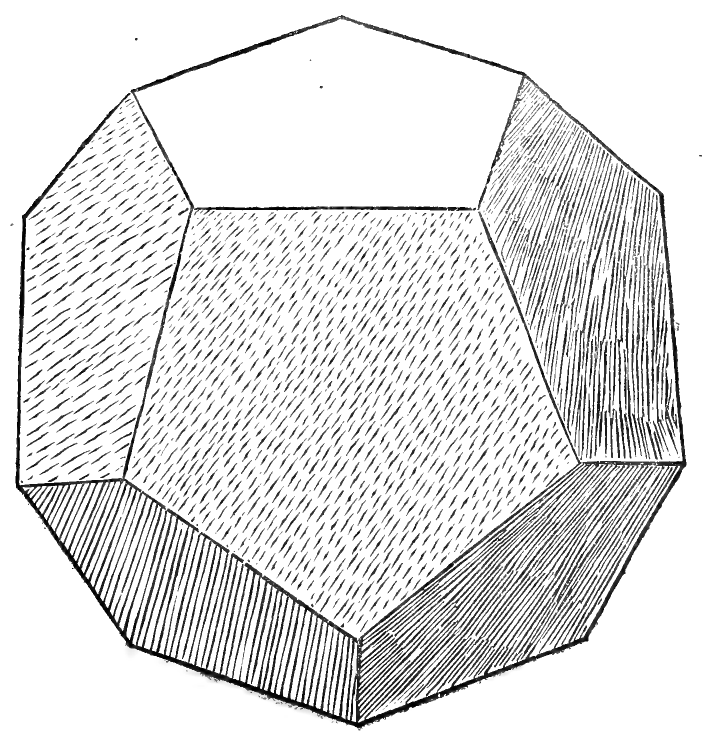
Tabulae XXVII–XXVIII: Dodecahedron Planum Solidum et Vacuum (1509)
The regular dodecahedron \(\{5, 3\}\) possesses 20 vertices, 30 edges, and 12 regular pentagonal faces governed by the divine proportion \(\phi\). Leonardo da Vinci illustrates this celestial solid in Tabula XXVII (Folio 0243) as Dodecahedron Planum Solidum and in Tabula XXVIII (Folio 0245) as Dodecahedron Planum Vacuum. In hollow form, the twelve open pentagonal windows form a wooden carpentry cage of topological genus \(g = F - 1 = 11\).