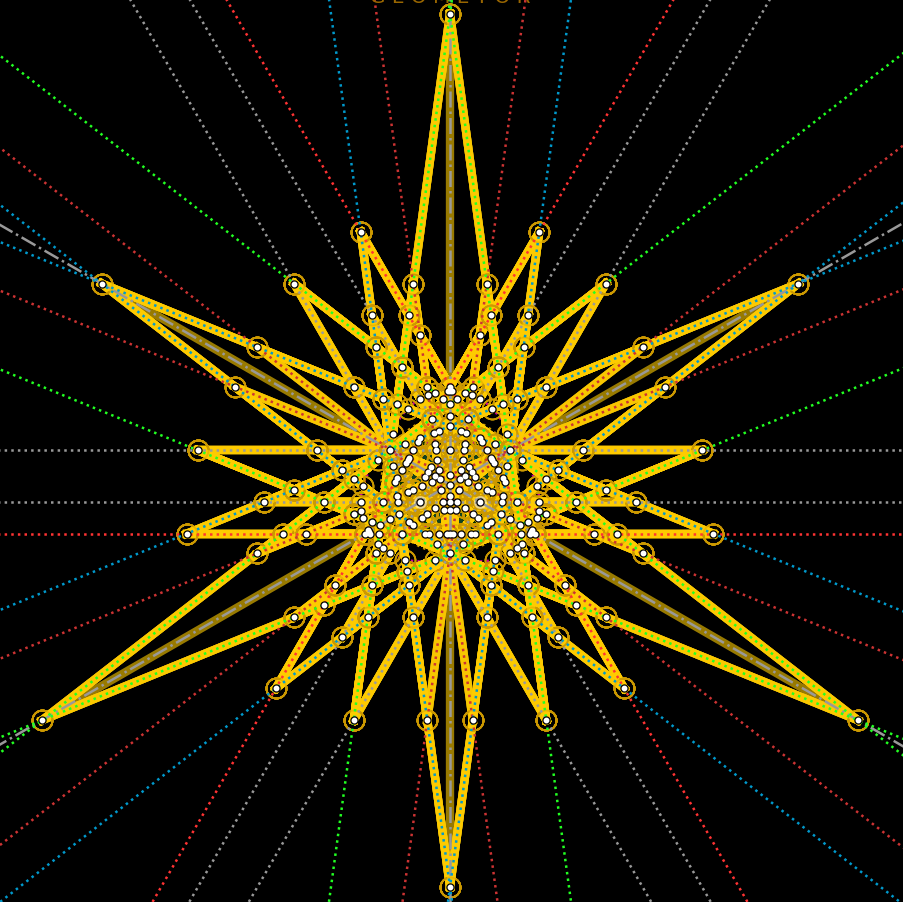
Posts tagged 'archimedean'
P-02.01 · Truncated Tetrahedron
The Truncated Tetrahedron (Tetrahedron Abscisum) is the simplest Archimedean semi-regular polyhedron, formed by cutting off the four corners of a regular tetrahedron at one-third of its edge length (\(t = 1/3\)). Bounded by 4 equilateral triangles and 4 regular hexagons with 12 vertices and 18 edges, every vertex is surrounded identically by one triangle and two hexagons (\(3 \cdot 6^2\)).
P-02.02 · Cuboctahedron
The Cuboctahedron (Exahedron Abscisum) is the canonical quasi-regular Archimedean solid formed by edge-midpoint rectification (
rectify) of either the cube or the regular octahedron. Bounded by 8 equilateral triangles and 6 squares with 12 vertices and 24 edges, every vertex is surrounded by alternating triangles and squares (\((3 \cdot 4)^2\)).P-02.03 · Truncated Hexahedron
The Truncated Hexahedron (Truncated Cube) is an Archimedean semi-regular solid formed by truncating the eight corners of a cube at edge depth \(t = 1 - \frac{\sqrt{2}}{2} \in \mathbb{Q}(\sqrt{2})\). Bounded by 8 equilateral triangles and 6 regular octagons with 24 vertices and 36 edges, every vertex is surrounded identically by one triangle and two octagons (\(3 \cdot 8^2\)).
P-02.04 · Truncated Octahedron
The Truncated Octahedron (Octahedron Abscisum, Lord Kelvin’s ideal foam cell, and the order-4 permutohedron) is the unique space-filling Archimedean solid formed by truncating the six corners of a regular octahedron at one-third edge depth (\(t = 1/3\)). Bounded by 6 squares and 8 regular hexagons with 24 vertices and 36 edges, every vertex is surrounded by one square and two hexagons (\(4 \cdot 6^2\)).
P-02.05 · Rhombicuboctahedron
The Rhombicuboctahedron (Vigintisex Basium, the 26-Base Body) is the celebrated centerpiece of Renaissance stereometry depicted by Leonardo da Vinci. Bounded by 18 squares (6 axial and 12 chamfer facets) and 8 equilateral octant triangles with 24 vertices and 48 edges, every vertex is surrounded by three squares and one triangle (\(3 \cdot 4^3\)).
P-02.06 · Icosidodecahedron
The Icosidodecahedron (Dodecahedron Abscisum) is the canonical quasi-regular golden ratio solid formed by edge-midpoint rectification (
rectify) of either the regular dodecahedron or regular icosahedron. Bounded by 20 equilateral triangles and 12 regular pentagons with 30 vertices and 60 edges, every vertex is surrounded by alternating triangles and pentagons (\((3 \cdot 5)^2\)).P-02.07 · Truncated Icosahedron
The Truncated Icosahedron (Icosahedron Abscisum, the canonical Archimedean fullerene / Buckminsterfullerene \(C_{60}\)) is formed by truncating the twelve vertices of a regular icosahedron at one-third edge depth (\(t = 1/3\)). Bounded by 12 regular pentagons and 20 regular hexagons with 60 vertices and 90 edges, every vertex is surrounded identically by one pentagon and two hexagons (\(5 \cdot 6^2\)).
P-02.08 · Truncated Dodecahedron
The Truncated Dodecahedron (Dodecahedron Abscisum Decagonale) is an Archimedean semi-regular solid formed by truncating the twenty vertices of a regular dodecahedron at the exact golden edge depth \(t = \frac{3 - \phi}{5} = \frac{5 - \sqrt{5}}{10} \in \mathbb{Q}(\phi)\). Bounded by 20 equilateral triangles and 12 regular decagons with 60 vertices and 90 edges, every vertex is surrounded identically by one triangle and two decagons (\(3 \cdot 10^2\)).