Posts tagged 'hexahedron'
P-01.02 · Hexahedron (Cube)
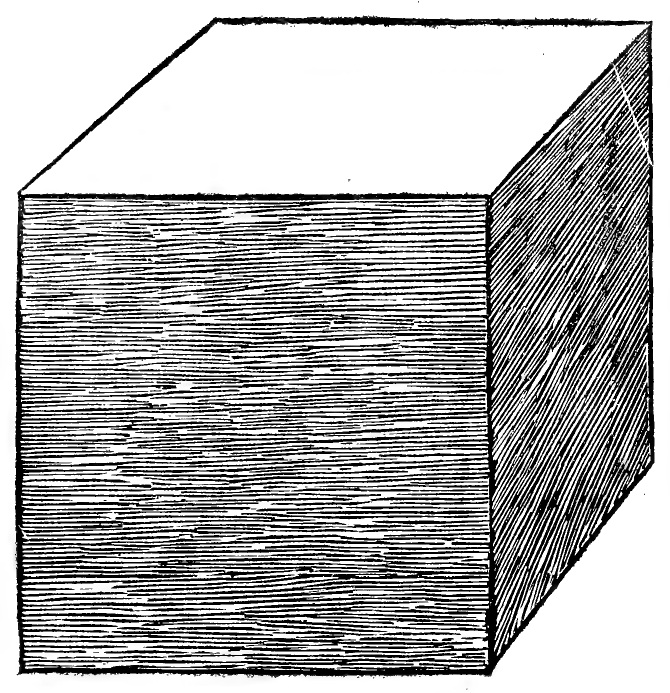
The Regular Hexahedron (commonly called the Cube) is the canonical orthogonal solid of Euclidean three-space. Bounded by 6 congruent square faces with 8 vertices and 12 edges, each vertex is shared by 3 squares (\(\{4, 3\}\)). In Plato’s Timaeus (55d–56a), the cube is assigned to the element Earth: possessing square faces that sit firmly upon any plane, it is the most stable, immovable, and solid of the five Platonic bodies.
Tabulae VII–VIII: Exahedron Planum Solidum et Vacuum (1509)
The regular hexahedron (cube) \(\{4, 3\}\) possesses 8 vertices, 12 edges, and 6 square faces. Leonardo da Vinci illustrates this fundamental Platonic solid in Tabula VII (Folio 0199) as Exahedron sive Cubus Planum Solidum and in Tabula VIII (Folio 0201) as Exahedron Planum Vacuum. Hollowing the 6 square faces transforms the cube into a 2-manifold wooden framework of topological genus \(g = F - 1 = 5\).