Posts tagged 'cube'
P-01.02 · Hexahedron (Cube)
The Regular Hexahedron (commonly called the Cube) is the canonical orthogonal solid of Euclidean three-space. Bounded by 6 congruent square faces with 8 vertices and 12 edges, each vertex is shared by 3 squares (\(\{4, 3\}\)). In Plato’s Timaeus (55d–56a), the cube is assigned to the element Earth: possessing square faces that sit firmly upon any plane, it is the most stable, immovable, and solid of the five Platonic bodies.
P-02.02 · Cuboctahedron
The Cuboctahedron (Exahedron Abscisum) is the canonical quasi-regular Archimedean solid formed by edge-midpoint rectification (
rectify) of either the cube or the regular octahedron. Bounded by 8 equilateral triangles and 6 squares with 12 vertices and 24 edges, every vertex is surrounded by alternating triangles and squares (\((3 \cdot 4)^2\)).P-04.02 · Hexahedron Elevatum
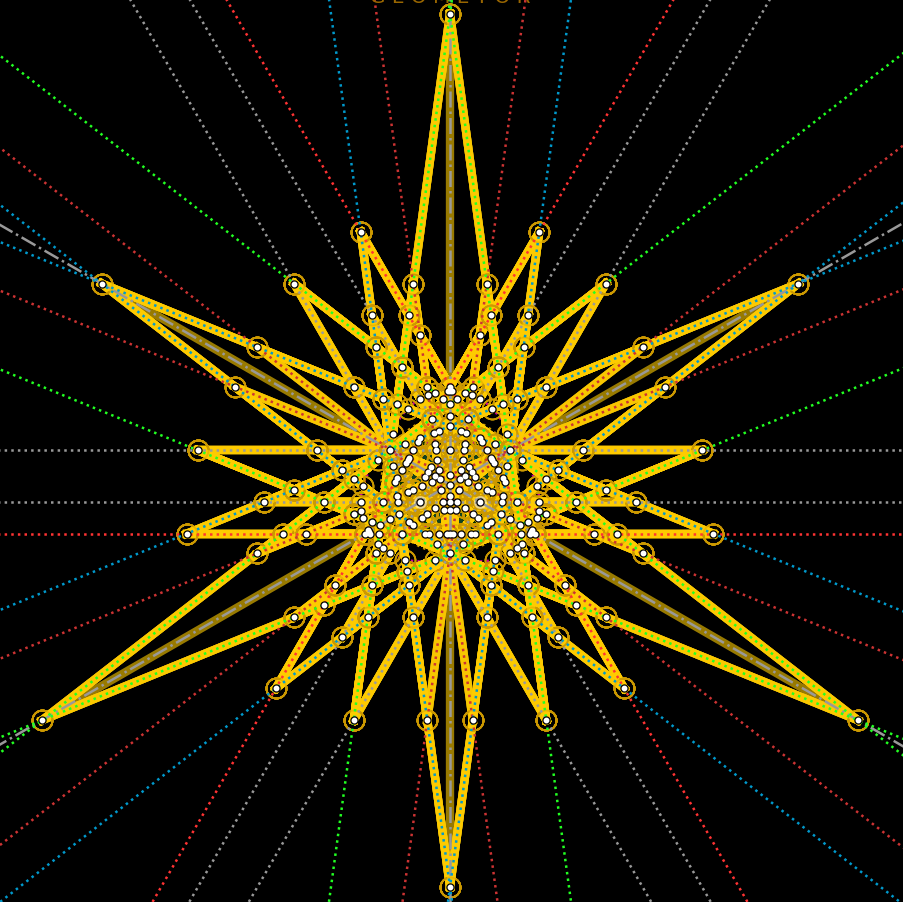
A stellated polyhedron formed by erecting equilateral pyramids on the six faces of a cube.
Five Inscribed Cubes in the Dodecahedron
In Elements Book XIII, Proposition 17, Euclid demonstrates that the twenty vertices of the regular dodecahedron \(\{5, 3\}\) can be constructed by erecting hipped roof wedges upon the six faces of a central inscribed cube. The sixty diagonals of the twelve pentagonal faces partition into five mutually disjoint sets of twelve edges, defining five inscribed regular cubes whose edge quadrance ratio to the dodecahedron edge is identically \(Q_{\text{cube}} / Q_{\text{dod}} = \phi^2\), permuted by the alternating group \(A_5\).
P-02.03 · Truncated Hexahedron
The Truncated Hexahedron (Truncated Cube) is an Archimedean semi-regular solid formed by truncating the eight corners of a cube at edge depth \(t = 1 - \frac{\sqrt{2}}{2} \in \mathbb{Q}(\sqrt{2})\). Bounded by 8 equilateral triangles and 6 regular octagons with 24 vertices and 36 edges, every vertex is surrounded identically by one triangle and two octagons (\(3 \cdot 8^2\)).
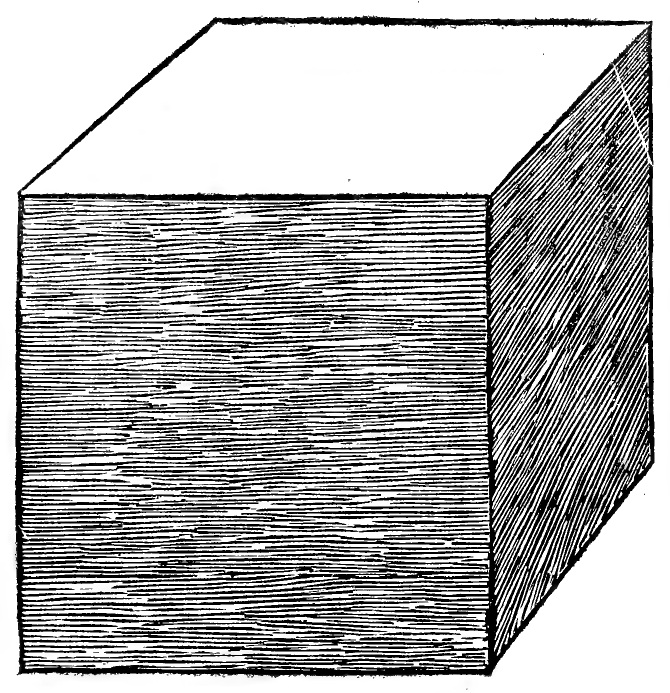
Tabulae VII–VIII: Exahedron Planum Solidum et Vacuum (1509)
The regular hexahedron (cube) \(\{4, 3\}\) possesses 8 vertices, 12 edges, and 6 square faces. Leonardo da Vinci illustrates this fundamental Platonic solid in Tabula VII (Folio 0199) as Exahedron sive Cubus Planum Solidum and in Tabula VIII (Folio 0201) as Exahedron Planum Vacuum. Hollowing the 6 square faces transforms the cube into a 2-manifold wooden framework of topological genus \(g = F - 1 = 5\).