Posts tagged 'truncation'
P-02.01 · Truncated Tetrahedron
The Truncated Tetrahedron (Tetrahedron Abscisum) is the simplest Archimedean semi-regular polyhedron, formed by cutting off the four corners of a regular tetrahedron at one-third of its edge length (\(t = 1/3\)). Bounded by 4 equilateral triangles and 4 regular hexagons with 12 vertices and 18 edges, every vertex is surrounded identically by one triangle and two hexagons (\(3 \cdot 6^2\)).
P-02.03 · Truncated Hexahedron
The Truncated Hexahedron (Truncated Cube) is an Archimedean semi-regular solid formed by truncating the eight corners of a cube at edge depth \(t = 1 - \frac{\sqrt{2}}{2} \in \mathbb{Q}(\sqrt{2})\). Bounded by 8 equilateral triangles and 6 regular octagons with 24 vertices and 36 edges, every vertex is surrounded identically by one triangle and two octagons (\(3 \cdot 8^2\)).
P-02.04 · Truncated Octahedron
The Truncated Octahedron (Octahedron Abscisum, Lord Kelvin’s ideal foam cell, and the order-4 permutohedron) is the unique space-filling Archimedean solid formed by truncating the six corners of a regular octahedron at one-third edge depth (\(t = 1/3\)). Bounded by 6 squares and 8 regular hexagons with 24 vertices and 36 edges, every vertex is surrounded by one square and two hexagons (\(4 \cdot 6^2\)).
P-02.07 · Truncated Icosahedron
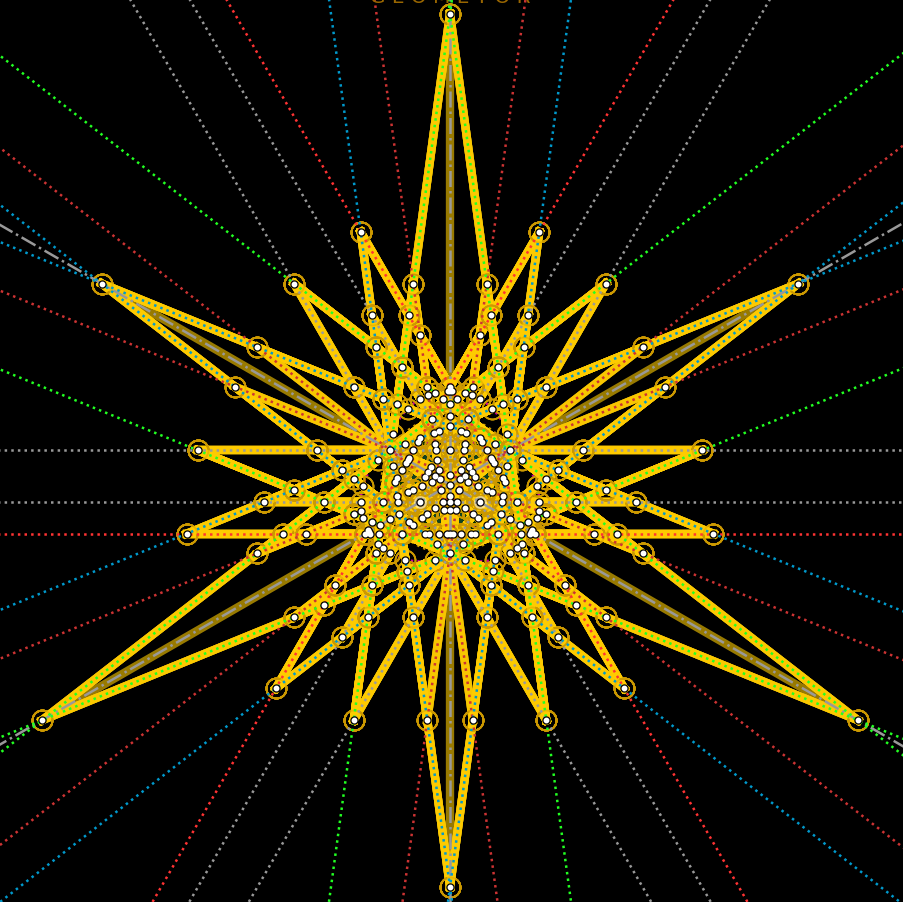
The Truncated Icosahedron (Icosahedron Abscisum, the canonical Archimedean fullerene / Buckminsterfullerene \(C_{60}\)) is formed by truncating the twelve vertices of a regular icosahedron at one-third edge depth (\(t = 1/3\)). Bounded by 12 regular pentagons and 20 regular hexagons with 60 vertices and 90 edges, every vertex is surrounded identically by one pentagon and two hexagons (\(5 \cdot 6^2\)).
P-02.08 · Truncated Dodecahedron
The Truncated Dodecahedron (Dodecahedron Abscisum Decagonale) is an Archimedean semi-regular solid formed by truncating the twenty vertices of a regular dodecahedron at the exact golden edge depth \(t = \frac{3 - \phi}{5} = \frac{5 - \sqrt{5}}{10} \in \mathbb{Q}(\phi)\). Bounded by 20 equilateral triangles and 12 regular decagons with 60 vertices and 90 edges, every vertex is surrounded identically by one triangle and two decagons (\(3 \cdot 10^2\)).