Posts tagged 'vigintisex-basium'
P-02.05 · Rhombicuboctahedron
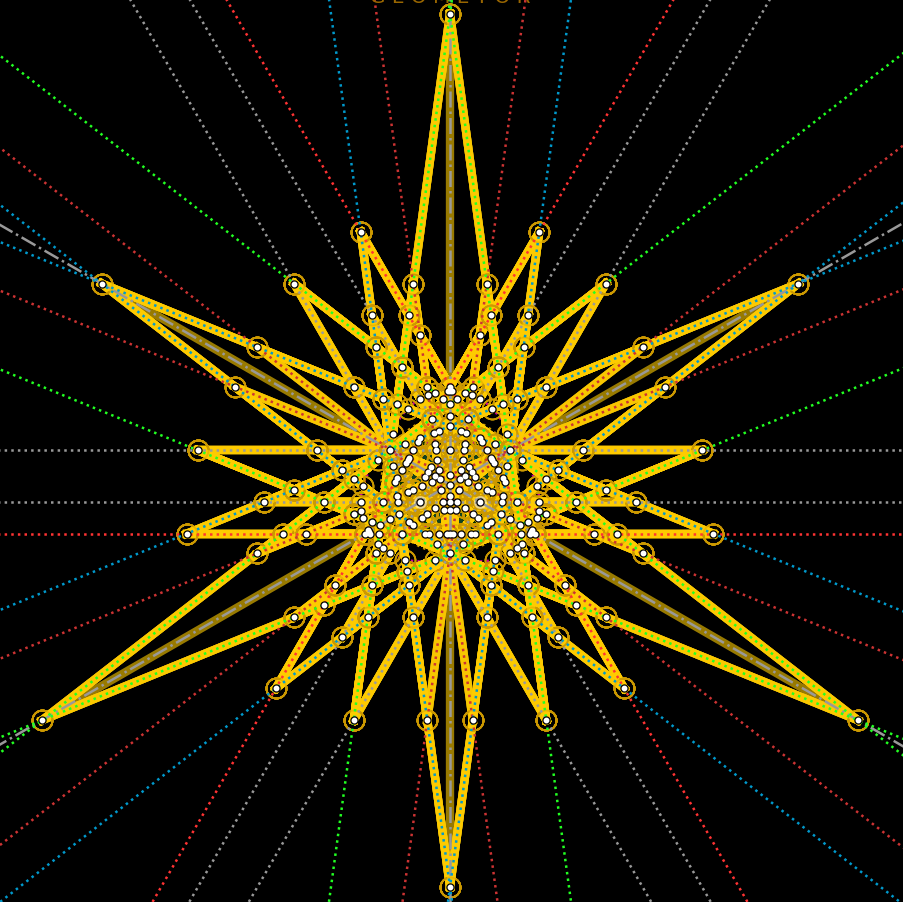
The Rhombicuboctahedron (Vigintisex Basium, the 26-Base Body) is the celebrated centerpiece of Renaissance stereometry depicted by Leonardo da Vinci. Bounded by 18 squares (6 axial and 12 chamfer facets) and 8 equilateral octant triangles with 24 vertices and 48 edges, every vertex is surrounded by three squares and one triangle (\(3 \cdot 4^3\)).
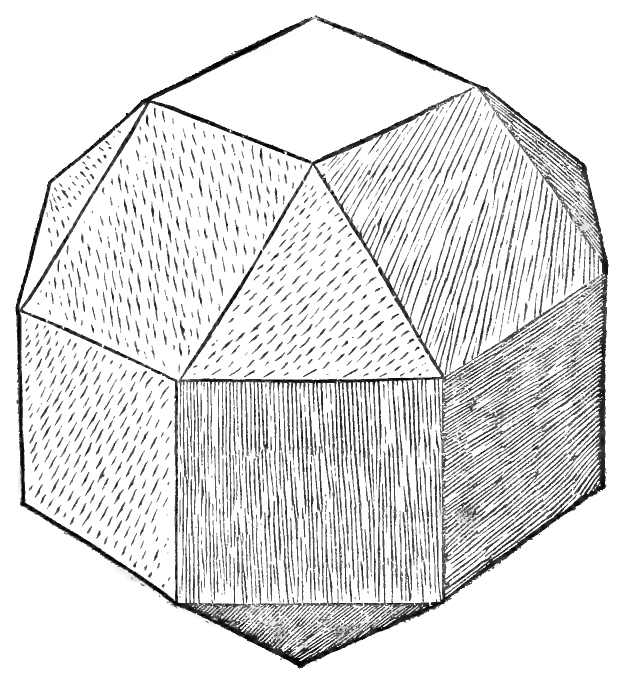
Tabulae XXXV–XXXVI: Vigintisex Basium Planum Solidum et Vacuum (1509)
The 26-Base Body (Vigintisex Basium), known in modern geometry as the Archimedean Rhombicuboctahedron, consists of 26 faces (8 equilateral triangles and 18 squares: 6 axial squares aligned with the cube and 12 belt squares aligned with the cuboctahedron), 48 edges, and 24 vertices over \(\mathbb{Q}(\sqrt{2})\). In Luca Pacioli’s De Divina Proportione (1509), this architectural climax of the treatise is illustrated by Leonardo da Vinci in Tabula XXXV (Folio 0259) as Vigintisex Basium Planum Solidum and in Tabula XXXVI (Folio 0261) as Vigintisex Basium Planum Vacuum (genus \(g = 25\)).