Content of type 'family'
P-01 · The Five Platonic Solids
Euclidean Book XIII Constructions · Golden Ratio Coordinates · 3D Rational Trigonometry
P-02 · Archimedean & Abscisa Solids
Uniform Corner Truncations, Edge-Midpoint Rectifications, and Leonardo’s Vigintisex Basium
P-03 · Catalan Duals & Rhombic Zonohedra
The Catalan solids are the convex, face-transitive (isohedral) polar duals of the semi-regular Archimedean solids. While their vertices are not all equivalent, their faces are congruent non-regular polygons whose dihedral angles are uniform throughout. Among the Catalan solids, the two quasi-regular duals discovered by Johannes Kepler—the Rhombic Dodecahedron (1611) and the Rhombic Triacontahedron (1619)—occupy a unique place: they are equilateral zonohedra bounded by congruent rhombi whose diagonal quadrance ratios embody the fundamental square roots \(\sqrt{2}\) and the Divine Proportion \(\phi\).
P-04 · Elevated Solids (Corpora Elevata)
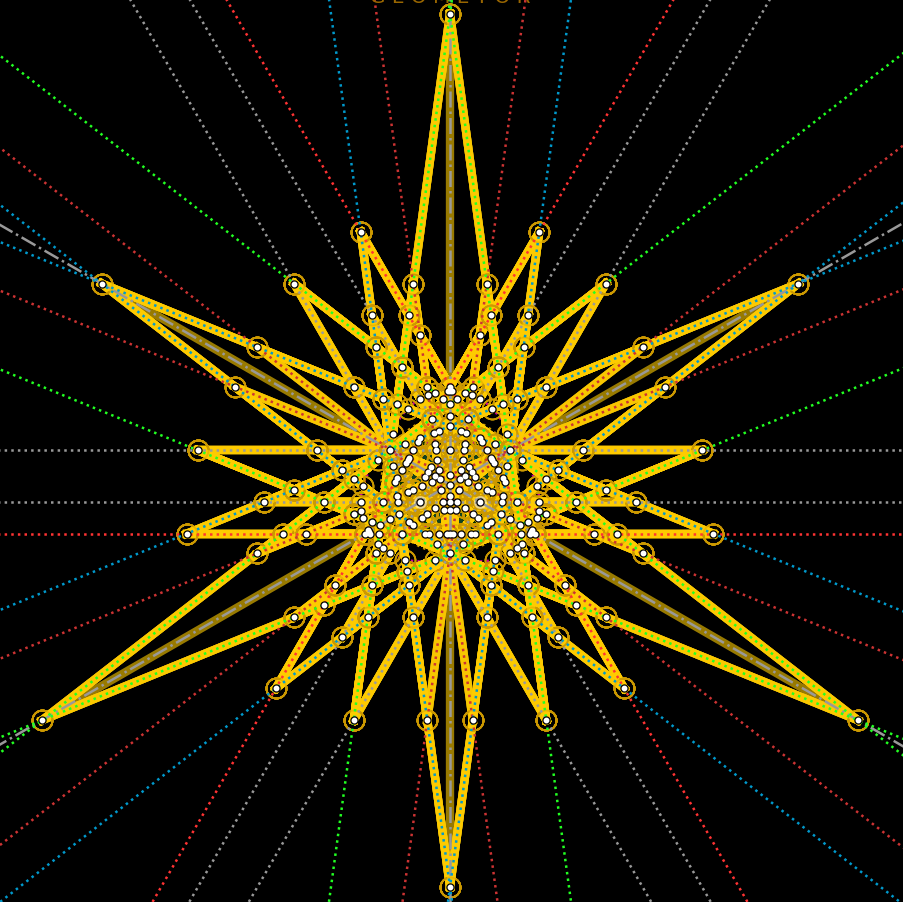
The Elevated Solids (Corpora Elevata) are non-convex stellated polyhedra created by erecting equilateral-triangle pyramids upon every planar facet of a convex Platonic or Archimedean solid. Systematically cataloged by Fra Luca Pacioli and illustrated with perspective mastery by Leonardo da Vinci in De Divina Proportione (1509), these seven canonical stellations bridge classical Euclidean polyhedra with early modern projective and star geometry.
P-05 · Canonical Pyramids & Bipyramids
The Pyramids and Bipyramids comprise four foundational polyhedral manifolds bridging monumental architecture, circle quadrature, extreme and mean ratio, and equilateral Johnson caps. Anchored by the Kepler Golden Pyramid (1597), the Old Kingdom Egyptian Seked 14:11 Pyramid (c. 2560 BCE), the Golden Square Bipyramid, and the regular Pentagonal Pyramid (Johnson J2) of Euclid XIII.16, these solids demonstrate how exact Rational Trigonometry invariants govern pyramidal space.