Posts tagged 'phi'
Golden Rectangles of the Icosahedron
The twelve vertices of the regular icosahedron \(\{3, 5\}\) partition into three congruent, mutually orthogonal golden rectangles centered at the origin, each having aspect ratio \(1 : \phi\). The six short edges form six edges of the icosahedron, while the long edges cross the solid’s interior. Every circumradius satisfies \(Q_{\text{out}} = \phi + 2\), and the vertical side of each rectangle divides the equatorial radius in extreme and mean ratio.
P-05.01 · Kepler Golden Pyramid
The Great Pyramid profile based on the Kepler right triangle 1 : sqrt(phi) : phi satisfying Herodotus’s area law.
Golden Division of the Octahedron
If each of the twelve edges of a regular octahedron of scale \(\phi^2\) is directed cyclically and divided in extreme and mean ratio (\(1 : \phi\)), the twelve division points constitute the exact twelve vertices of the regular icosahedron \(\{3, 5\}\). As the division parameter varies from \(\tau = 1/2\) to \(\tau = \phi^{-1}\), the solid smoothly morphs from the Archimedean cuboctahedron into the regular icosahedron.
P-03.02 · Rhombic Triacontahedron
A Catalan zonohedron bounded by 30 congruent golden rhombi, polar dual to the icosidodecahedron.
Five Inscribed Cubes in the Dodecahedron
In Elements Book XIII, Proposition 17, Euclid demonstrates that the twenty vertices of the regular dodecahedron \(\{5, 3\}\) can be constructed by erecting hipped roof wedges upon the six faces of a central inscribed cube. The sixty diagonals of the twelve pentagonal faces partition into five mutually disjoint sets of twelve edges, defining five inscribed regular cubes whose edge quadrance ratio to the dodecahedron edge is identically \(Q_{\text{cube}} / Q_{\text{dod}} = \phi^2\), permuted by the alternating group \(A_5\).
P-05.03 · Golden Square Bipyramid
An octahedral bipyramid formed by reflecting the Kepler Golden Pyramid across its square base.
Kepler’s Rhombic Triacontahedron (1611)
In Strena Seu de Nive Sexangula (1611), Johannes Kepler united the 20 vertices of the regular dodecahedron with the 12 vertices of its dual regular icosahedron to form the 32 vertices of the Rhombic Triacontahedron. Its 30 faces are congruent golden rhombi whose long-to-short diagonal quadrance ratio is identically \(Q_{\text{long}} / Q_{\text{short}} = \phi^2\), establishing the divine proportion \(\phi = \frac{1 + \sqrt{5}}{2}\) as the diagonal aspect ratio of every face.
P-01.04 · Icosahedron
The Regular Icosahedron is the highest-order deltahedral Platonic solid, possessing 20 congruent equilateral triangular faces, 12 vertices, and 30 edges (\(\{3, 5\}\)). In Plato’s Timaeus (56a–56b), the icosahedron is assigned to the element Water: with the greatest number of faces, the most obtuse dihedral angles, and the closest approximation to a rolling sphere, it is the most mobile, fluid, and least sharp of all triangular polyhedra.
P-04.04 · Icosahedron Elevatum
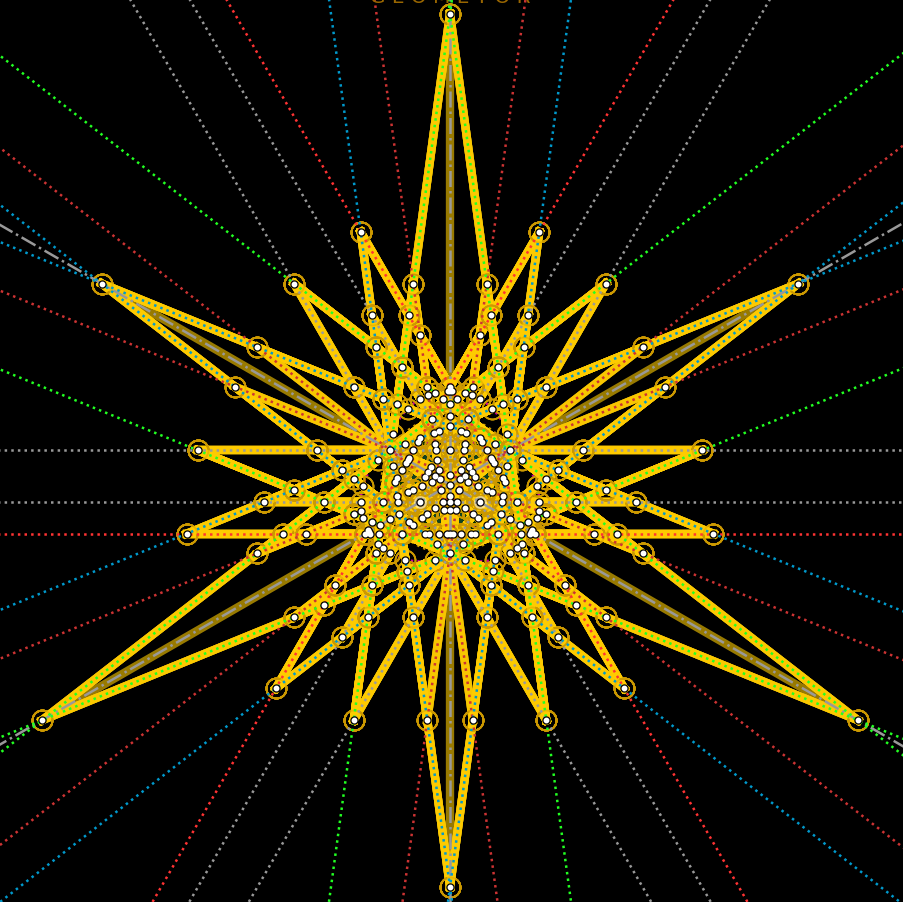
A stellated polyhedron formed by erecting equilateral triangular pyramids on the twenty faces of an icosahedron.
P-05.04 · Regular Pentagonal Pyramid (Johnson J2)
The regular equilateral pentagonal pyramid (Johnson Solid J2), forming the 6-vertex cap of the regular icosahedron.
George Odom’s Golden Construction in the Tetrahedron (1983)
In 1983, the American artist and geometer George Odom discovered that connecting the midpoints \(M_1\) and \(M_2\) of two sides of an equilateral triangular face of a regular tetrahedron and extending the segment to intersect the face’s circumcircle at \(G_2\) divides the chord in the divine proportion: \(Q(M_1, M_2) / Q(M_2, G_2) = \phi^2\), proving that \(\phi\) is an organic invariant of tetrahedral geometry.
P-01.05 · Dodecahedron
The Regular Dodecahedron is the crowning masterpiece of classical stereometry and the principal subject of Luca Pacioli’s De Divina Proportione (1509). Bounded by 12 regular pentagonal faces with 20 vertices and 30 edges (\(\{5, 3\}\)), in Platonic and Pythagorean cosmology it represents the Quintessence (Aether / Cosmos), embodying celestial harmony and the divine proportion \(\phi\).
P-04.05 · Dodecahedron Elevatum
A stellated polyhedron formed by erecting equilateral pentagonal pyramids on the twelve faces of a dodecahedron.
P-02.06 · Icosidodecahedron
The Icosidodecahedron (Dodecahedron Abscisum) is the canonical quasi-regular golden ratio solid formed by edge-midpoint rectification (
rectify) of either the regular dodecahedron or regular icosahedron. Bounded by 20 equilateral triangles and 12 regular pentagons with 30 vertices and 60 edges, every vertex is surrounded by alternating triangles and pentagons (\((3 \cdot 5)^2\)).P-02.07 · Truncated Icosahedron
The Truncated Icosahedron (Icosahedron Abscisum, the canonical Archimedean fullerene / Buckminsterfullerene \(C_{60}\)) is formed by truncating the twelve vertices of a regular icosahedron at one-third edge depth (\(t = 1/3\)). Bounded by 12 regular pentagons and 20 regular hexagons with 60 vertices and 90 edges, every vertex is surrounded identically by one pentagon and two hexagons (\(5 \cdot 6^2\)).
P-04.07 · Icosidodecahedron Elevatum
Pacioli’s Dodecahedron Abscisum Elevatum, formed by erecting equilateral pyramids on the 32 faces of an icosidodecahedron.
P-02.08 · Truncated Dodecahedron
The Truncated Dodecahedron (Dodecahedron Abscisum Decagonale) is an Archimedean semi-regular solid formed by truncating the twenty vertices of a regular dodecahedron at the exact golden edge depth \(t = \frac{3 - \phi}{5} = \frac{5 - \sqrt{5}}{10} \in \mathbb{Q}(\phi)\). Bounded by 20 equilateral triangles and 12 regular decagons with 60 vertices and 90 edges, every vertex is surrounded identically by one triangle and two decagons (\(3 \cdot 10^2\)).