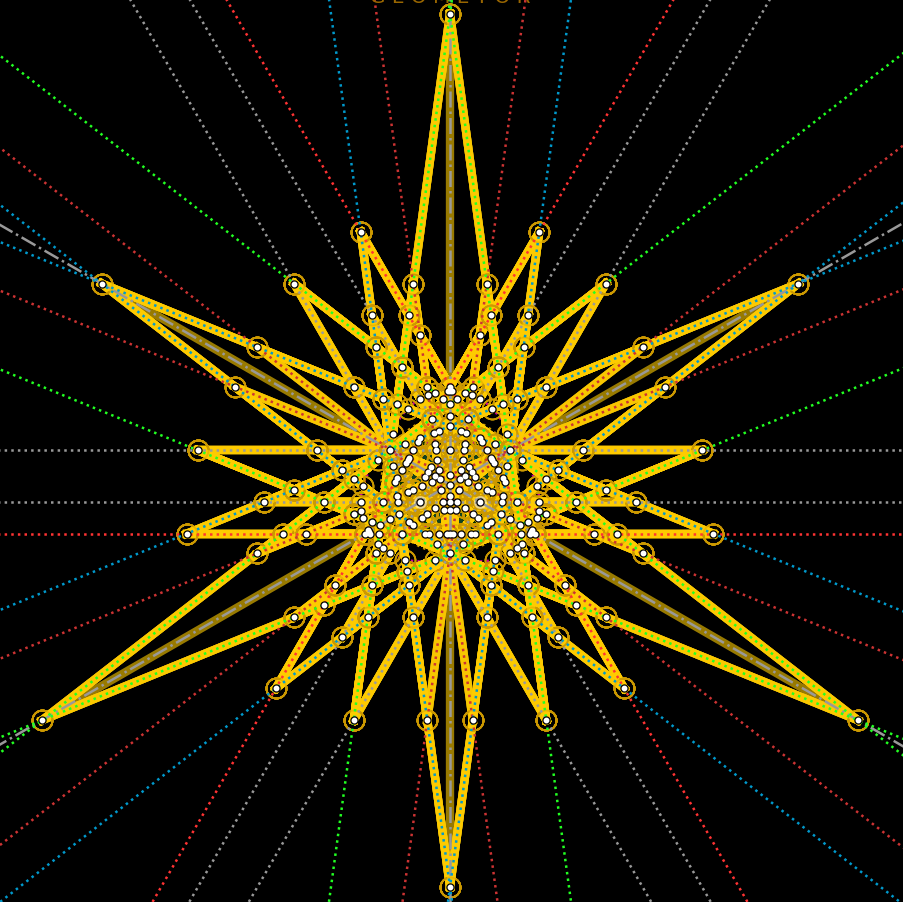
Tabulae XXI–XXII: Icosahedron Planum Solidum et Vacuum (1509)
The Regular Icosahedron in Solid and Hollow Perspective by Leonardo da Vinci
Icosahedron planum solidum est corpus viginti basibus triangularibus aequilateris contentum…
The solid plane icosahedron is a body contained by twenty equilateral triangular bases…
—Luca Pacioli, De Divina Proportione, Cap. XXXVI (Venice, 1509)
The Paired Folios: Solidum and Vacuum
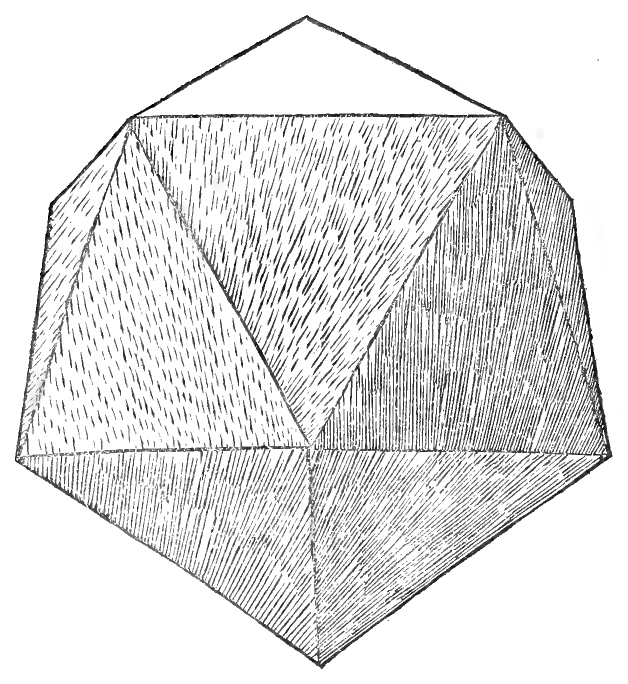
Tabula XXI (Folio 0231): Icosahedron Planum Solidum.¶ |
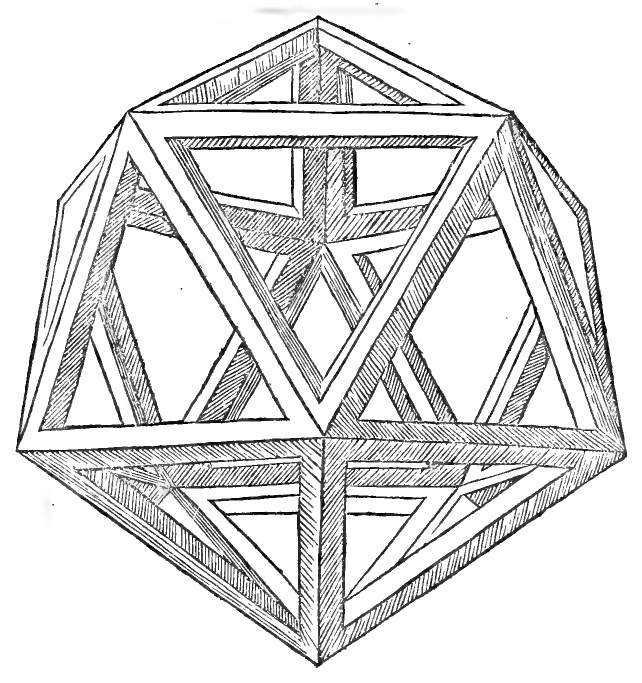
Tabula XXII (Folio 0233): Icosahedron Planum Vacuum (\(g = 19\)).¶ |
Water Cosmology & The Three Golden Rectangles
In Plato’s Timaeus (55b), the icosahedron represents Water (Aqua), possessing the greatest number of faces and the smoothest rolling mobility among the four terrestrial elements.
Algebraically, the icosahedron cannot be embedded over the rational field \(\mathbb{Q}\): its 12 vertices are defined by three mutually perpendicular golden rectangles having aspect ratio \(1 : \phi\):
In Tabula XXI, Leonardo showcases the sphere-like curvature of the 20 triangular facets with subtle parallel hatching.
In Tabula XXII, Leonardo hollows out each facet into mitered wooden frames. The central cavity exposes the complex web of converging beams, where every window reveals the antipodal faces with perfect perspective depth.
Topological Invariants of the Hollow Framework
By the Vacuate Manifold Theorem, the hollow icosahedron framework satisfies:
Base Solid Invariants: \(V = 12\), \(E = 30\), \(F = 20\) equilateral triangular faces
Hollow Frame Vertices: \(V_{\text{vac}} = 2V + 4E = 2(12) + 4(30) = 144\)
Hollow Frame Edges: \(E_{\text{vac}} = 12E = 12(30) = 360\)
Hollow Frame Faces: \(F_{\text{vac}} = 6E = 6(30) = 180\) planar trapezoids
Euler Characteristic: \(\chi_{\text{vac}} = 144 - 360 + 180 = -36\)
Topological Genus: \(g = F - 1 = 20 - 1 = 19\)
Coordinate Field: Quadratic extension field \(\mathbb{Q}(\phi)\)
Canonical Solid Codex
For the complete interactive 3D model, exact symbolic coordinates over \(\mathbb{Q}(\phi)\), face normals, and dihedral angles, consult the canonical solid codex: