Posts tagged 'octahedron'
Golden Division of the Octahedron
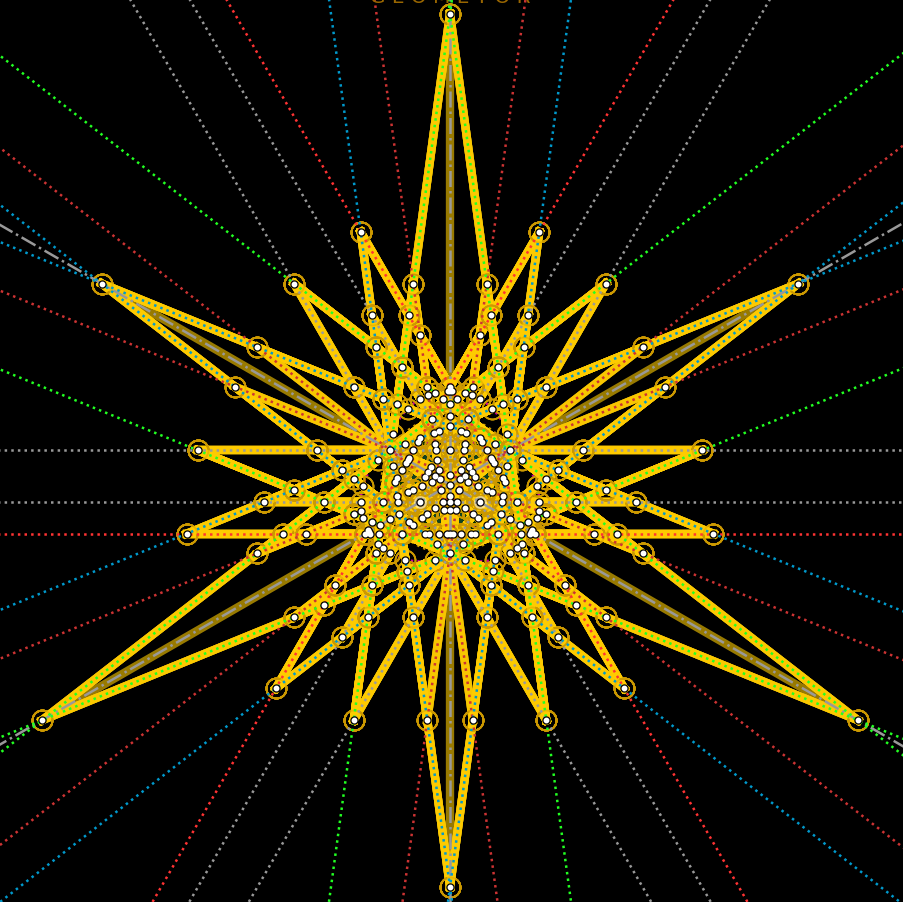
If each of the twelve edges of a regular octahedron of scale \(\phi^2\) is directed cyclically and divided in extreme and mean ratio (\(1 : \phi\)), the twelve division points constitute the exact twelve vertices of the regular icosahedron \(\{3, 5\}\). As the division parameter varies from \(\tau = 1/2\) to \(\tau = \phi^{-1}\), the solid smoothly morphs from the Archimedean cuboctahedron into the regular icosahedron.
P-02.02 · Cuboctahedron
The Cuboctahedron (Exahedron Abscisum) is the canonical quasi-regular Archimedean solid formed by edge-midpoint rectification (
rectify) of either the cube or the regular octahedron. Bounded by 8 equilateral triangles and 6 squares with 12 vertices and 24 edges, every vertex is surrounded by alternating triangles and squares (\((3 \cdot 4)^2\)).P-01.03 · Octahedron
The Regular Octahedron is the central dual bridge between the fire-tetrahedron and the water-icosahedron. Bounded by 8 congruent equilateral triangular faces with 6 vertices and 12 edges, each vertex is shared by 4 triangles (\(\{3, 4\}\)). In Plato’s Timaeus (56a–56b), the octahedron is assigned to the element Air: with intermediate mobility, intermediate sharpness of dihedral angles, and intermediate fineness of parts between the keen tetrahedron (fire) and the multi-faceted icosahedron (water).
P-04.03 · Stella Octangula (Octahedron Elevatum)
The Stella Octangula compound of two dual tetrahedra, formed by elevating the eight faces of an octahedron.
P-02.04 · Truncated Octahedron
The Truncated Octahedron (Octahedron Abscisum, Lord Kelvin’s ideal foam cell, and the order-4 permutohedron) is the unique space-filling Archimedean solid formed by truncating the six corners of a regular octahedron at one-third edge depth (\(t = 1/3\)). Bounded by 6 squares and 8 regular hexagons with 24 vertices and 36 edges, every vertex is surrounded by one square and two hexagons (\(4 \cdot 6^2\)).
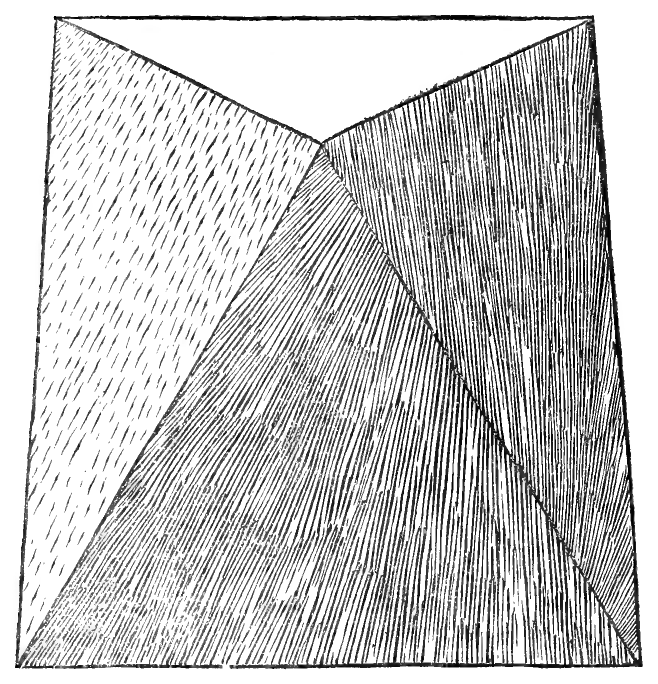
Tabulae XV–XVI: Octahedron Planum Solidum et Vacuum (1509)
The regular octahedron \(\{3, 4\}\) is the Platonic dual of the cube, possessing 6 vertices, 12 edges, and 8 equilateral triangular faces. Leonardo da Vinci illustrates this fundamental cosmic solid in Tabula XV (Folio 0219) as Octahedron Planum Solidum and in Tabula XVI (Folio 0221) as Octahedron Planum Vacuum. In hollow form, the eight open triangular apertures create a wooden framework of topological genus \(g = F - 1 = 7\).