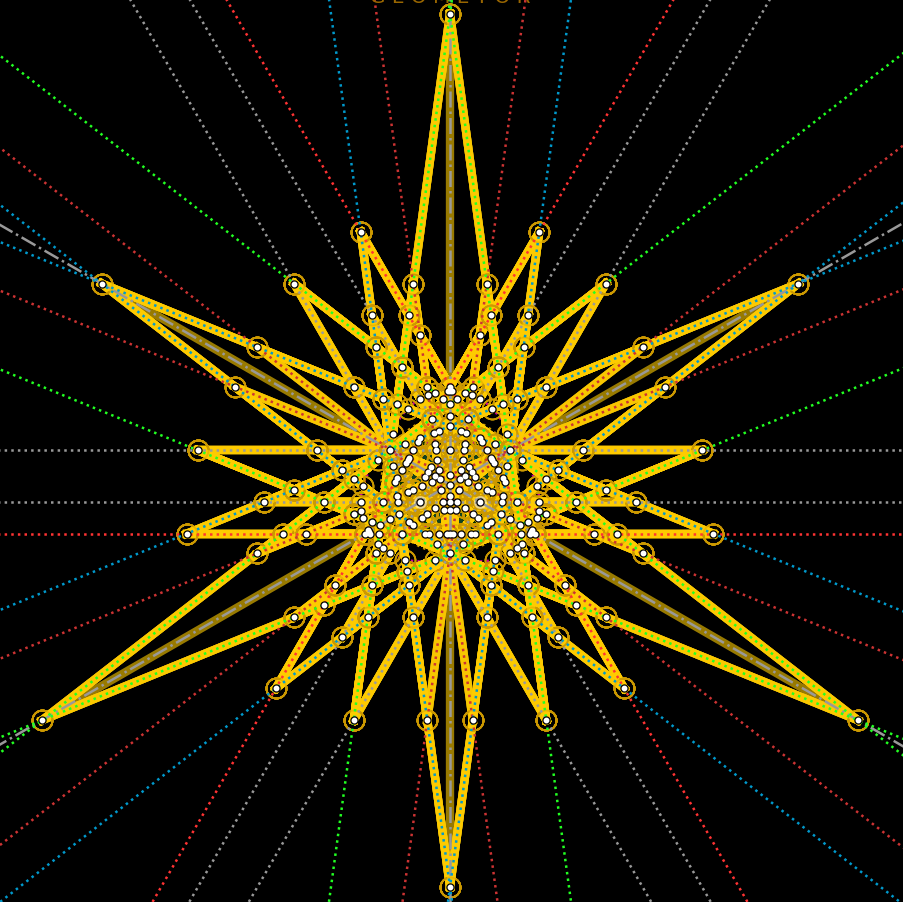
Tabulae XXVII–XXVIII: Dodecahedron Planum Solidum et Vacuum (1509)
The Regular Dodecahedron in Solid and Hollow Perspective by Leonardo da Vinci
Dodecahedron planum solidum est corpus duodecim basibus pentagonalibus aequilateris et aequiangulis contentum…
The solid plane dodecahedron is a body contained by twelve equilateral and equiangular pentagonal bases…
—Luca Pacioli, De Divina Proportione, Cap. XXXIX (Venice, 1509)
The Paired Folios: Solidum and Vacuum
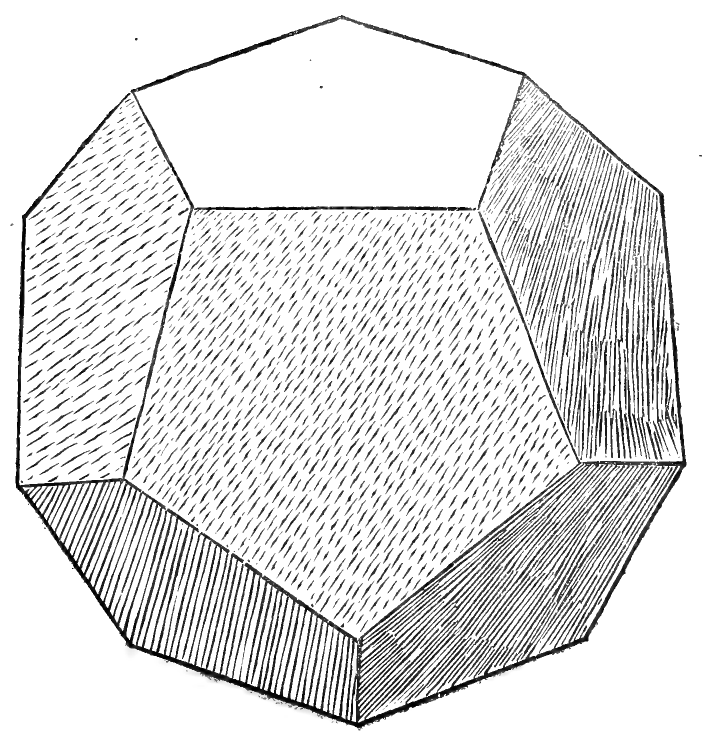
Tabula XXVII (Folio 0243): Dodecahedron Planum Solidum.¶ |
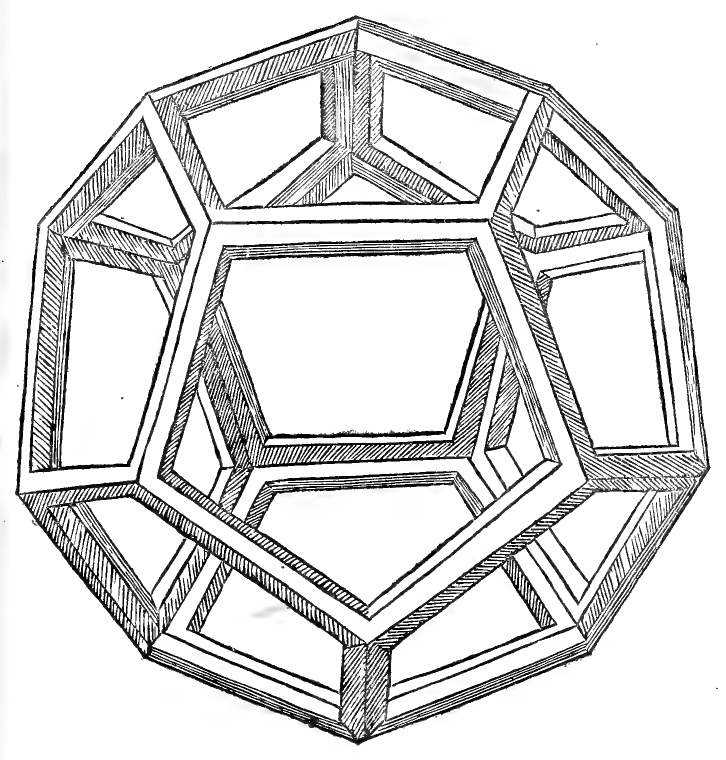
Tabula XXVIII (Folio 0245): Dodecahedron Planum Vacuum (\(g = 11\)).¶ |
Cosmology of the Quintessence & The Divine Proportion
In Plato’s Timaeus (55c), the dodecahedron is reserved for the entire cosmos: “There remained a fifth construction, which God used for embroidering the constellations on the whole heaven.”
Pacioli identifies the dodecahedron with the Aether or Quintessence (Quinta Essentia), because the golden ratio governs its pentagonal face diagonals in accordance with Euclid XIII.17. In exact coordinates over \(\mathbb{Q}(\phi)\), its 20 vertices comprise the 8 corners of the cube \((\pm 1, \pm 1, \pm 1)\) plus 12 golden roof vertices:
In Tabula XXVII, Leonardo depicts the solid dodecahedron tilted so that the pentagonal symmetry is immediately discernible.
In Tabula XXVIII, the hollow carpentry framework features 12 pentagonal window apertures framed by 30 mitered wooden beams. Looking through the top pentagon reveals the floor and rear walls of the inner chamber with breathtaking perspective accuracy.
Topological Invariants of the Hollow Framework
By the Vacuate Manifold Theorem, the hollow dodecahedron framework satisfies:
Base Solid Invariants: \(V = 20\), \(E = 30\), \(F = 12\) regular pentagonal faces
Hollow Frame Vertices: \(V_{\text{vac}} = 2V + 4E = 2(20) + 4(30) = 160\)
Hollow Frame Edges: \(E_{\text{vac}} = 12E = 12(30) = 360\)
Hollow Frame Faces: \(F_{\text{vac}} = 6E = 6(30) = 180\) planar trapezoids
Euler Characteristic: \(\chi_{\text{vac}} = 160 - 360 + 180 = -20\)
Topological Genus: \(g = F - 1 = 12 - 1 = 11\)
Coordinate Field: Quadratic extension field \(\mathbb{Q}(\phi)\)
Canonical Solid Codex
For the complete interactive 3D model, exact symbolic coordinates over \(\mathbb{Q}(\phi)\), face normals, and dihedral angles, consult the canonical solid codex: