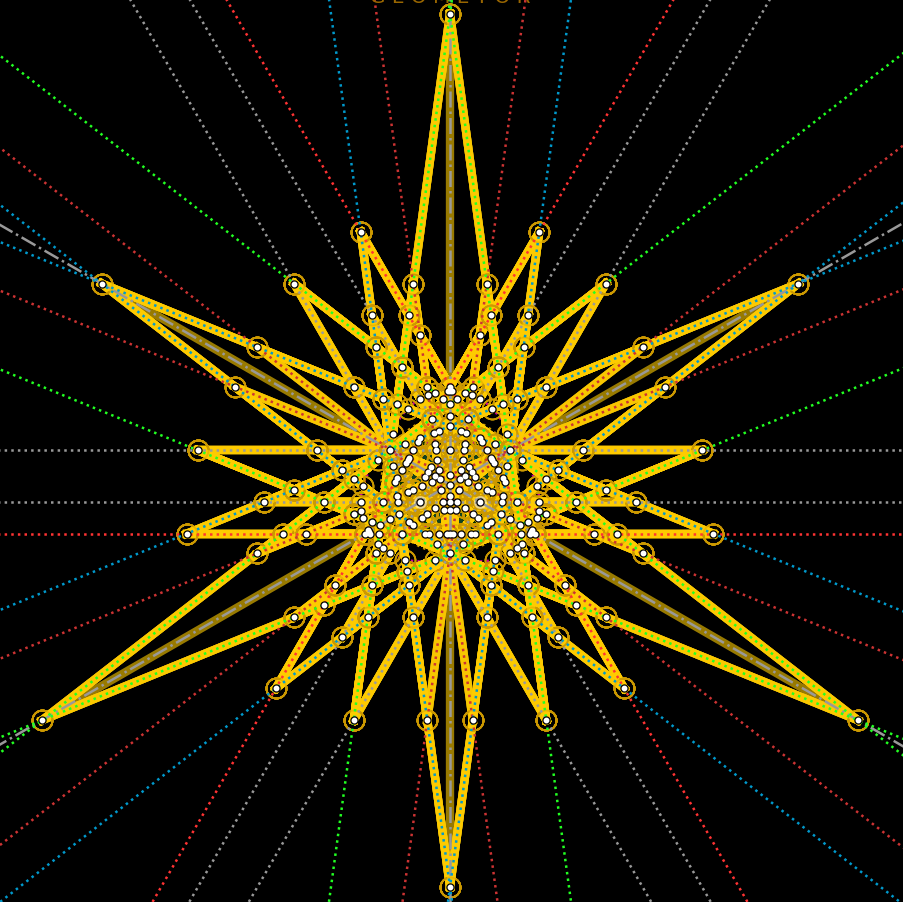
Kepler’s Rhombic Triacontahedron (1611)
The Thirty Golden Rhombi of the Rhombic Triacontahedron
Hic habes triacontaedron rhombicum, figura pulcherrima, cuius triginta bases sunt rhombi aequales, quorum anguli sunt conformes proportioni divinae…
Here you have the rhombic triacontahedron, a most beautiful figure whose thirty bases are equal rhombi, whose angles conform to the divine proportion…
—Johannes Kepler, Strena Seu de Nive Sexangula (Frankfurt, 1611)
Interactive 3D Codex
The interactive 3D model below displays Kepler’s Rhombic Triacontahedron, uniting the twenty vertices of the regular dodecahedron with the twelve vertices of its dual regular icosahedron into thirty golden rhombi:
Kepler’s Rhombic Triacontahedron (1611)
In his 1611 treatise Strena Seu de Nive Sexangula (A New Year’s Gift of Hexagonal Snow), Johannes Kepler discovered two magnificent rhombic polyhedra: the rhombic dodecahedron (dual of the cuboctahedron) and the rhombic triacontahedron (dual of the icosidodecahedron).
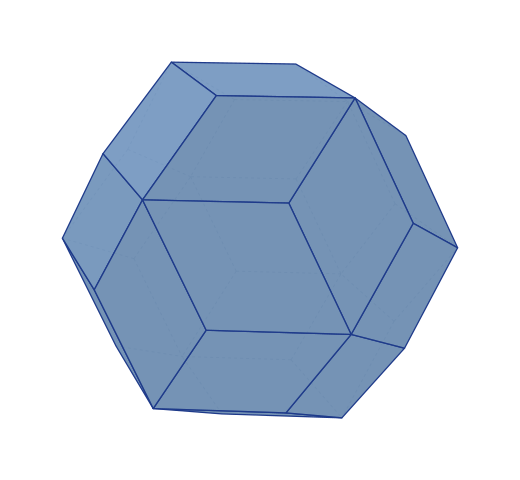
Kepler’s Rhombic Triacontahedron: 32 vertices and 30 congruent golden rhombic faces uniting the dodecahedral and icosahedral duals.
The rhombic triacontahedron is a Catalan zonohedron whose topology satisfies:
Vertices: \(V = 32\), consisting of: - \(20\) degree-3 obtuse vertices belonging to the regular dodecahedron; - \(12\) degree-5 acute vertices belonging to the dual-oriented regular icosahedron.
Faces: \(F = 30\) congruent golden rhombi.
Edges: \(E = 60\) congruent edges.
Euler Characteristic: \(V - E + F = 32 - 60 + 30 = 2\).
Exact Geometry of the Golden Rhombus
Each of the thirty faces is a planar golden rhombus whose vertices alternate between the degree-3 dodecahedral set and the degree-5 icosahedral set:
Long Diagonal: Joins two opposite degree-5 (icosahedral) vertices:
\[Q_{\text{long}} = 4 \implies \text{Length} = 2\]Short Diagonal: Joins two opposite degree-3 (dodecahedral) vertices:
\[Q_{\text{short}} = 4\phi^{-2} = 4(2 - \phi) = 8 - 4\phi \implies \text{Length} = 2\phi^{-1}\]Diagonal Quadrance Ratio:
\[\frac{Q_{\text{long}}}{Q_{\text{short}}} = \frac{4}{4\phi^{-2}} = \phi^2 = \phi + 1\]Taking square roots confirms that the ratio of the diagonals is the divine proportion:
\[\frac{\text{Length}_{\text{long}}}{\text{Length}_{\text{short}}} = \phi : 1\]Edge Quadrance: In any rhombus, the edge quadrance is one quarter the sum of the diagonal quadrances:
\[Q_{\text{edge}} = \frac{Q_{\text{long}} + Q_{\text{short}}}{4} = \frac{4 + 4(2 - \phi)}{4} = 1 + 2 - \phi = 3 - \phi\]Dihedral Spread: The angle between adjacent rhombic faces is an exact rational invariant in Norman Wildberger’s Rational Trigonometry:
\[s_{\text{dihedral}} = \sin^2(144^\circ) = \frac{5 - \sqrt{5}}{8}\]
Canonical Solid Codex
For the complete interactive 3D model, exact symbolic coordinates over \(\mathbb{Q}(\phi)\), face normals, and dihedral angles, consult the canonical solid codex: