Posts tagged 'icosahedron'
Golden Rectangles of the Icosahedron
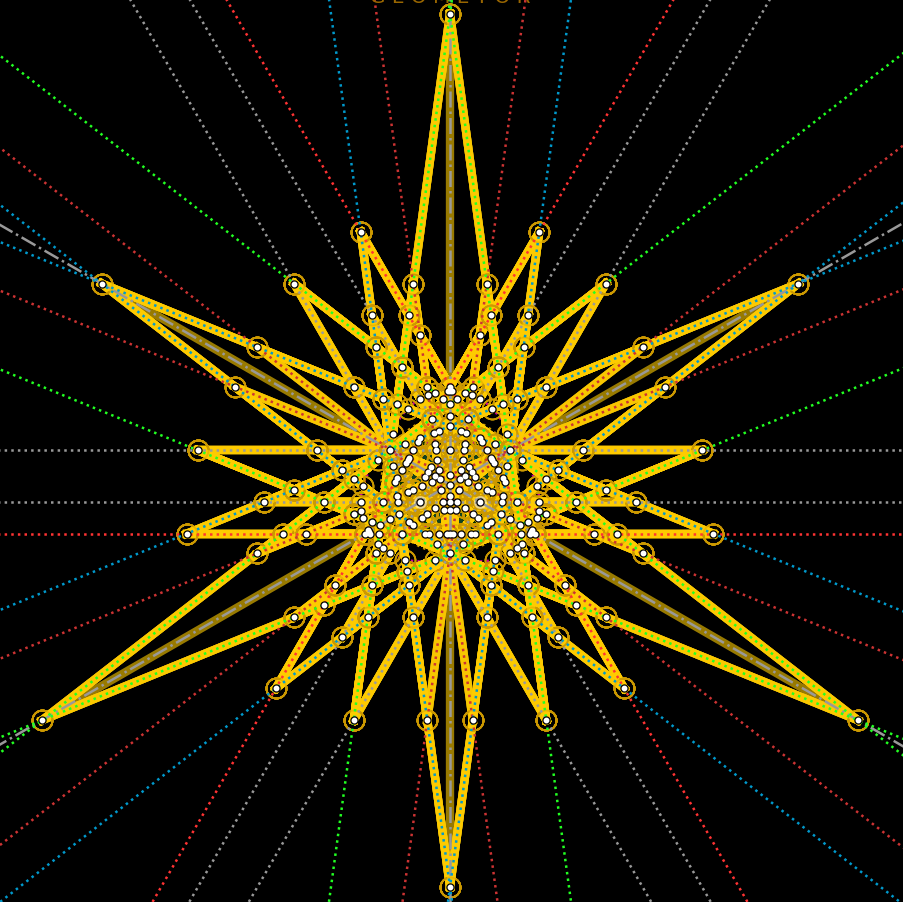
The twelve vertices of the regular icosahedron \(\{3, 5\}\) partition into three congruent, mutually orthogonal golden rectangles centered at the origin, each having aspect ratio \(1 : \phi\). The six short edges form six edges of the icosahedron, while the long edges cross the solid’s interior. Every circumradius satisfies \(Q_{\text{out}} = \phi + 2\), and the vertical side of each rectangle divides the equatorial radius in extreme and mean ratio.
Golden Division of the Octahedron
If each of the twelve edges of a regular octahedron of scale \(\phi^2\) is directed cyclically and divided in extreme and mean ratio (\(1 : \phi\)), the twelve division points constitute the exact twelve vertices of the regular icosahedron \(\{3, 5\}\). As the division parameter varies from \(\tau = 1/2\) to \(\tau = \phi^{-1}\), the solid smoothly morphs from the Archimedean cuboctahedron into the regular icosahedron.
P-01.04 · Icosahedron
The Regular Icosahedron is the highest-order deltahedral Platonic solid, possessing 20 congruent equilateral triangular faces, 12 vertices, and 30 edges (\(\{3, 5\}\)). In Plato’s Timaeus (56a–56b), the icosahedron is assigned to the element Water: with the greatest number of faces, the most obtuse dihedral angles, and the closest approximation to a rolling sphere, it is the most mobile, fluid, and least sharp of all triangular polyhedra.
P-04.04 · Icosahedron Elevatum
A stellated polyhedron formed by erecting equilateral triangular pyramids on the twenty faces of an icosahedron.
P-02.06 · Icosidodecahedron
The Icosidodecahedron (Dodecahedron Abscisum) is the canonical quasi-regular golden ratio solid formed by edge-midpoint rectification (
rectify) of either the regular dodecahedron or regular icosahedron. Bounded by 20 equilateral triangles and 12 regular pentagons with 30 vertices and 60 edges, every vertex is surrounded by alternating triangles and pentagons (\((3 \cdot 5)^2\)).P-02.07 · Truncated Icosahedron
The Truncated Icosahedron (Icosahedron Abscisum, the canonical Archimedean fullerene / Buckminsterfullerene \(C_{60}\)) is formed by truncating the twelve vertices of a regular icosahedron at one-third edge depth (\(t = 1/3\)). Bounded by 12 regular pentagons and 20 regular hexagons with 60 vertices and 90 edges, every vertex is surrounded identically by one pentagon and two hexagons (\(5 \cdot 6^2\)).
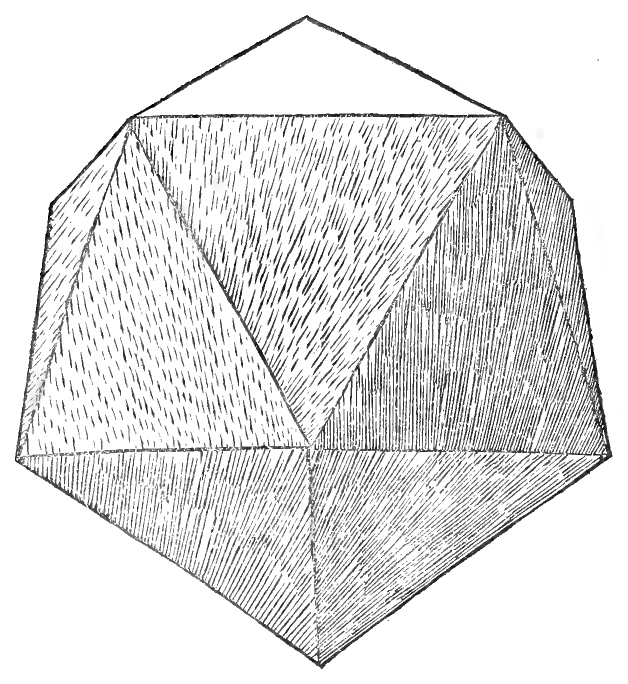
Tabulae XXI–XXII: Icosahedron Planum Solidum et Vacuum (1509)
The regular icosahedron \(\{3, 5\}\) is composed of 20 equilateral triangular faces, 30 edges, and 12 vertices defined by three mutually perpendicular golden rectangles over \(\mathbb{Q}(\phi)\). Leonardo da Vinci illustrates this Platonic solid in Tabula XXI (Folio 0231) as Icosahedron Planum Solidum and in Tabula XXII (Folio 0233) as Icosahedron Planum Vacuum. In vacuate form, the 20 triangular window apertures form a wooden framework of topological genus \(g = F - 1 = 19\), the highest among the five Platonic solids.