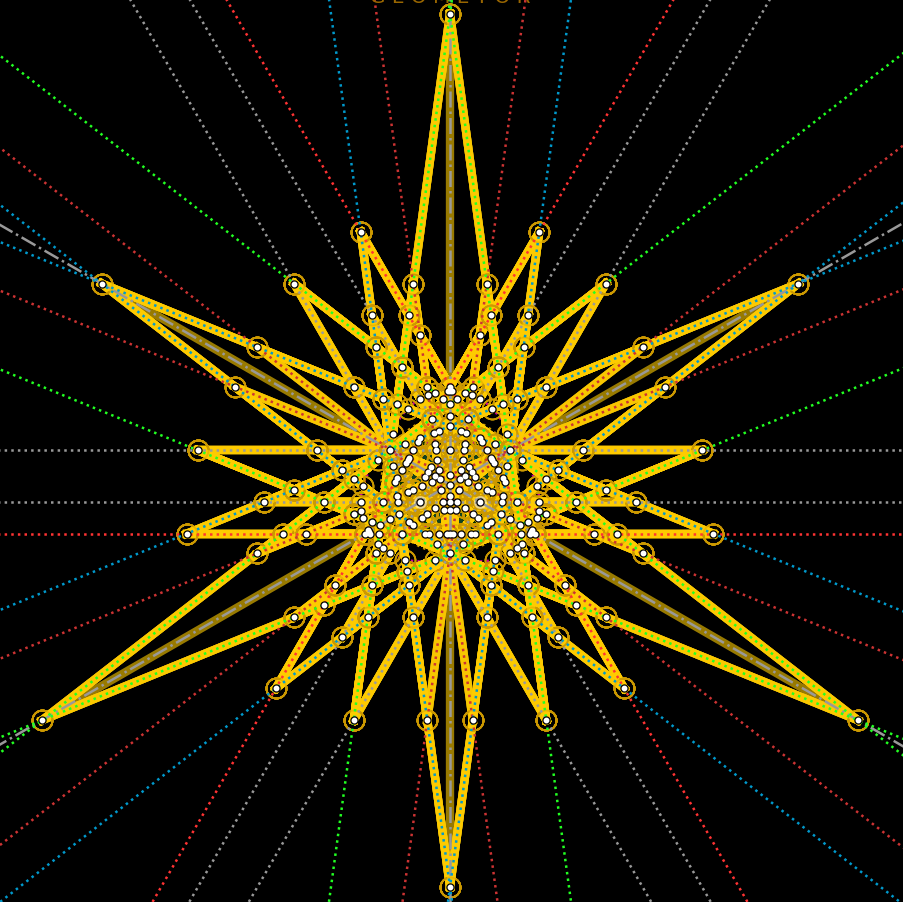
Content of type 'solid'
P-01.01 · Tetrahedron
The Regular Tetrahedron is the primary regular convex polyhedron in three-dimensional Euclidean space. Bounded by 4 equilateral triangular faces with 4 vertices and 6 edges, each vertex is shared by 3 triangles (\(\{3, 3\}\)). In Plato’s Timaeus (56b), the tetrahedron is assigned to the element Fire: having the fewest faces, the sharpest solid angles, and the greatest piercing power, it is the lightest, keenest, and most mobile of all elementary bodies.
P-02.01 · Truncated Tetrahedron
The Truncated Tetrahedron (Tetrahedron Abscisum) is the simplest Archimedean semi-regular polyhedron, formed by cutting off the four corners of a regular tetrahedron at one-third of its edge length (\(t = 1/3\)). Bounded by 4 equilateral triangles and 4 regular hexagons with 12 vertices and 18 edges, every vertex is surrounded identically by one triangle and two hexagons (\(3 \cdot 6^2\)).
P-03.01 · Rhombic Dodecahedron
A Catalan solid and space-filling polyhedron bounded by 12 congruent rhombi, polar dual to the cuboctahedron.
P-04.01 · Tetrahedron Elevatum
A stellated polyhedron formed by erecting equilateral triangular pyramids on the four faces of a tetrahedron.
P-05.01 · Kepler Golden Pyramid
The Great Pyramid profile based on the Kepler right triangle 1 : sqrt(phi) : phi satisfying Herodotus’s area law.
P-01.02 · Hexahedron (Cube)
The Regular Hexahedron (commonly called the Cube) is the canonical orthogonal solid of Euclidean three-space. Bounded by 6 congruent square faces with 8 vertices and 12 edges, each vertex is shared by 3 squares (\(\{4, 3\}\)). In Plato’s Timaeus (55d–56a), the cube is assigned to the element Earth: possessing square faces that sit firmly upon any plane, it is the most stable, immovable, and solid of the five Platonic bodies.
P-02.02 · Cuboctahedron
The Cuboctahedron (Exahedron Abscisum) is the canonical quasi-regular Archimedean solid formed by edge-midpoint rectification (
rectify) of either the cube or the regular octahedron. Bounded by 8 equilateral triangles and 6 squares with 12 vertices and 24 edges, every vertex is surrounded by alternating triangles and squares (\((3 \cdot 4)^2\)).P-03.02 · Rhombic Triacontahedron
A Catalan zonohedron bounded by 30 congruent golden rhombi, polar dual to the icosidodecahedron.
P-04.02 · Hexahedron Elevatum
A stellated polyhedron formed by erecting equilateral pyramids on the six faces of a cube.
P-05.02 · Seked 14:11 Pyramid
The canonical Egyptian architectural pyramid with Seked slope 14:11 (rise 14 to run 11 palms).
P-01.03 · Octahedron
The Regular Octahedron is the central dual bridge between the fire-tetrahedron and the water-icosahedron. Bounded by 8 congruent equilateral triangular faces with 6 vertices and 12 edges, each vertex is shared by 4 triangles (\(\{3, 4\}\)). In Plato’s Timaeus (56a–56b), the octahedron is assigned to the element Air: with intermediate mobility, intermediate sharpness of dihedral angles, and intermediate fineness of parts between the keen tetrahedron (fire) and the multi-faceted icosahedron (water).
P-02.03 · Truncated Hexahedron
The Truncated Hexahedron (Truncated Cube) is an Archimedean semi-regular solid formed by truncating the eight corners of a cube at edge depth \(t = 1 - \frac{\sqrt{2}}{2} \in \mathbb{Q}(\sqrt{2})\). Bounded by 8 equilateral triangles and 6 regular octagons with 24 vertices and 36 edges, every vertex is surrounded identically by one triangle and two octagons (\(3 \cdot 8^2\)).
P-04.03 · Stella Octangula (Octahedron Elevatum)
The Stella Octangula compound of two dual tetrahedra, formed by elevating the eight faces of an octahedron.
P-05.03 · Golden Square Bipyramid
An octahedral bipyramid formed by reflecting the Kepler Golden Pyramid across its square base.
P-01.04 · Icosahedron
The Regular Icosahedron is the highest-order deltahedral Platonic solid, possessing 20 congruent equilateral triangular faces, 12 vertices, and 30 edges (\(\{3, 5\}\)). In Plato’s Timaeus (56a–56b), the icosahedron is assigned to the element Water: with the greatest number of faces, the most obtuse dihedral angles, and the closest approximation to a rolling sphere, it is the most mobile, fluid, and least sharp of all triangular polyhedra.
P-02.04 · Truncated Octahedron
The Truncated Octahedron (Octahedron Abscisum, Lord Kelvin’s ideal foam cell, and the order-4 permutohedron) is the unique space-filling Archimedean solid formed by truncating the six corners of a regular octahedron at one-third edge depth (\(t = 1/3\)). Bounded by 6 squares and 8 regular hexagons with 24 vertices and 36 edges, every vertex is surrounded by one square and two hexagons (\(4 \cdot 6^2\)).
P-04.04 · Icosahedron Elevatum
A stellated polyhedron formed by erecting equilateral triangular pyramids on the twenty faces of an icosahedron.
P-05.04 · Regular Pentagonal Pyramid (Johnson J2)
The regular equilateral pentagonal pyramid (Johnson Solid J2), forming the 6-vertex cap of the regular icosahedron.
P-01.05 · Dodecahedron
The Regular Dodecahedron is the crowning masterpiece of classical stereometry and the principal subject of Luca Pacioli’s De Divina Proportione (1509). Bounded by 12 regular pentagonal faces with 20 vertices and 30 edges (\(\{5, 3\}\)), in Platonic and Pythagorean cosmology it represents the Quintessence (Aether / Cosmos), embodying celestial harmony and the divine proportion \(\phi\).
P-02.05 · Rhombicuboctahedron
The Rhombicuboctahedron (Vigintisex Basium, the 26-Base Body) is the celebrated centerpiece of Renaissance stereometry depicted by Leonardo da Vinci. Bounded by 18 squares (6 axial and 12 chamfer facets) and 8 equilateral octant triangles with 24 vertices and 48 edges, every vertex is surrounded by three squares and one triangle (\(3 \cdot 4^3\)).
P-04.05 · Dodecahedron Elevatum
A stellated polyhedron formed by erecting equilateral pentagonal pyramids on the twelve faces of a dodecahedron.
P-02.06 · Icosidodecahedron
The Icosidodecahedron (Dodecahedron Abscisum) is the canonical quasi-regular golden ratio solid formed by edge-midpoint rectification (
rectify) of either the regular dodecahedron or regular icosahedron. Bounded by 20 equilateral triangles and 12 regular pentagons with 30 vertices and 60 edges, every vertex is surrounded by alternating triangles and pentagons (\((3 \cdot 5)^2\)).P-04.06 · Cuboctahedron Elevatum
Pacioli’s Exahedron Abscisum Elevatum, formed by erecting equilateral pyramids on the 14 faces of a cuboctahedron.
P-02.07 · Truncated Icosahedron
The Truncated Icosahedron (Icosahedron Abscisum, the canonical Archimedean fullerene / Buckminsterfullerene \(C_{60}\)) is formed by truncating the twelve vertices of a regular icosahedron at one-third edge depth (\(t = 1/3\)). Bounded by 12 regular pentagons and 20 regular hexagons with 60 vertices and 90 edges, every vertex is surrounded identically by one pentagon and two hexagons (\(5 \cdot 6^2\)).
P-04.07 · Icosidodecahedron Elevatum
Pacioli’s Dodecahedron Abscisum Elevatum, formed by erecting equilateral pyramids on the 32 faces of an icosidodecahedron.
P-02.08 · Truncated Dodecahedron
The Truncated Dodecahedron (Dodecahedron Abscisum Decagonale) is an Archimedean semi-regular solid formed by truncating the twenty vertices of a regular dodecahedron at the exact golden edge depth \(t = \frac{3 - \phi}{5} = \frac{5 - \sqrt{5}}{10} \in \mathbb{Q}(\phi)\). Bounded by 20 equilateral triangles and 12 regular decagons with 60 vertices and 90 edges, every vertex is surrounded identically by one triangle and two decagons (\(3 \cdot 10^2\)).