Posts tagged 'dodecahedron'
Five Inscribed Cubes in the Dodecahedron
In Elements Book XIII, Proposition 17, Euclid demonstrates that the twenty vertices of the regular dodecahedron \(\{5, 3\}\) can be constructed by erecting hipped roof wedges upon the six faces of a central inscribed cube. The sixty diagonals of the twelve pentagonal faces partition into five mutually disjoint sets of twelve edges, defining five inscribed regular cubes whose edge quadrance ratio to the dodecahedron edge is identically \(Q_{\text{cube}} / Q_{\text{dod}} = \phi^2\), permuted by the alternating group \(A_5\).
P-01.05 · Dodecahedron
The Regular Dodecahedron is the crowning masterpiece of classical stereometry and the principal subject of Luca Pacioli’s De Divina Proportione (1509). Bounded by 12 regular pentagonal faces with 20 vertices and 30 edges (\(\{5, 3\}\)), in Platonic and Pythagorean cosmology it represents the Quintessence (Aether / Cosmos), embodying celestial harmony and the divine proportion \(\phi\).
P-04.05 · Dodecahedron Elevatum
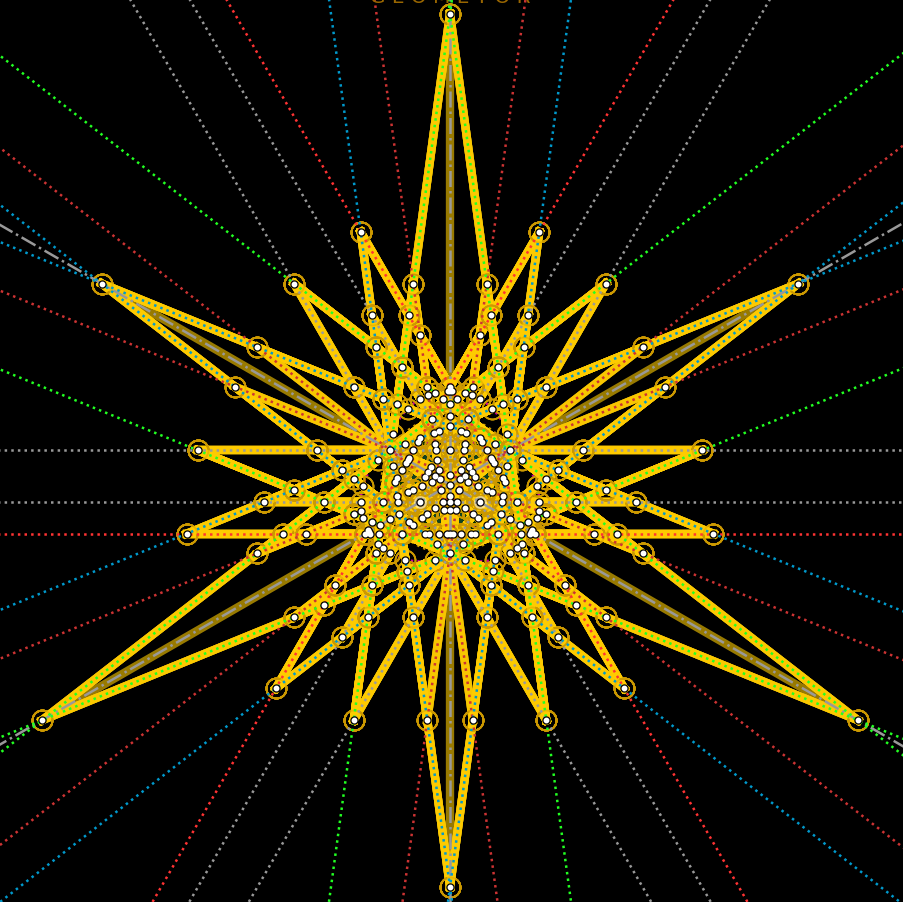
A stellated polyhedron formed by erecting equilateral pentagonal pyramids on the twelve faces of a dodecahedron.
P-02.06 · Icosidodecahedron
The Icosidodecahedron (Dodecahedron Abscisum) is the canonical quasi-regular golden ratio solid formed by edge-midpoint rectification (
rectify) of either the regular dodecahedron or regular icosahedron. Bounded by 20 equilateral triangles and 12 regular pentagons with 30 vertices and 60 edges, every vertex is surrounded by alternating triangles and pentagons (\((3 \cdot 5)^2\)).P-02.08 · Truncated Dodecahedron
The Truncated Dodecahedron (Dodecahedron Abscisum Decagonale) is an Archimedean semi-regular solid formed by truncating the twenty vertices of a regular dodecahedron at the exact golden edge depth \(t = \frac{3 - \phi}{5} = \frac{5 - \sqrt{5}}{10} \in \mathbb{Q}(\phi)\). Bounded by 20 equilateral triangles and 12 regular decagons with 60 vertices and 90 edges, every vertex is surrounded identically by one triangle and two decagons (\(3 \cdot 10^2\)).
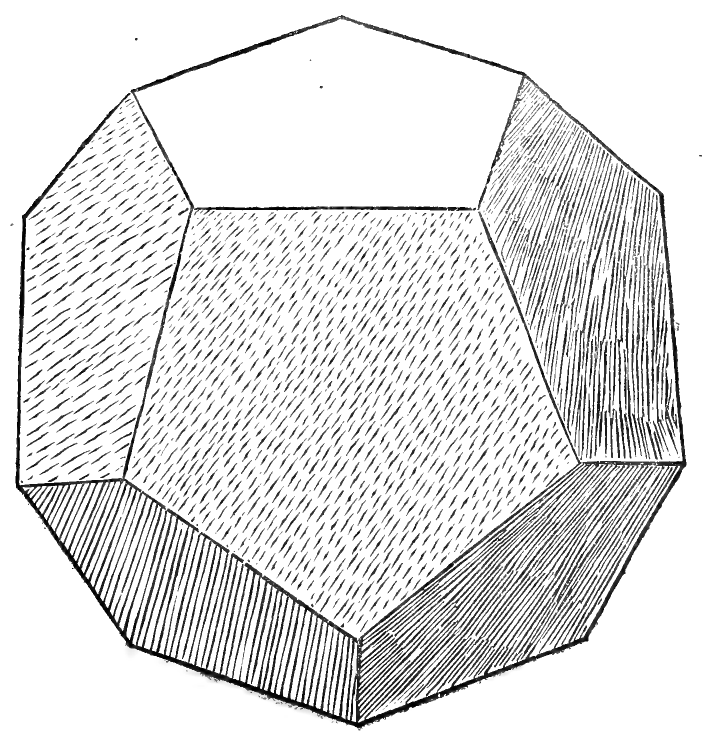
Tabulae XXVII–XXVIII: Dodecahedron Planum Solidum et Vacuum (1509)
The regular dodecahedron \(\{5, 3\}\) possesses 20 vertices, 30 edges, and 12 regular pentagonal faces governed by the divine proportion \(\phi\). Leonardo da Vinci illustrates this celestial solid in Tabula XXVII (Folio 0243) as Dodecahedron Planum Solidum and in Tabula XXVIII (Folio 0245) as Dodecahedron Planum Vacuum. In hollow form, the twelve open pentagonal windows form a wooden carpentry cage of topological genus \(g = F - 1 = 11\).