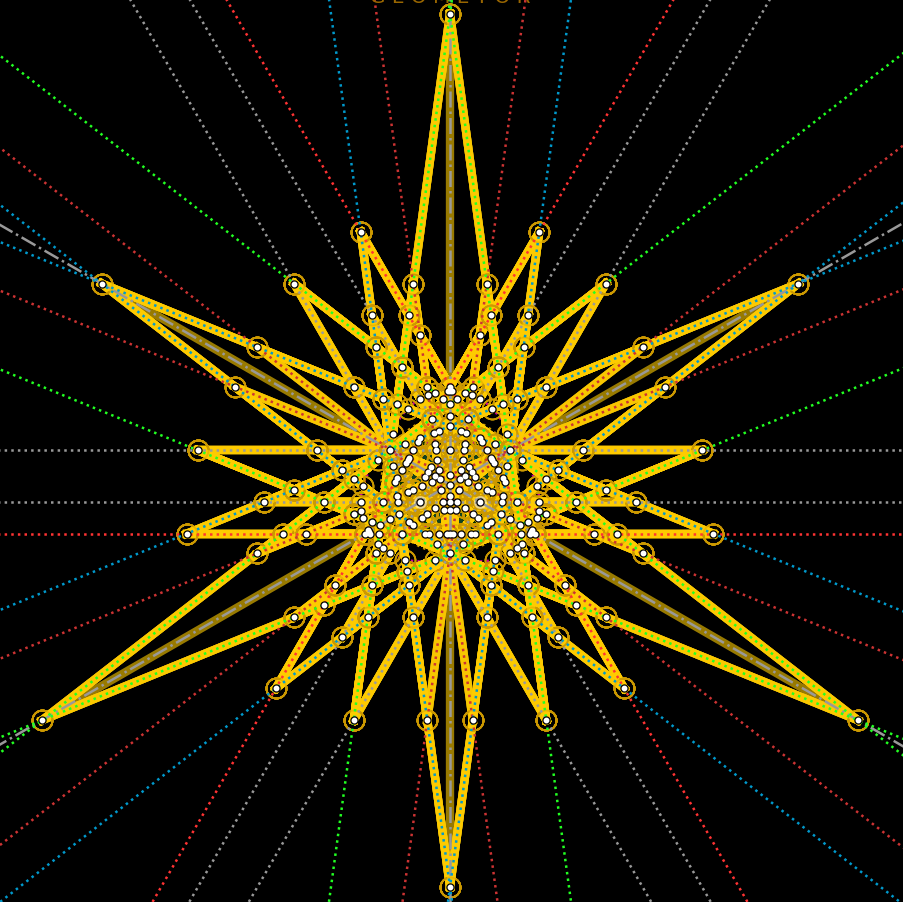
Content of type 'treatise'
The 1597 Kepler Right Triangle & Golden Surface Harmony
In October 1597, Johannes Kepler synthesized the Pythagorean Theorem (\(a^2 + b^2 = c^2\)) and the Divine Proportion (\(1 + \phi = \phi^2\)) into a singular right-angled triangle whose sides form a continuous geometric progression \((1, \sqrt{\phi}, \phi)\). When this triangle serves as the meridian cross-section of a square pyramid, the square on the vertical height equals the area of each triangular face (\(A_{\text{face}} = h^2\)), fulfilling Herodotus’s ancient architectural enunciation over the quartic number field \(\mathbb{Q}(\sqrt{\phi})\).
Squaring the Circle & the Earth–Moon Cosmogram
The Great Pyramid of Giza embodies the perimeter dual of squaring the circle: constructing a square pyramid whose square base perimeter equals the circumference of a circle whose radius is the pyramid’s vertical height (\(8a = 2\pi h \iff h/a = 4/\pi\)). Under the Kepler Golden Pyramid profile (\(h = \sqrt{\phi}\)), this relation yields the celebrated algebraic approximation \(\pi \approx 4/\sqrt{\phi} \approx 3.1446\) (\(< 0.1\%\) discrepancy), geometrically realizing the astronomical Earth–Moon tangent cosmogram.
Egyptian Seked Mensuration, 3D Spreads & Polyhedral Relatives
Old Kingdom Egyptian architecture formalized pyramid inclination not via degrees, but through the seked (\(\text{sqd}\)): the horizontal setback in palms per vertical rise of one Royal Cubit (7 palms). For the Great Pyramid of Khufu, the historical blueprint of 280 cubits height by 220 cubits half-base yields the exact rational seked \(5\frac{1}{2}\) palms (\(14 : 11\)), converging with Kepler’s Golden Pyramid within 0.05% and reflecting across the square base into the 8-faced Golden Square Bipyramid.