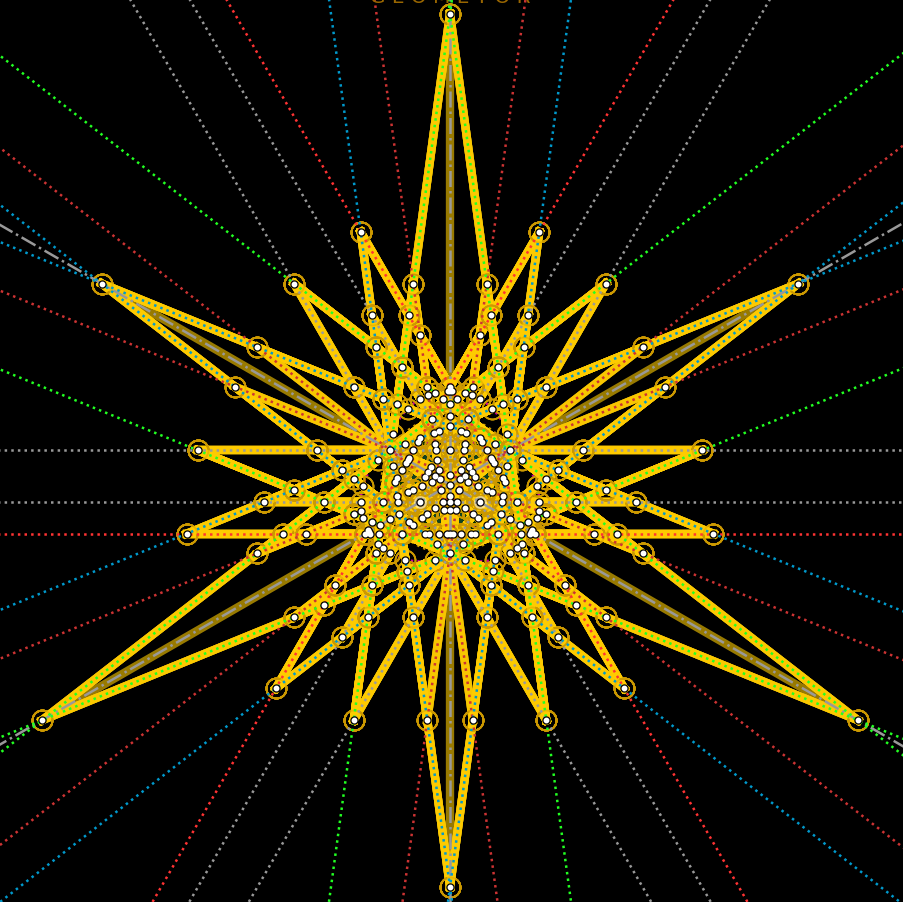
Content of type 'theorem'
Golden Rectangles of the Icosahedron
The twelve vertices of the regular icosahedron \(\{3, 5\}\) partition into three congruent, mutually orthogonal golden rectangles centered at the origin, each having aspect ratio \(1 : \phi\). The six short edges form six edges of the icosahedron, while the long edges cross the solid’s interior. Every circumradius satisfies \(Q_{\text{out}} = \phi + 2\), and the vertical side of each rectangle divides the equatorial radius in extreme and mean ratio.
Golden Division of the Octahedron
If each of the twelve edges of a regular octahedron of scale \(\phi^2\) is directed cyclically and divided in extreme and mean ratio (\(1 : \phi\)), the twelve division points constitute the exact twelve vertices of the regular icosahedron \(\{3, 5\}\). As the division parameter varies from \(\tau = 1/2\) to \(\tau = \phi^{-1}\), the solid smoothly morphs from the Archimedean cuboctahedron into the regular icosahedron.
Five Inscribed Cubes in the Dodecahedron
In Elements Book XIII, Proposition 17, Euclid demonstrates that the twenty vertices of the regular dodecahedron \(\{5, 3\}\) can be constructed by erecting hipped roof wedges upon the six faces of a central inscribed cube. The sixty diagonals of the twelve pentagonal faces partition into five mutually disjoint sets of twelve edges, defining five inscribed regular cubes whose edge quadrance ratio to the dodecahedron edge is identically \(Q_{\text{cube}} / Q_{\text{dod}} = \phi^2\), permuted by the alternating group \(A_5\).
Kepler’s Rhombic Triacontahedron (1611)
In Strena Seu de Nive Sexangula (1611), Johannes Kepler united the 20 vertices of the regular dodecahedron with the 12 vertices of its dual regular icosahedron to form the 32 vertices of the Rhombic Triacontahedron. Its 30 faces are congruent golden rhombi whose long-to-short diagonal quadrance ratio is identically \(Q_{\text{long}} / Q_{\text{short}} = \phi^2\), establishing the divine proportion \(\phi = \frac{1 + \sqrt{5}}{2}\) as the diagonal aspect ratio of every face.
George Odom’s Golden Construction in the Tetrahedron (1983)
In 1983, the American artist and geometer George Odom discovered that connecting the midpoints \(M_1\) and \(M_2\) of two sides of an equilateral triangular face of a regular tetrahedron and extending the segment to intersect the face’s circumcircle at \(G_2\) divides the chord in the divine proportion: \(Q(M_1, M_2) / Q(M_2, G_2) = \phi^2\), proving that \(\phi\) is an organic invariant of tetrahedral geometry.