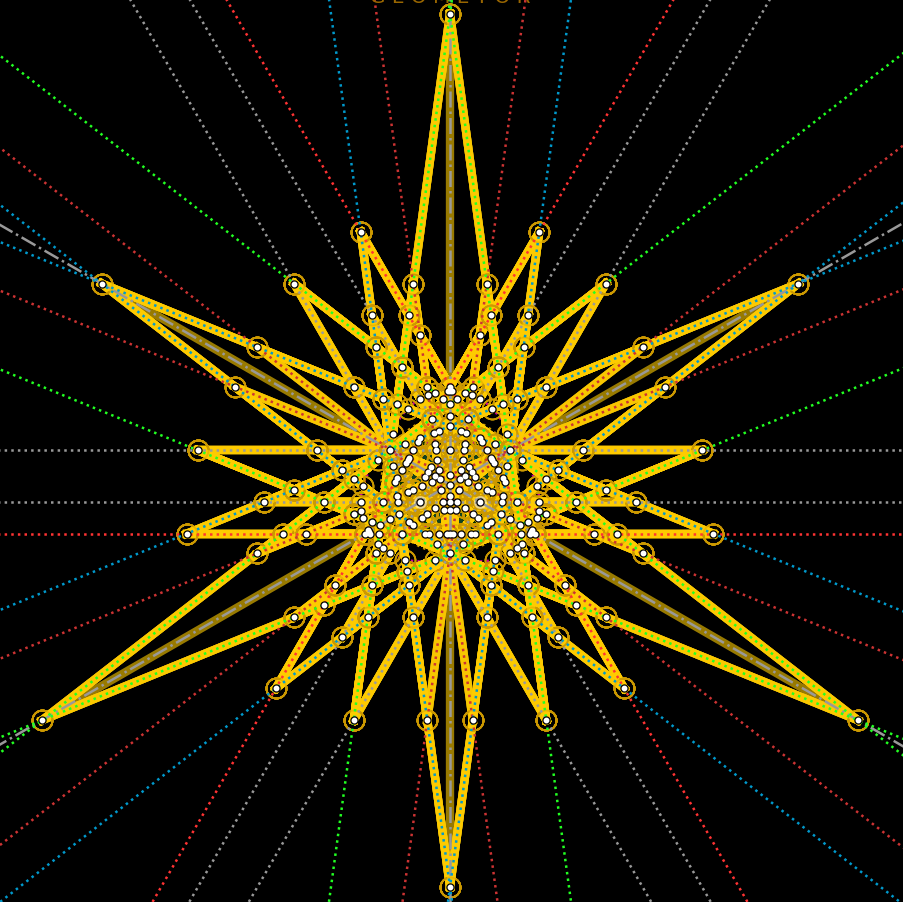
Tabulae XIX–XX: Octahedron Elevatum — Stella Octangula (1509)
The Compound of Two Dual Tetrahedra in Solid and Hollow Perspective by Leonardo da Vinci
Octahedron elevatum solidum est quando super qualibet octo basium octahedri erigitur una pyramis triangularis…
The solid elevated octahedron is when upon each of the eight bases of the octahedron a triangular pyramid is erected…
—Luca Pacioli, De Divina Proportione, Cap. XXXV (Venice, 1509)
The Paired Folios: Solidum and Vacuum
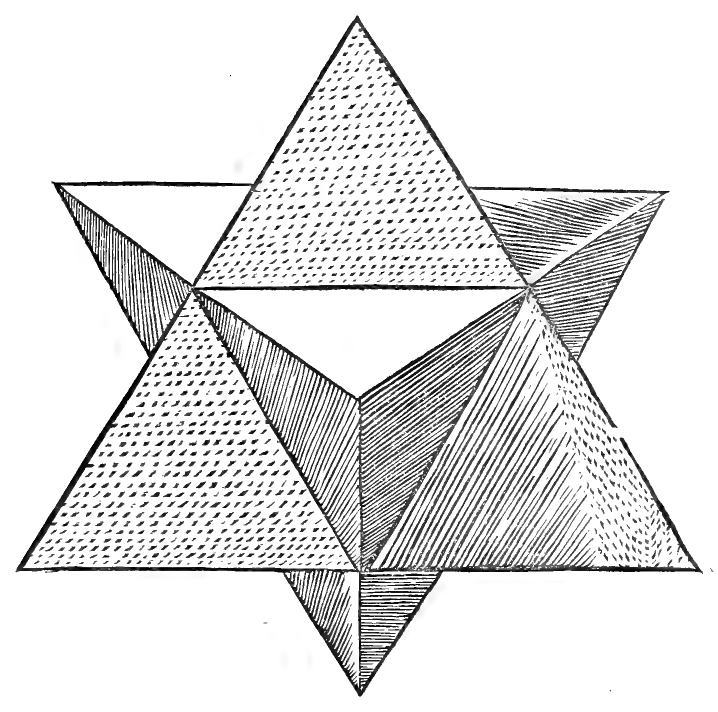
Tabula XIX (Folio 0227): Octahedron Elevatum Solidum (Stella Octangula).¶ |
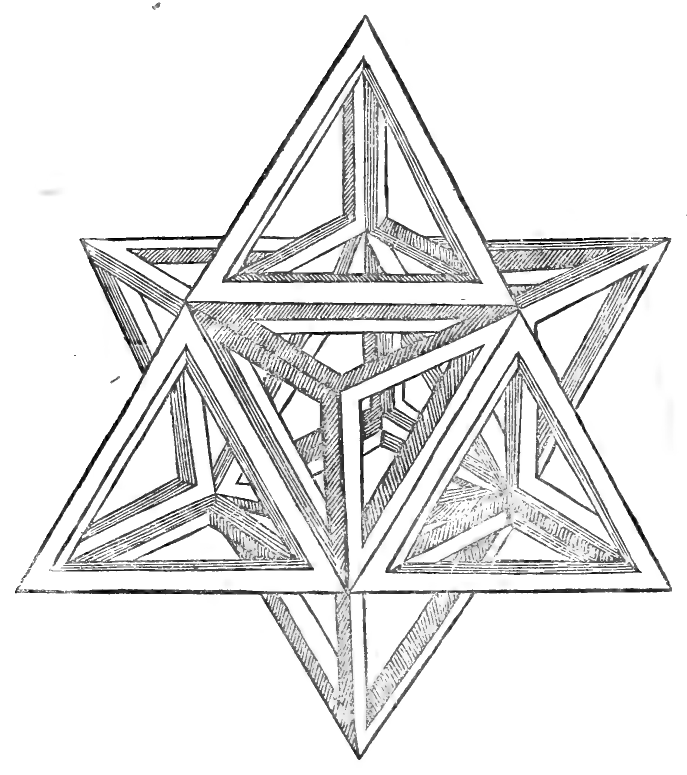
Tabula XX (Folio 0229): Octahedron Elevatum Vacuum.¶ |
Historical Discovery: Leonardo Before Kepler
In astronomical and mathematical history, credit for discovering the Stella Octangula (the compound of two interpenetrating regular tetrahedra) is almost universally accorded to Johannes Kepler, who coined the term in Harmonices Mundi (Linz, 1619, Book II).
However, Leonardo da Vinci drew both the solid and hollow Stella Octangula with rigorous perspective and chiaroscuro modeling in 1497, published in Pacioli’s De Divina Proportione in 1509—more than 110 years before Kepler!
Geometric Structure of the Stella Octangula
When equilateral pyramids are erected over the 8 triangular faces of an octahedron, the apex of each pyramid forms an equilateral tetrahedron sharing an octahedral face. In exact integer coordinates, the 8 pyramid apices are precisely the 8 corners of a cube \((\pm 1, \pm 1, \pm 1)\).
The 8 triangular pyramids combine in groups of four to form two interpenetrating regular tetrahedra:
Apex Vertices: 8 (corners of cube)
Octahedral Core Vertices: 6 (centers of cube faces)
Total Vertices: \(V = 8 + 6 = 14\)
Edges: \(E = 36\)
Faces: \(F = 24\) equilateral triangular facets
Shared Intersection Core: An exact regular octahedron
Topological Invariants of the Hollow Framework
By the Vacuate Manifold Theorem, the hollow elevated octahedron framework satisfies:
Base Solid Invariants: \(V = 14\), \(E = 36\), \(F = 24\) triangular faces
Hollow Frame Vertices: \(V_{\text{vac}} = 2V + 4E = 2(14) + 4(36) = 172\)
Hollow Frame Edges: \(E_{\text{vac}} = 12E = 12(36) = 432\)
Hollow Frame Faces: \(F_{\text{vac}} = 6E = 6(36) = 216\) planar trapezoids
Euler Characteristic: \(\chi_{\text{vac}} = 172 - 432 + 216 = -44\)
Topological Genus: \(g = F - 1 = 24 - 1 = 23\)
Coordinate Field: Pure integer lattice \(\mathbb{Z}\) / rational field \(\mathbb{Q}\)
Canonical Solid Codex
For the complete interactive 3D model, exact symbolic coordinates over \(\mathbb{Q}\), face normals, and dihedral angles, consult the canonical solid codex: