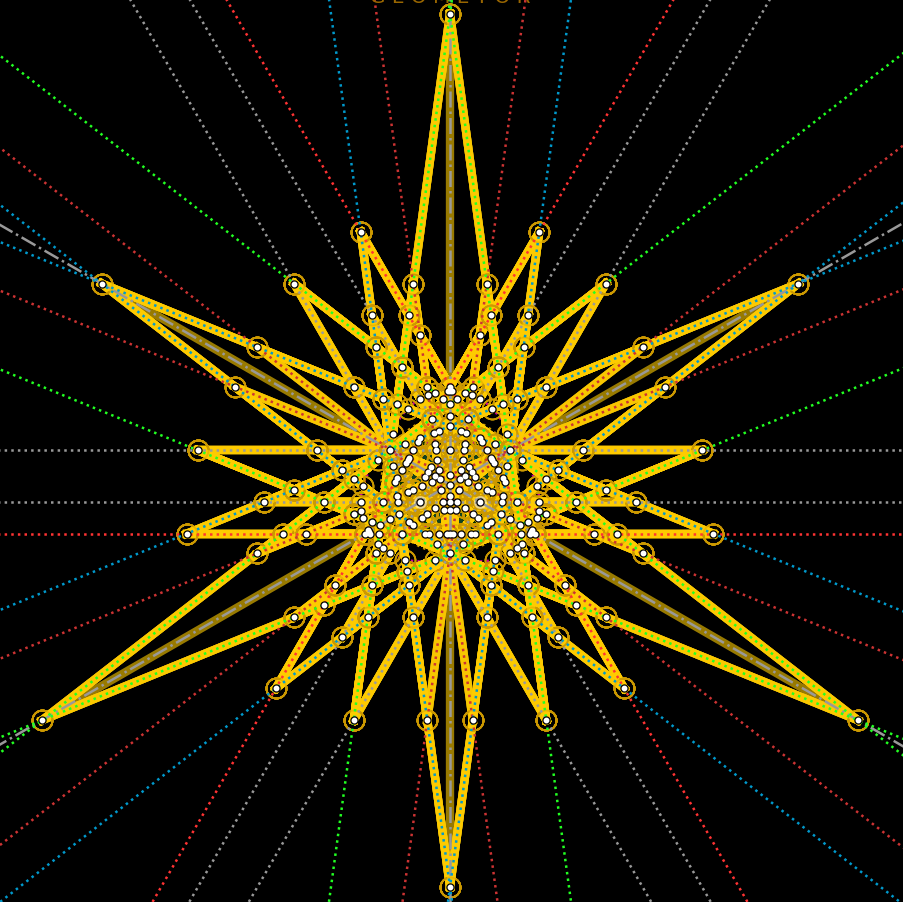
Tabulae XXIII–XXIIII: Icosahedron Abscisum — The Fullerene (1509)
The Truncated Icosahedron in Solid and Hollow Perspective by Leonardo da Vinci
Icosahedron abscisum solidum fit quando a singulis angulis icosahedri abscinditur portio unius tertiae partis laterum confluentium…
The solid truncated icosahedron is made when from each angle of the icosahedron a portion of one-third part of the converging edges is cut away…
—Luca Pacioli, De Divina Proportione, Cap. XXXVII (Venice, 1509)
The Paired Folios: Solidum and Vacuum
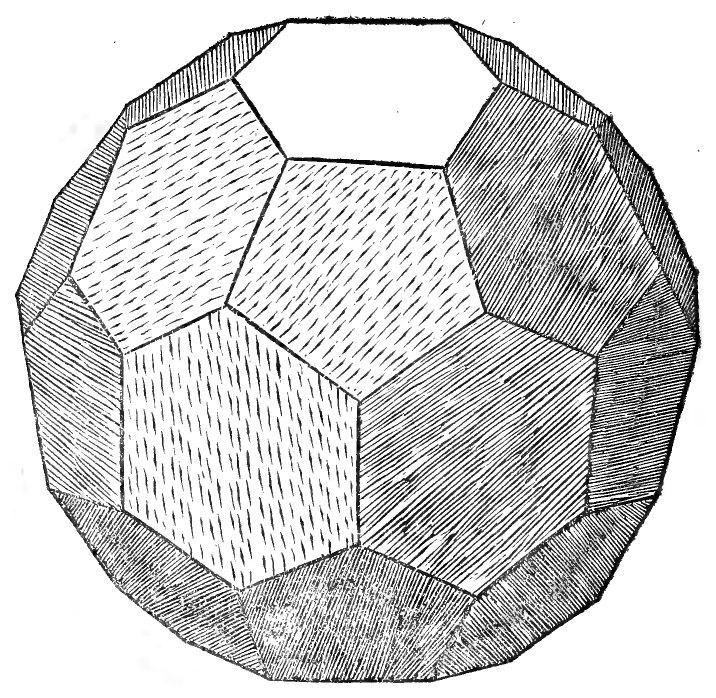
Tabula XXIII (Folio 0235): Icosahedron Abscisum Solidum.¶ |
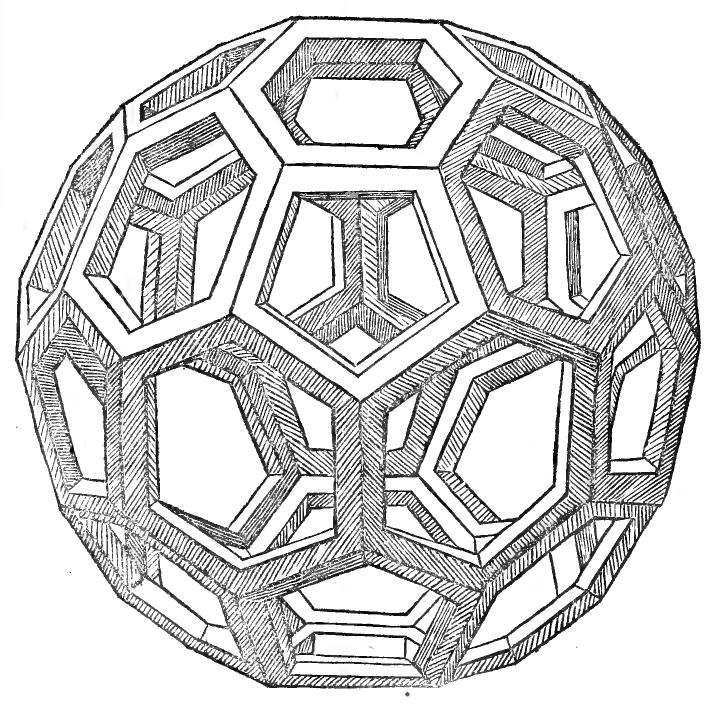
Tabula XXIIII (Folio 0237): Icosahedron Abscisum Vacuum.¶ |
Leonardo as the First Illustrator of the Buckyball
The truncated icosahedron possesses:
Vertices: \(V = 2E_{\text{ico}} = 2(30) = 60\)
Edges: \(E = 3(30) = 90\)
Faces: \(F = 12 \text{ pentagons} + 20 \text{ hexagons} = 32\)
This is the exact geometric architecture of the classical association football (soccer ball) and the Nobel Prize-winning molecule Buckminsterfullerene (\(\text{C}_{60}\)).
Leonardo da Vinci was the very first person in history to draw and publish this 32-face cage—four hundred and seventy-six years before Kroto, Smalley, and Curl synthesized \(\text{C}_{60}\) in 1985.
In Tabula XXIII, Leonardo renders the alternating rhythm of pentagons and hexagons with spherical volume.
In Tabula XXIIII, the hollow carpentry lattice creates a through-hole at every face (12 pentagonal windows and 20 hexagonal windows), yielding a manifold of genus \(g = 31\).
Topological Invariants of the Hollow Framework
By the Vacuate Manifold Theorem, the hollow truncated icosahedron satisfies:
Base Solid Invariants: \(V = 60\), \(E = 90\), \(F = 32\) (12 pentagons, 20 hexagons)
Hollow Frame Vertices: \(V_{\text{vac}} = 2V + 4E = 2(60) + 4(90) = 480\)
Hollow Frame Edges: \(E_{\text{vac}} = 12E = 12(90) = 1080\)
Hollow Frame Faces: \(F_{\text{vac}} = 6E = 6(90) = 540\) planar trapezoids
Euler Characteristic: \(\chi_{\text{vac}} = 480 - 1080 + 540 = -60\)
Topological Genus: \(g = F - 1 = 32 - 1 = 31\)
Coordinate Field: Quadratic extension field \(\mathbb{Q}(\phi)\)
Canonical Solid Codex
For the complete interactive 3D model, exact symbolic coordinates over \(\mathbb{Q}(\phi)\), face normals, and dihedral angles, consult the canonical solid codex: