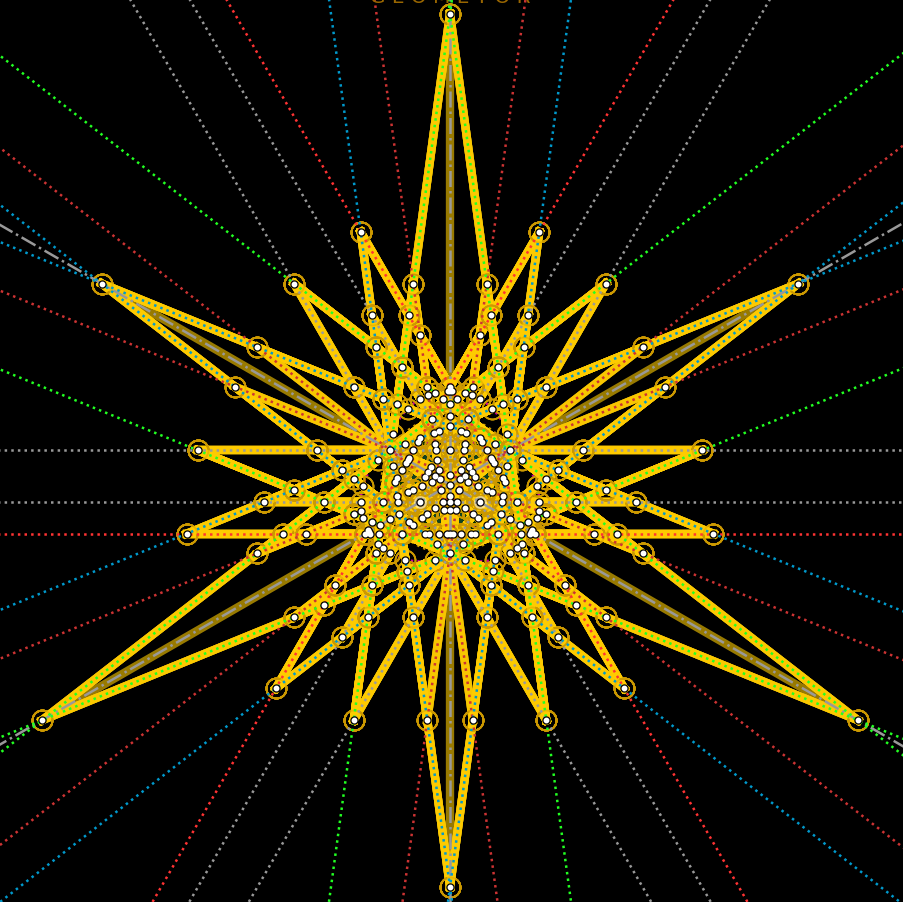
Tabulae XV–XVI: Octahedron Planum Solidum et Vacuum (1509)
The Regular Octahedron in Solid and Hollow Perspective by Leonardo da Vinci
Octahedron planum solidum est corpus octo basibus triangularibus aequilateris contentum…
The solid plane octahedron is a body contained by eight equilateral triangular bases…
—Luca Pacioli, De Divina Proportione, Cap. XXXIII (Venice, 1509)
The Paired Folios: Solidum and Vacuum
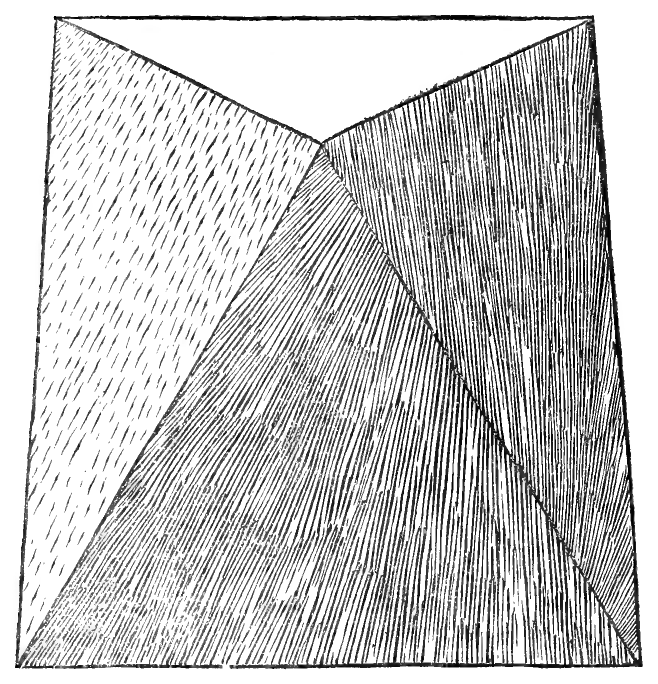
Tabula XV (Folio 0219): Octahedron Planum Solidum.¶ |
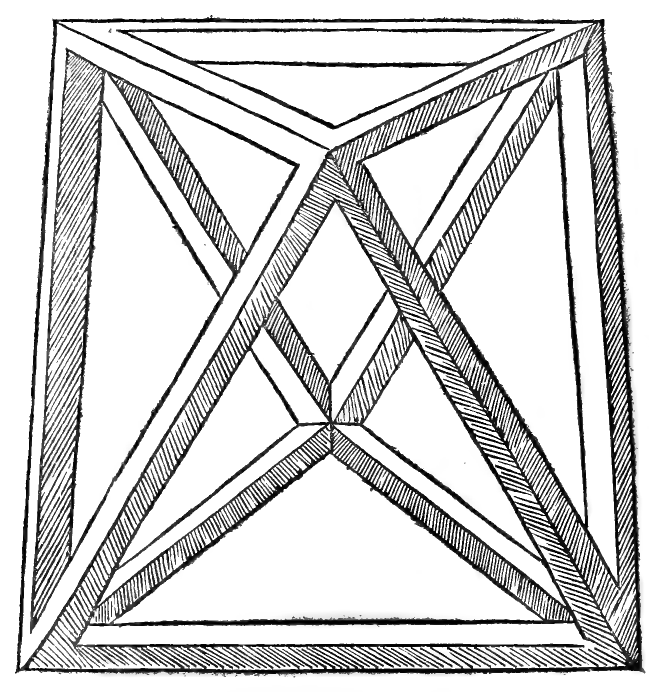
Tabula XVI (Folio 0221): Octahedron Planum Vacuum (\(g = 7\)).¶ |
Air Cosmology & Octahedral Duality
In Plato’s Timaeus (54e), the regular octahedron represents Air (Aer), occupying the intermediate position between Fire (tetrahedron) and Water (icosahedron) in subtlety and mobile weight.
Leonardo renders the solid octahedron resting on one of its equatorial vertices, showcasing four frontal faces converging toward the upper and lower apices.
In Tabula XVI, the hollow carpentry cage features 8 equilateral triangular window openings bounded by 12 mitered wooden rails meeting at 6 vertices. Through the front triangular apertures, the spectator looks directly into the central void and perceives the rear triangular framework.
Topological Invariants of the Hollow Framework
By the Vacuate Manifold Theorem, the hollow octahedron framework satisfies:
Base Solid Invariants: \(V = 6\), \(E = 12\), \(F = 8\) equilateral triangular faces
Hollow Frame Vertices: \(V_{\text{vac}} = 2V + 4E = 2(6) + 4(12) = 60\)
Hollow Frame Edges: \(E_{\text{vac}} = 12E = 12(12) = 144\)
Hollow Frame Faces: \(F_{\text{vac}} = 6E = 6(12) = 72\) planar trapezoids
Euler Characteristic: \(\chi_{\text{vac}} = 60 - 144 + 72 = -12\)
Topological Genus: \(g = F - 1 = 8 - 1 = 7\)
Coordinate Field: Pure rational field \(\mathbb{Q}\)
Canonical Solid Codex
For the complete interactive 3D model, exact symbolic coordinates over \(\mathbb{Q}\), face normals, and dihedral angles, consult the canonical solid codex: