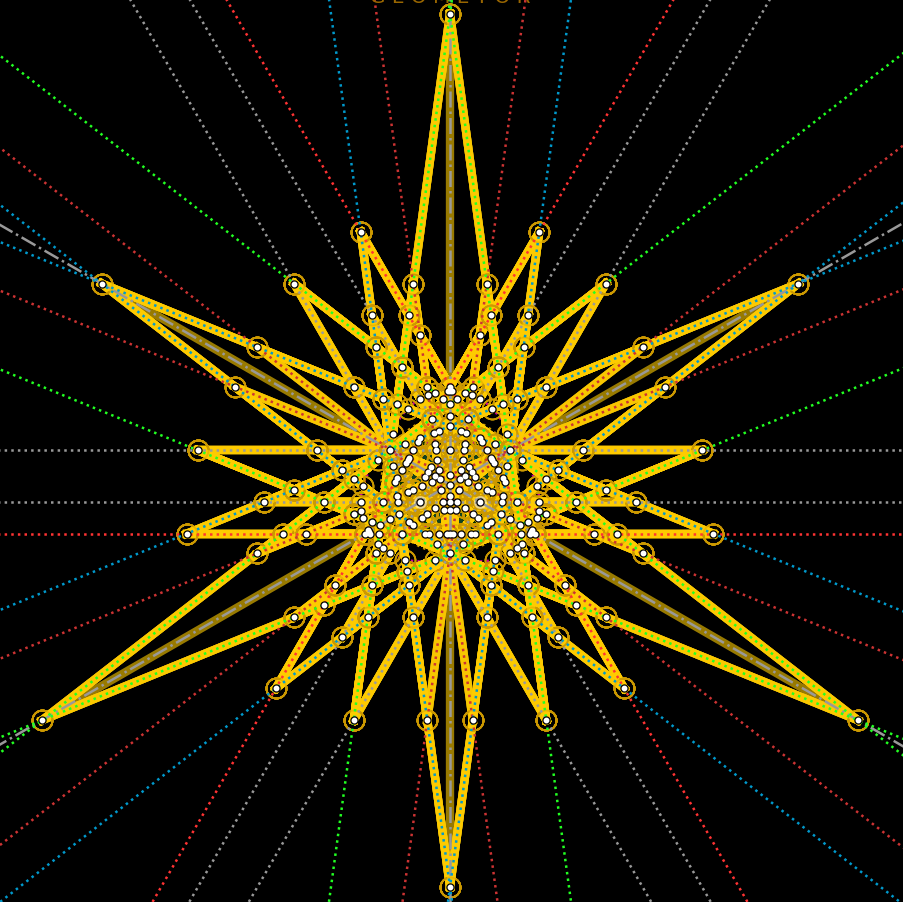
Tabulae XIII–XIIII: Exahedron Abscisum Elevatum Solidum et Vacuum (1509)
The Compound Elevated Cuboctahedron in Solid and Hollow Perspective by Leonardo da Vinci
Exahedron abscisum elevatum solidum est corpus habens super qualibet base abscisi cubi pyramidem erectam…
The solid elevated truncated hexahedron is a body having erected upon each base of the truncated cube a pyramid…
—Luca Pacioli, De Divina Proportione, Cap. XXXII (Venice, 1509)
The Paired Folios: Solidum and Vacuum
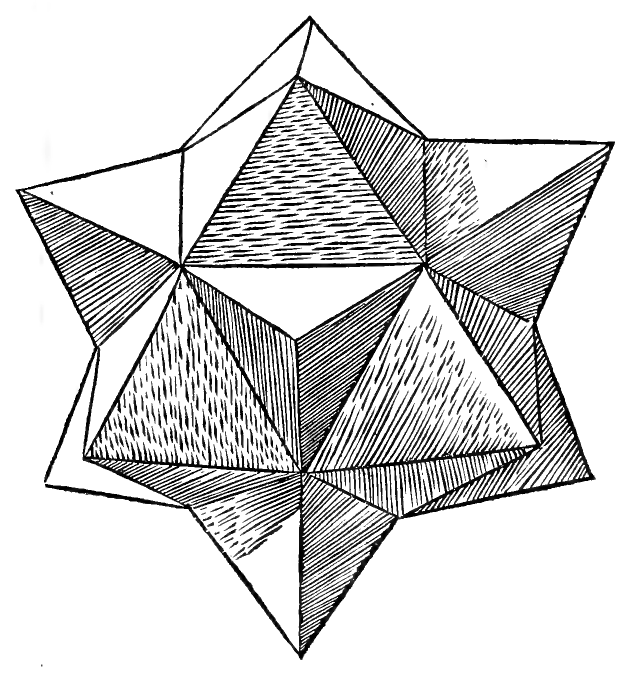
Tabula XIII (Folio 0211): Exahedron Abscisum Elevatum Solidum.¶ |
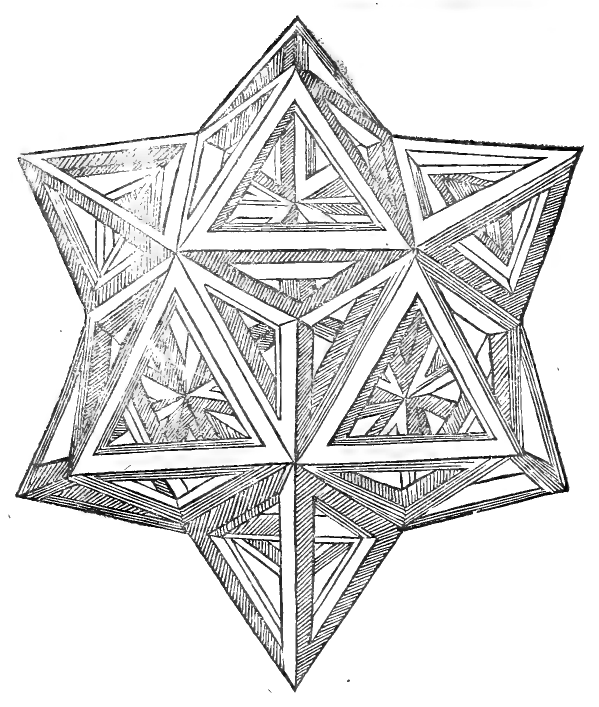
Tabula XIIII (Folio 0217): Exahedron Abscisum Elevatum Vacuum.¶ |
Scholarly Note on Paganini’s 1509 Folio Numbering
In Paganini’s 1509 Venetian print edition, folios 0213 and 0215 were allocated to full-page Vitruvian architectural column plates (Colonna Corinta, Jonica e Pulvinata con Stilobata e Steriobata). Consequently, the hollow counterpart Tabula XIIII was placed on Folio 0217, immediately following the architectural treatise plates.
Compound Stellation & Multi-Pyramidal Architecture
This compound solid illustrates the recursive power of Renaissance constructive operations: starting from the cube, edge-midpoint truncation generates the 14-faced cuboctahedron, upon which 14 distinct pyramids (8 triangular pyramids and 6 square pyramids) are erected.
In Tabula XIII, the multi-faceted star body sparkles with alternating illuminated and shaded planes.
In Tabula XIIII, the hollow carpentry cage becomes a triumph of wooden craftsmanship: 48 triangular window openings reveal the intricate interior cage, yielding a manifold of topological genus \(g = 47\).
Topological Invariants of the Hollow Framework
By the Vacuate Manifold Theorem, the hollow elevated cuboctahedron satisfies:
Base Solid Invariants: \(V = 12 + 8 + 6 = 26\), \(E = 24 + 24 + 24 = 72\), \(F = 24 + 24 = 48\) triangular facets
Hollow Frame Vertices: \(V_{\text{vac}} = 2V + 4E = 2(26) + 4(72) = 340\)
Hollow Frame Edges: \(E_{\text{vac}} = 12E = 12(72) = 864\)
Hollow Frame Faces: \(F_{\text{vac}} = 6E = 6(72) = 432\) planar trapezoids
Euler Characteristic: \(\chi_{\text{vac}} = 340 - 864 + 432 = -92\)
Topological Genus: \(g = F - 1 = 48 - 1 = 47\)
Coordinate Field: Pure rational field \(\mathbb{Q}\)
Canonical Solid Codex
For the complete interactive 3D model, exact symbolic coordinates over \(\mathbb{Q}\), face normals, and dihedral angles, consult the canonical solid codex: