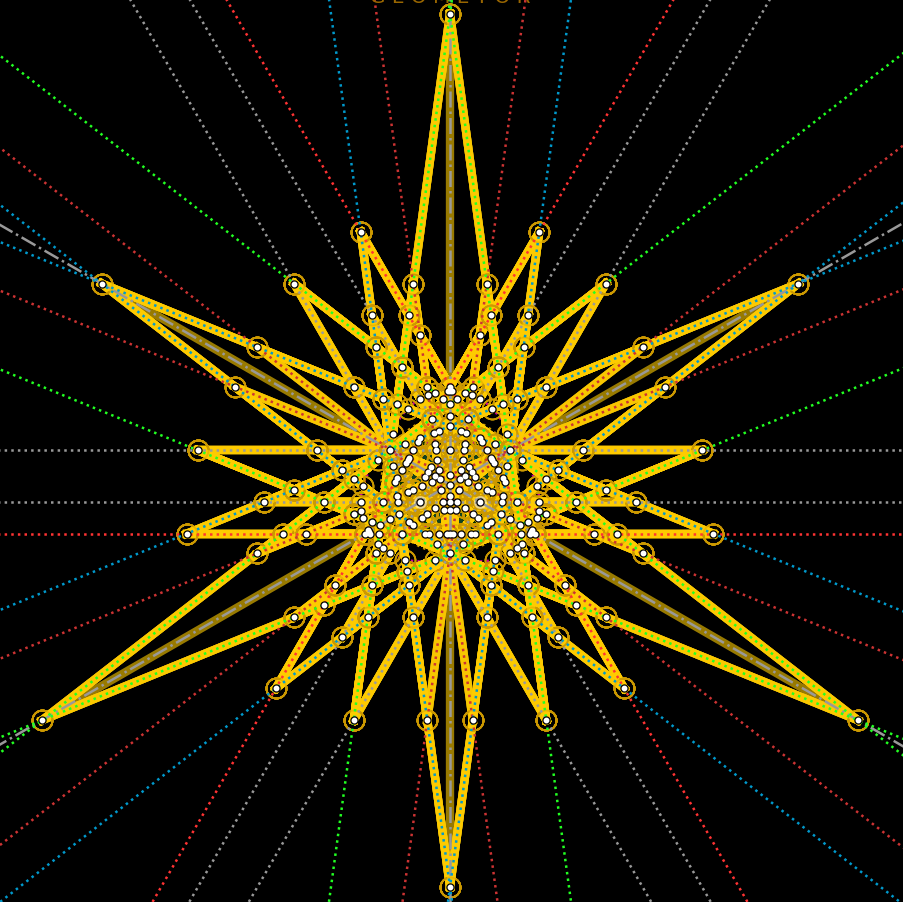
P-04.06 · Cuboctahedron Elevatum
Exahedron Abscisum Elevatum · Field: :math:`mathbb{Q}` · Symmetry: O_h (order 48) · Non-Convex
Interactive 3D Studio
Machine-Verified Symbolic Certificate
Canonical Identifier |
|
Classical Latin Name |
Exahedron Abscisum Elevatum |
Polyhedral Family |
04-elevated |
Number Field |
\(\mathbb{Q}\) |
Topology Invariants |
\(V = 26,\; E = 72,\; F = 48,\; \chi = 2\) |
Face Composition |
48 equilateral triangles |
Exact Edge Quadrance(s) |
\(Q_e = 2\) |
Exact Vertex Quadrance(s) |
\(Q_v = 2, Q_v = 4, Q_v = \frac{16}{3}\) |
Primary Dihedral Spread |
\(S = \frac{8}{9}\) |
Vacuum Manifold Invariants |
\(V_{\text{vac}} = 340,\; E_{\text{vac}} = 864,\; F_{\text{vac}} = 432,\; g = 47\) |
Polar Dual / Parent Solid |
Base: Cuboctahedron |
Symmetry Group |
O_h (order 48) |
Historical Literature |
Luca Pacioli & Leonardo da Vinci, De Divina Proportione (1509), Tabulae XIII–XIIII |
Exact Algebraic Coordinates & Geometric Proof
The Cuboctahedron Elevatum (Exahedron Abscisum Elevatum) is Pacioli’s 14-base stellation formed by elevating the 8 triangular and 6 square faces of the Archimedean cuboctahedron. Starting from the cuboctahedron with 12 vertices at permutations of \((\pm 1, \pm 1, 0)\) (edge length \(s = \sqrt{2}\)):
Triangular Apices (8): \(h_3 = \sqrt{2 - \frac{2}{3}} = \frac{2}{\sqrt{3}}\). Normal \((1, 1, 1)\) yields apex \((2/3, 2/3, 2/3) + 2/3(1, 1, 1) = (4/3, 4/3, 4/3)\).
Square Apices (6): \(h_4 = \sqrt{2 - 1} = 1\). Normal \((1, 0, 0)\) yields apex \((1, 0, 0) + 1 \cdot (1, 0, 0) = (2, 0, 0)\).
Both sets of apices have strictly rational coordinates! Thus all 26 vertices lie entirely in \(\mathbb{Q}\). The manifold contains 48 equilateral triangular faces with genus \(g = 47\).
Leonardo da Vinci’s Woodcuts & Corpus Vacuum Reconstruction
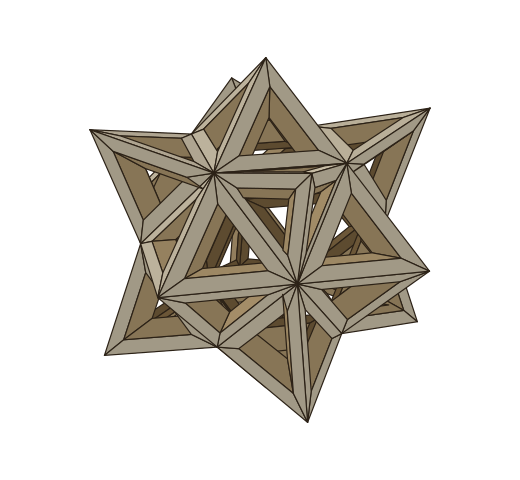
Hollow Framework: Exahedron Abscisum Elevatum Vacuum (topological genus \(g = 47\)).
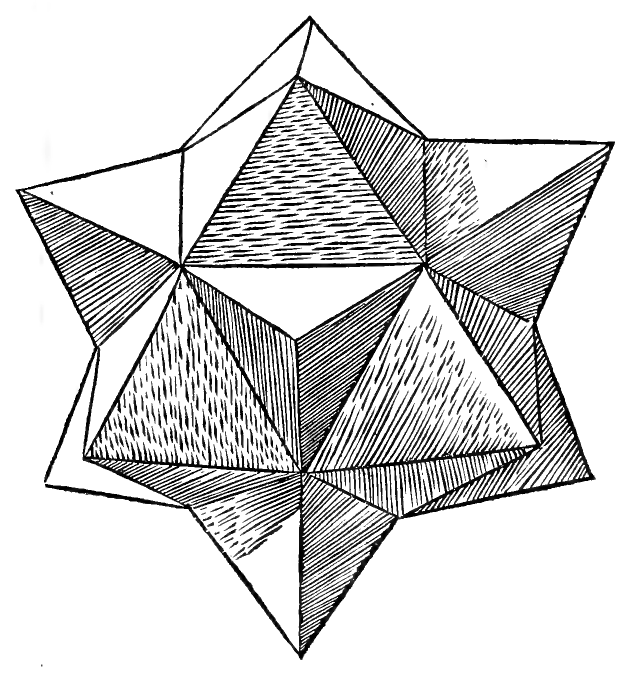
Tabula XIII (Folio 0211): Exahedron Abscisum Elevatum Solidum.¶ |
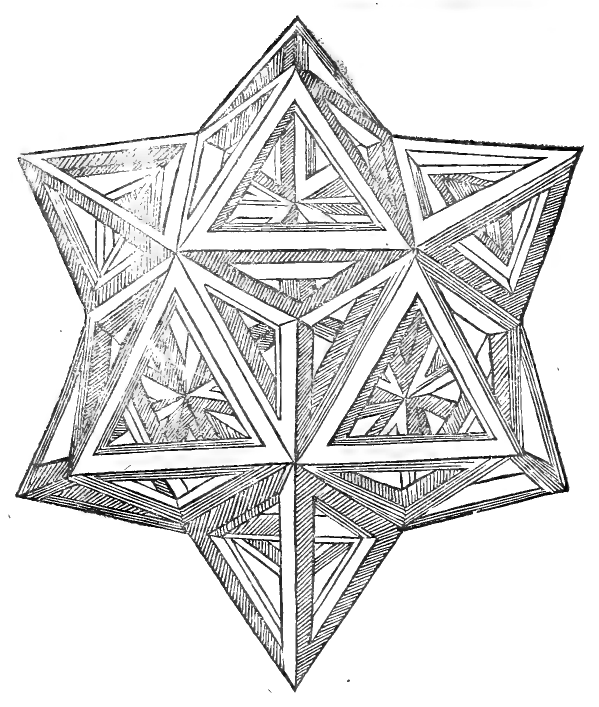
Tabula XIIII (Folio 0217): Exahedron Abscisum Elevatum Vacuum.¶ |
For detailed commentary and high-resolution plate studies, consult the manuscript folio codex: