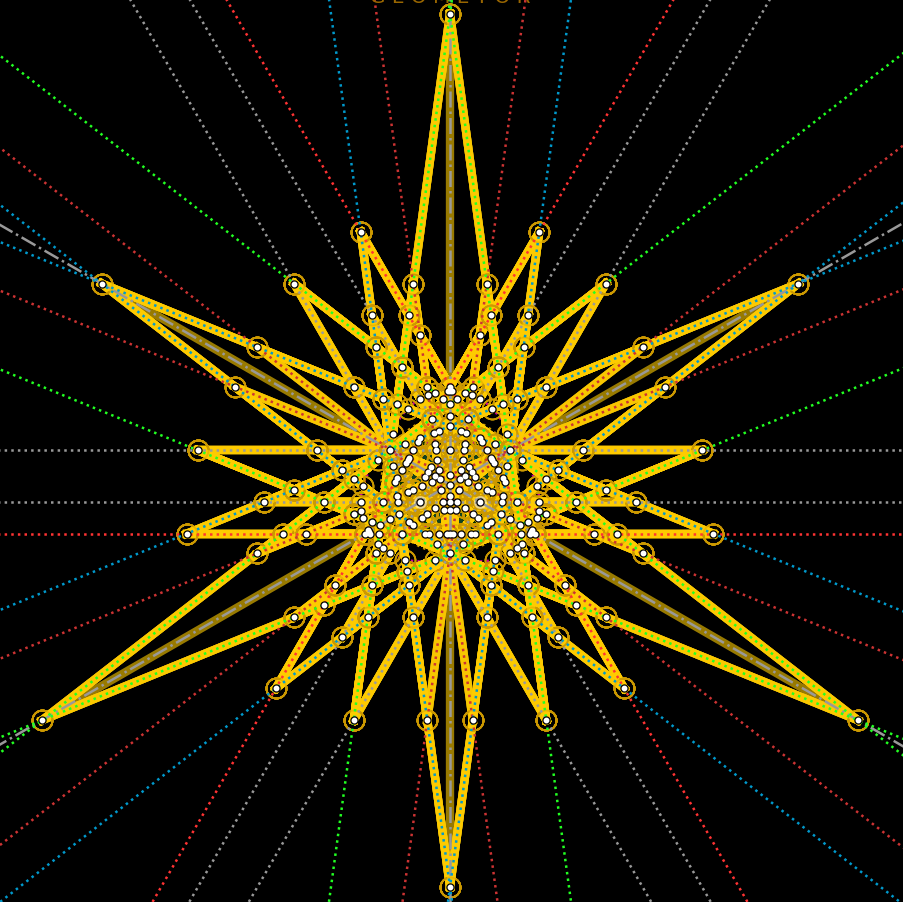
P-01.01 · Tetrahedron
Tetrahedron · Field: :math:`mathbb{Z}` · Symmetry: :math:`T_d` (order 24) · Convex · Euclid Elements XIII.13
To construct a regular tetrahedron inside a given sphere and to prove that the square on the diameter of the sphere is one and a half times the square on the side of the tetrahedron.
—Euclid of Alexandria, Elements Book XIII, Proposition 13 (G-Index:
G.592)
Interactive 3D Studio
Note
Interactive Studio Controls:
Display Modes: Switch between Surfaces (studio-lit polygonal facets), Wireframe (depth-cued structural edges), and Frame (mitered hollow beam manifold).
Opacity & Aperture Sliders: Adjust surface transparency from
0%to100%in Surfaces and Frame modes, and tune the window Aperture in Frame mode.Vertices, Dual & Golden φ: Toggle Vertices (default ON), Dual (the face-center dual whose vertices are the exact centers of the sides), and Golden φ (\(\phi : 1\) golden sections and \(1 : \phi\) golden rectangles).
Machine-Verified Symbolic Certificate
Mathematical Invariant |
Exact Symbolic Value |
Geometric Interpretation |
|---|---|---|
Catalog Identifier |
|
Family 01 (Platonic Solids), Solid 01 |
Algebraic Number Field |
\(\mathbb{Z}\) |
Pure rational integer ring |
Topology |
\((V=4, E=6, F=4)\) |
Euler characteristic \(\chi = 4 - 6 + 4 = 2\) |
Face Composition |
4 equilateral triangles |
Schläfli symbol \(\{3, 3\}\) |
Exact Edge Quadrance \(Q_E\) |
\(8\) |
Edge length \(s = 2\sqrt{2}\) |
Exact Circumquadrance \(Q_{\text{out}}\) |
\(3\) |
Circumradius \(R = \sqrt{3}\) across diagonal |
Inquadrance \(Q_{\text{in}}\) |
\(1/3\) |
Inradius \(r = 1/\sqrt{3}\) at face centroid |
Circum-to-Inratio \(Q_{\text{in}} / Q_{\text{out}}\) |
\(1/9\) |
Sphere volume ratio \((1/9)^{3/2} = 1/27\) |
Primary Dihedral Spread \(s\) |
\(8/9\) |
\(\cos\theta = 1/3 \implies s = 1 - (1/3)^2 = 8/9\) |
Vacuum Manifold |
\((V=32, E=72, F=36)\) |
Genus \(g = F - 1 = 3\), \(\chi = -4\) |
Polar Dual |
Self-dual inverted tetrahedron \(\{3, 3\}\) |
|
Symmetry Group |
\(T_d\) (order 24) |
Full tetrahedral chiral and reflection group |
Historical Canon |
Euclid XIII.13 ( |
Pacioli De Divina Proportione Cap. XXI; Tabulae I–II |
Exact Coordinate Representative Ledger & Algebraic Construction
Canonical Lattice Coordinates
In the GEOMETOR formulation, the regular tetrahedron is embedded directly into the integer lattice \(\mathbb{Z}^3\) as four alternating vertices of the canonical cube \([-1, 1]^3\):
Vertex Index |
Exact Symbolic Coordinates $(x, y, z)$ |
Circumquadrance $Q_{\text{out}}$ |
|---|---|---|
$V_0$ |
$(1, 1, 1)$ |
$1^2 + 1^2 + 1^2 = 3$ |
$V_1$ |
$(1, -1, -1)$ |
$1^2 + (-1)^2 + (-1)^2 = 3$ |
$V_2$ |
$(-1, 1, -1)$ |
$(-1)^2 + 1^2 + (-1)^2 = 3$ |
$V_3$ |
$(-1, -1, 1)$ |
$(-1)^2 + (-1)^2 + 1^2 = 3$ |
Face Cycles & Normal Orientations
The four equilateral triangular faces are oriented with outward-pointing counter-clockwise normal cycles:
Outward face normal vectors are computed via exact 3D cross products:
Dihedral Spread Derivation
The dihedral spread between two adjacent faces with normal vectors \(n_0 = (1, 1, -1)\) and \(n_1 = (1, -1, 1)\) is computed directly without trigonometry:
George Odom’s 1983 Golden Section Construction
While the tetrahedron is traditionally considered an elemental figure devoid of the golden ratio, in 1983 the American artist and geometer George Odom proved that the golden ratio is encoded directly on the face of the regular tetrahedron when inscribed within its circumscribing circle.
Let \(\triangle ABC\) be an equilateral face of the tetrahedron inscribed in its circumcircle \(\mathcal{C}\) of radius \(r = 2\):
Let \(M_1\) be the midpoint of edge \(AB\), and \(M_2\) be the midpoint of edge \(AC\).
Draw the midsegment line \(M_1 M_2\) and extend it to intersect the circle \(\mathcal{C}\) at points \(G_1\) and \(G_2\) (with \(G_2\) lying beyond \(M_2\)).
Theorem (George Odom, 1983): The point \(M_2\) divides the segment \(M_1 G_2\) in the golden ratio:
\[\frac{|M_1 M_2|}{|M_2 G_2|} = \phi = \frac{1 + \sqrt{5}}{2}\]
In the language of 3D Rational Trigonometry and geometor.model, the quadrance ratio satisfies:
Leonardo da Vinci’s 1509 Woodcuts & Corpus Vacuum Reconstruction
For Luca Pacioli’s De Divina Proportione (Venice, 1509), Leonardo da Vinci designed sixty polyhedral drawings, cut onto pearwood blocks. Tabulae I and II depict the Tetrahedron Planum Solidum and Tetrahedron Planum Vacuum.
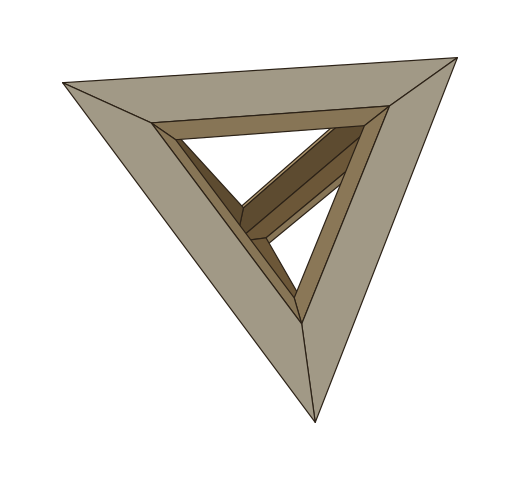
Exact Symbolic Reconstruction: Hollow wooden armillary framework (\(\mu = 0.25\)) of genus \(g = 3\) and Euler characteristic \(\chi = -4\).
Leonardo da Vinci (1509 Woodcut) |
Classical Designation & Codex Study |
|---|---|
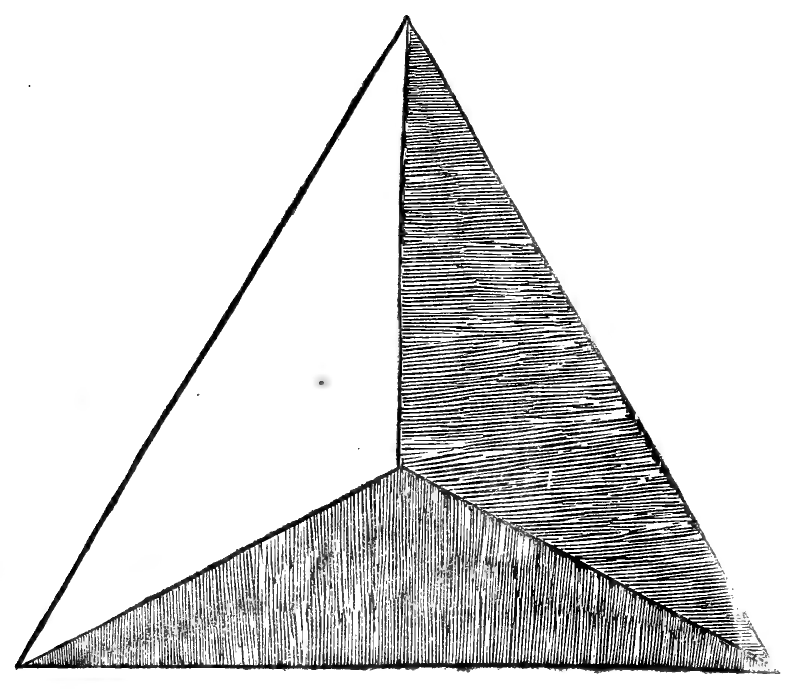
Tabula I (Folio 0187): Tetrahedron Planum Solidum¶ |
Detailed codex analysis in Tabulae I–II: Tetrahedron. Opaque body with directional shading (luce primaria) descending from upper-left at \(45^\circ\). |
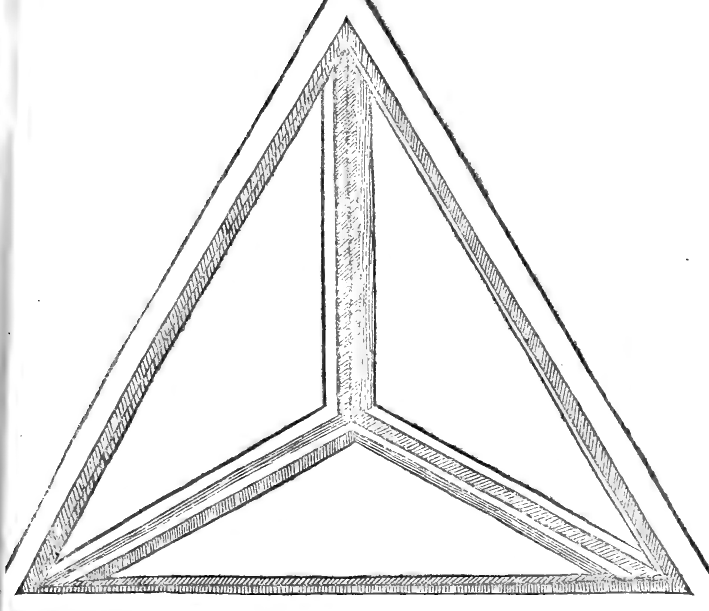
Tabula II (Folio 0189): Tetrahedron Planum Vacuum¶ |
Detailed codex analysis in Tabulae I–II: Tetrahedron. Open wooden beam lattice revealing opposite vertices and interior mitered joinery. |
Unfolded 2D Papercraft Net
The regular tetrahedron unfolds into the plane along three of its six edges without overlapping. The resulting net forms a larger equilateral triangle whose sides are twice the length of the tetrahedron’s edges:
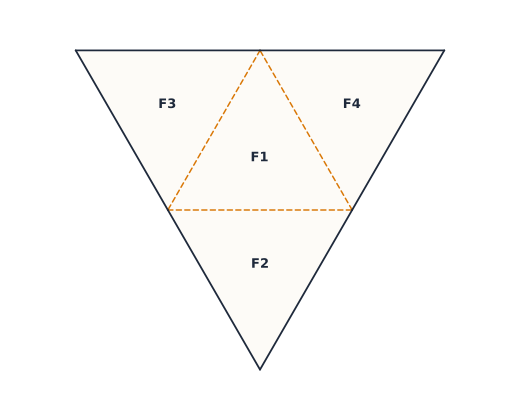
2D Dihedral-Hinge Unfolding: Central triangular face surrounded by three outer faces hinged along internal seams (dashed lines) and cut boundaries (solid lines).
The net demonstrates that the total surface area of the regular tetrahedron is four times the area of a single equilateral face: