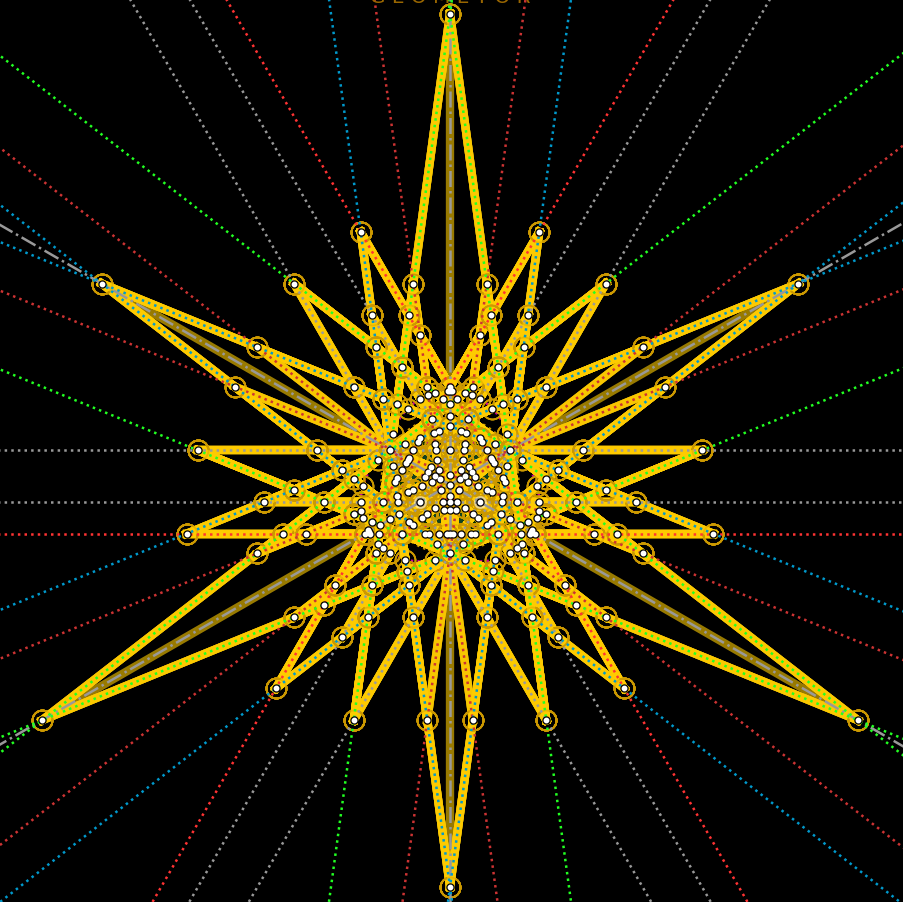
Tabulae I–II: Tetrahedron Planum Solidum et Vacuum (1509)
The Regular Tetrahedron in Solid and Hollow Perspective by Leonardo da Vinci
Tetrahedron planum solidum est corpus quatuor basibus triangularibus aequilateris contentum… vacuum vero est quando bases aperiuntur lignea trabecula circumdata.
The solid plane tetrahedron is a body contained by four equilateral triangular bases… but the vacuum is when the bases are opened, surrounded by wooden beams.
—Luca Pacioli, De Divina Proportione, Cap. XXVI (Venice, 1509)
The Paired Folios: Solidum and Vacuum
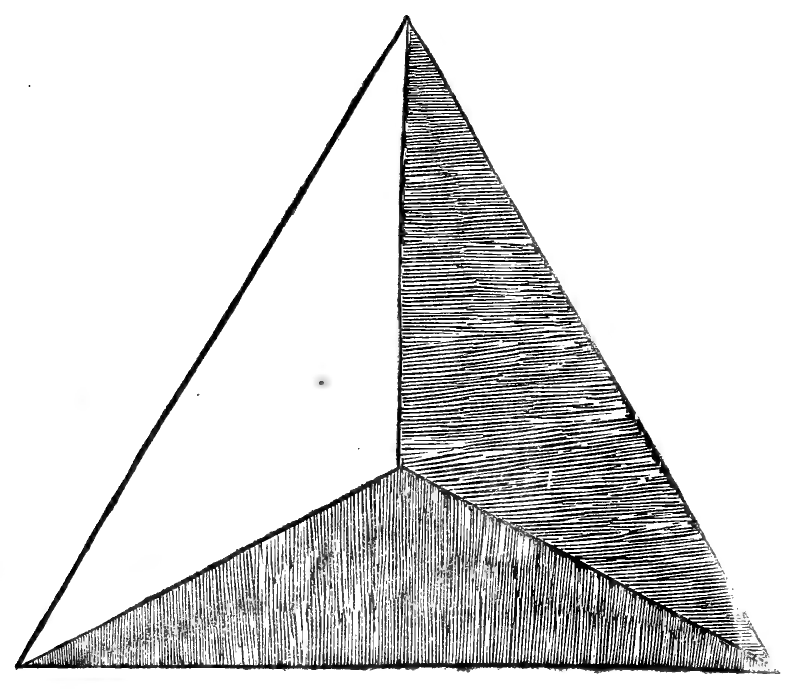
Tabula I (Folio 0187): Tetrahedron Planum Solidum (Τετράεδρον ἐπίπεδον στερεόν).¶ |
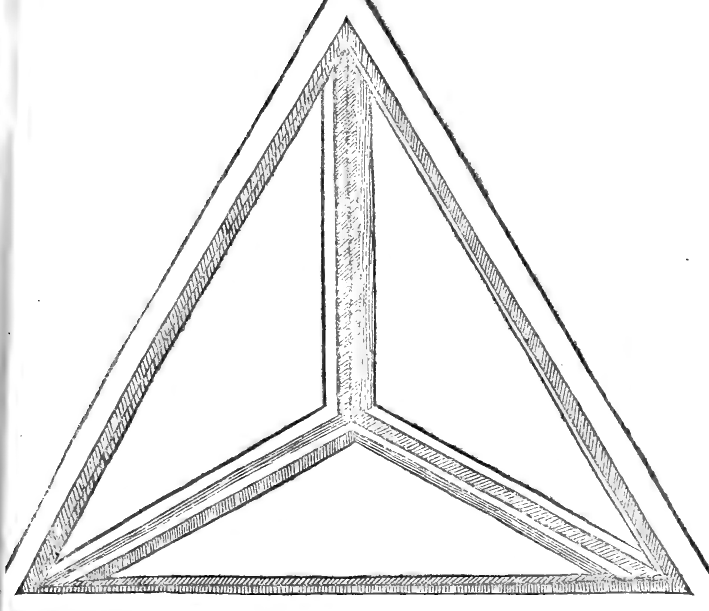
Tabula II (Folio 0189): Tetrahedron Planum Vacuum (Τετράεδρον ἐπίπεδον κενόν).¶ |
Historical & Iconographic Analysis
In the Platonic cosmology of the Timaeus (54d–55a), the regular tetrahedron is assigned to Fire (Ignis) because of its penetrating sharpness, minimal number of bounding facets, and agile mobility.
Leonardo’s rendering of Tabula I establishes the lighting conventions utilized across all sixty woodcuts: an illumination source located above and to the left of the spectator, casting crisp diagonal hatchings across the rightmost facets.
In Tabula II, Leonardo strips away the opaque faces to construct the hollow wooden lattice framework (Corpus Vacuum). These hollow models were crafted in boxwood and hung from the ceiling of Duke Ludovico Sforza’s banquet hall in Milan.
Topological Invariants of the Hollow Framework
By the Vacuate Manifold Theorem, the hollow lattice framework replaces each triangular face with an open window reveal framed by mitered boundary beams:
Base Solid Invariants: \(V = 4\), \(E = 6\), \(F = 4\)
Hollow Frame Vertices: \(V_{\text{vac}} = 2V + 4E = 2(4) + 4(6) = 32\)
Hollow Frame Edges: \(E_{\text{vac}} = 12E = 12(6) = 72\)
Hollow Frame Faces: \(F_{\text{vac}} = 6E = 6(6) = 36\) planar trapezoids
Euler Characteristic: \(\chi_{\text{vac}} = 32 - 72 + 36 = -4\)
Topological Genus: \(g = F - 1 = 4 - 1 = 3\)
Coordinate Field: Pure rational field \(\mathbb{Q}\)
Canonical Solid Codex
For the complete interactive 3D model, exact symbolic coordinates over \(\mathbb{Q}\), face normals, and dihedral angles, consult the canonical solid codex: