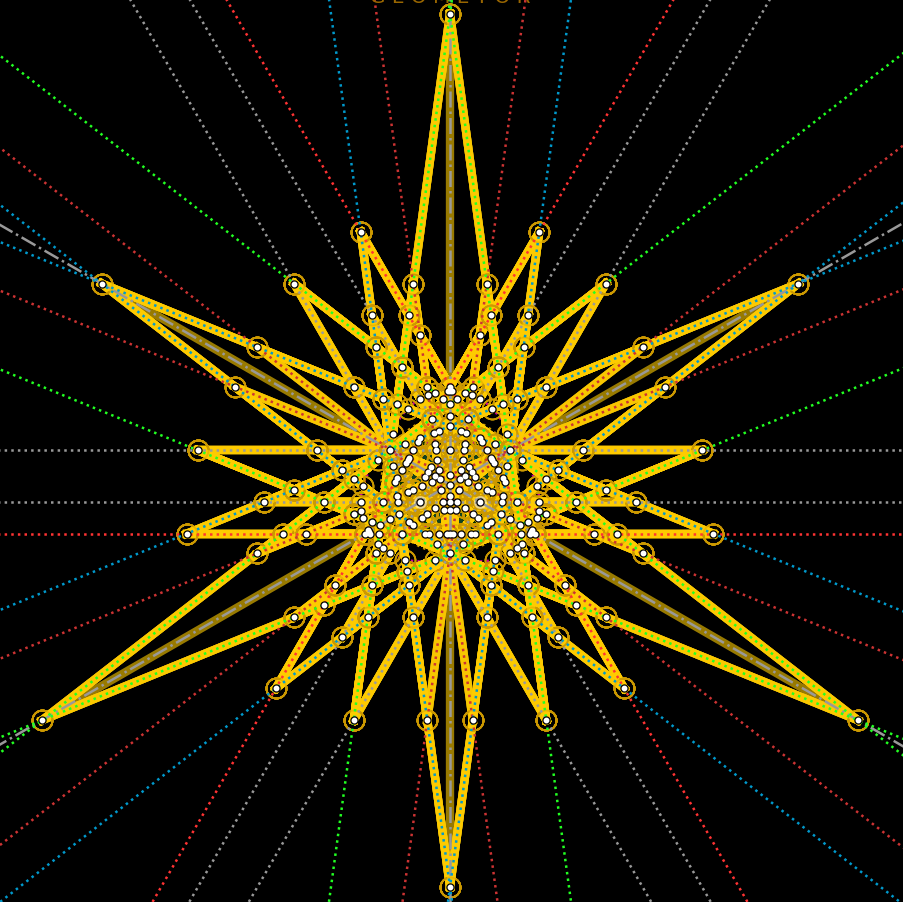
P-01.03 · Octahedron
Octahedron · Field: :math:`mathbb{Z}` · Symmetry: :math:`O_h` (order 48) · Convex · Euclid Elements XIII.14
To construct a regular octahedron inside a given sphere and to prove that the square on the diameter of the sphere is double the square on the side of the octahedron.
—Euclid of Alexandria, Elements Book XIII, Proposition 14 (G-Index:
G.594)
Interactive 3D Studio
Note
Interactive Studio Controls:
Display Modes: Switch between Surfaces (studio-lit polygonal facets), Wireframe (depth-cued structural edges), and Frame (mitered hollow beam manifold).
Opacity & Aperture Sliders: Adjust surface transparency from
0%to100%in Surfaces and Frame modes, and tune the window Aperture in Frame mode.Vertices, Dual & Golden φ: Toggle Vertices (default ON), Dual (the face-center dual whose vertices are the exact centers of the sides), and Golden φ (\(\phi : 1\) golden sections and \(1 : \phi\) golden rectangles).
Machine-Verified Symbolic Certificate
Mathematical Invariant |
Exact Symbolic Value |
Geometric Interpretation |
|---|---|---|
Catalog Identifier |
|
Family 01 (Platonic Solids), Solid 03 |
Algebraic Number Field |
\(\mathbb{Z}\) |
Pure rational integer ring |
Topology |
\((V=6, E=12, F=8)\) |
Euler characteristic \(\chi = 6 - 12 + 8 = 2\) |
Face Composition |
8 equilateral triangles |
Schläfli symbol \(\{3, 4\}\) |
Exact Edge Quadrance \(Q_E\) |
\(2\) |
Edge length \(s = \sqrt{2}\) across axes |
Exact Circumquadrance \(Q_{\text{out}}\) |
\(1\) |
Circumradius \(R = 1\) along coordinate axes |
Inquadrance \(Q_{\text{in}}\) |
\(1/3\) |
Inradius \(r = 1/\sqrt{3}\) at face centroid \((1/3, 1/3, 1/3)\) |
Circum-to-Inratio \(Q_{\text{in}} / Q_{\text{out}}\) |
\(1/3\) |
Sphere volume ratio \((1/3)^{3/2} = 1/(3\sqrt{3})\) |
Primary Dihedral Spread \(s\) |
\(8/9\) |
\(\cos\theta = -1/3 \implies s = 1 - (-1/3)^2 = 8/9\) |
Vacuum Manifold |
\((V=60, E=144, F=72)\) |
Genus \(g = F - 1 = 7\), \(\chi = -12\) |
Polar Dual |
Regular cube connecting 8 face centroids |
|
Symmetry Group |
\(O_h\) (order 48) |
Full octahedral chiral and reflection group |
Historical Canon |
Euclid XIII.14 ( |
Pacioli De Divina Proportione Cap. XXIII; Tabulae XV–XVI |
Exact Coordinate Representative Ledger & Algebraic Construction
Canonical Lattice Coordinates
In the GEOMETOR formulation, the octahedron resides directly on the six Cartesian axial unit vertices:
Vertex Index |
Exact Symbolic Coordinates $(x, y, z)$ |
Circumquadrance $Q_{\text{out}}$ |
|---|---|---|
$V_0$ |
$(1, 0, 0)$ |
$1^2 + 0^2 + 0^2 = 1$ |
$V_1$ |
$(-1, 0, 0)$ |
$(-1)^2 + 0^2 + 0^2 = 1$ |
$V_2$ |
$(0, 1, 0)$ |
$0^2 + 1^2 + 0^2 = 1$ |
$V_3$ |
$(0, -1, 0)$ |
$0^2 + (-1)^2 + 0^2 = 1$ |
$V_4$ |
$(0, 0, 1)$ |
$0^2 + 0^2 + 1^2 = 1$ |
$V_5$ |
$(0, 0, -1)$ |
$0^2 + 0^2 + (-1)^2 = 1$ |
Face Cycles & Normal Orientations
The eight equilateral triangular faces are oriented with outward-pointing counter-clockwise normal cycles:
Dihedral Spread Derivation
Adjacent faces meet across coordinate edges. Taking unnormalized outward normals \(n_0 = (1, 1, 1)\) and \(n_1 = (1, -1, 1)\):
The dihedral spread is:
Important
Identical Dihedral Spread with Tetrahedron: The Octahedron \(\{3, 4\}\) and the Tetrahedron \(\{3, 3\}\) share the exact same dihedral spread \(s = 8/9\), reflecting their mutual participation in the face-centered cubic lattice.
Leonardo da Vinci’s 1509 Woodcuts & Corpus Vacuum Reconstruction
In Luca Pacioli’s De Divina Proportione (1509), Leonardo da Vinci rendered the octahedron in Tabulae XV and XVI as Octahedron Planum Solidum and Octahedron Planum Vacuum.
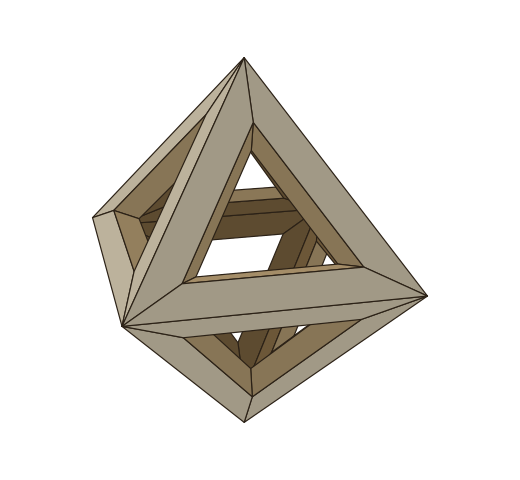
Exact Symbolic Reconstruction: Hollow wooden frame (\(\mu = 0.25\)) of genus \(g = 7\) and Euler characteristic \(\chi = -12\).
Leonardo da Vinci (1509 Woodcut) |
Classical Designation & Codex Study |
|---|---|
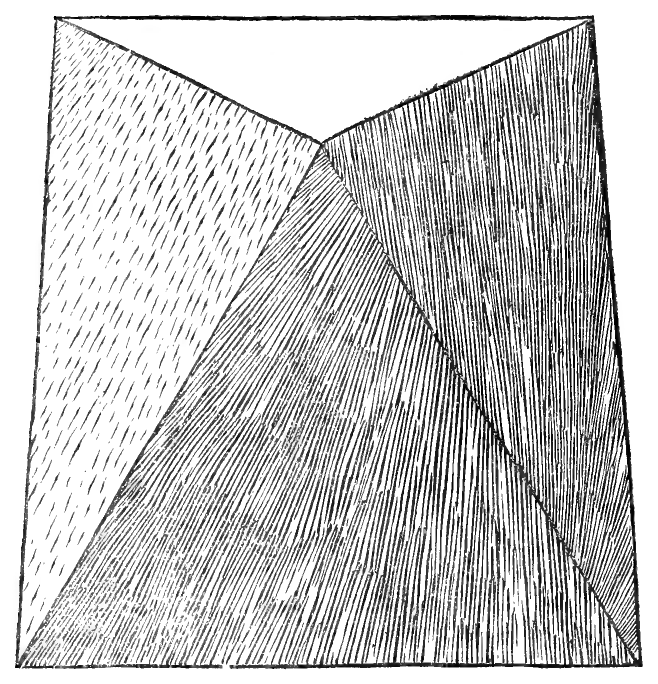
Tabula XV (Folio 0219): Octahedron Planum Solidum¶ |
Detailed codex analysis in Tabulae XV–XVI: Octahedron. Opaque octahedron exhibiting pyramidal face shading. |
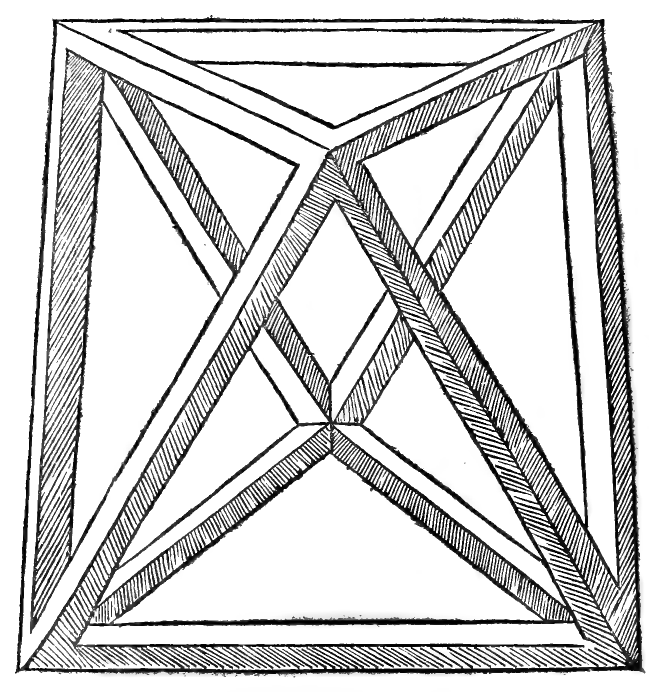
Tabula XVI (Folio 0221): Octahedron Planum Vacuum¶ |
Detailed codex analysis in Tabulae XV–XVI: Octahedron. Open-lattice wooden structure framing internal voids. |
Unfolded 2D Papercraft Net
The regular octahedron unfolds into the Euclidean plane along 5 cut edges into a staggered double-row parallelogram of eight equilateral triangles:
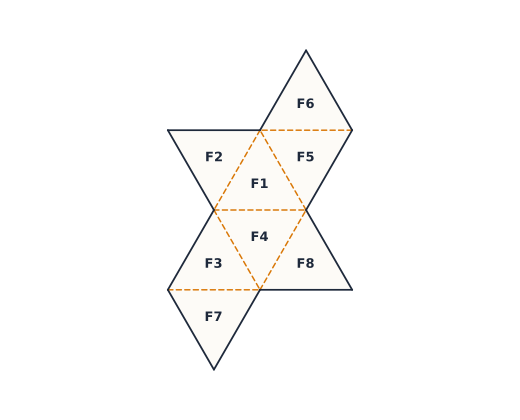
2D Dihedral-Hinge Unfolding: Eight equilateral triangles joined along seven internal hinges (dashed lines) and twelve boundary cut edges (solid lines).
The total surface area is eight times the area of an equilateral triangle: