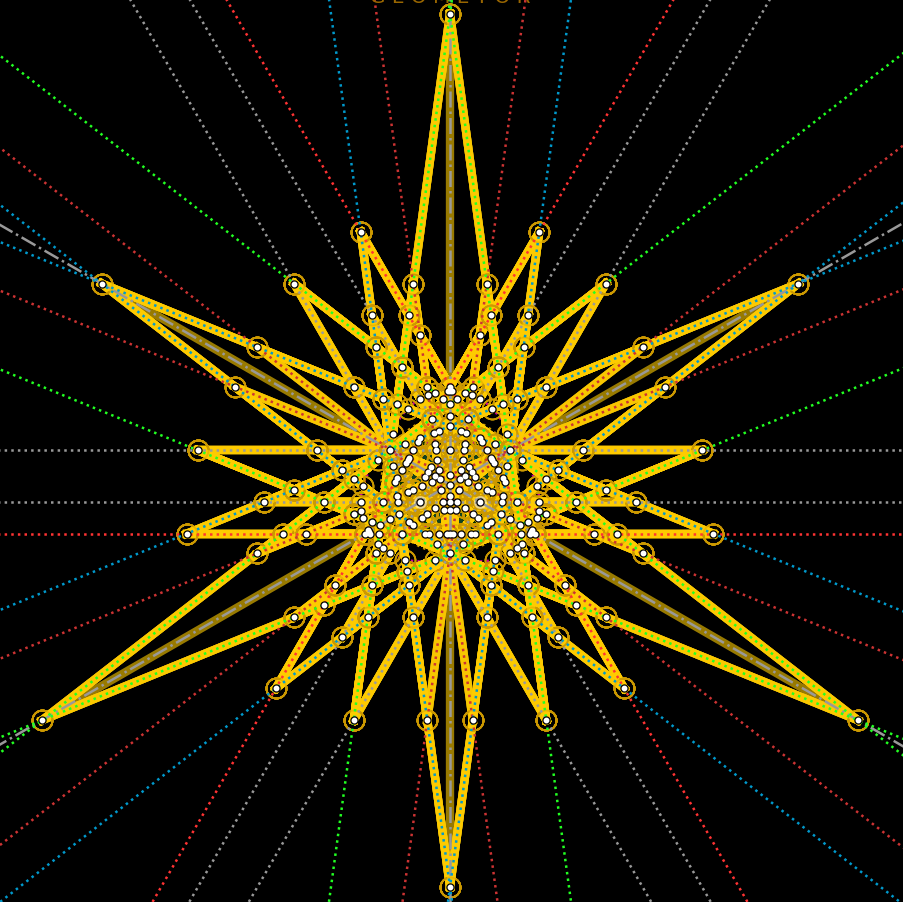
Tabulae LI–LII: Pyramis Penthagona Solida et Vacua (1509)
The Pentagonal Pyramid in Solid and Hollow Perspective by Leonardo da Vinci
Pyramis laterata penthagona solida est corpus sex basibus contentum, quarum una est penthagonalis et quinque sunt triangulares…
The solid five-sided pyramid is a body contained by six bases, of which one is pentagonal and five are triangular…
—Luca Pacioli, De Divina Proportione, Cap. LXV (Venice, 1509)
The Paired Folios: Solidum and Vacuum
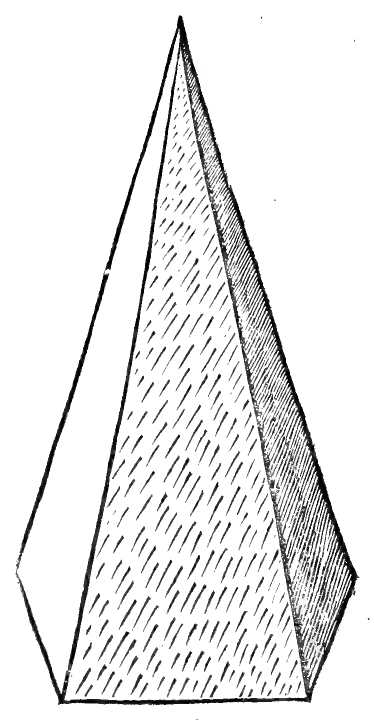
Tabula LI (Folio 0293): Pyramis Laterata Penthagona Solida.¶ |
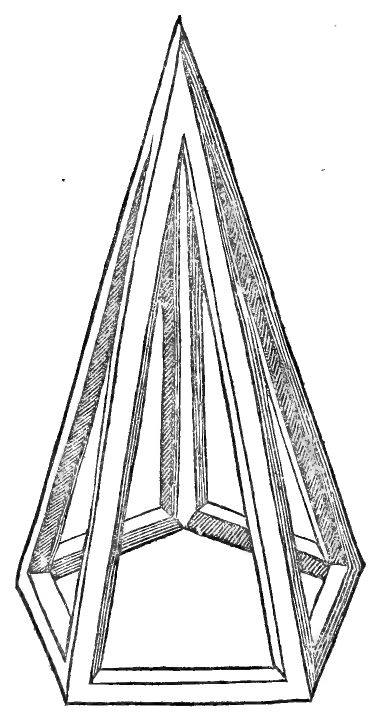
Tabula LII (Folio 0295): Pyramis Laterata Penthagona Vacua (\(g = 5\)).¶ |
The Golden Pyramid & Johnson Solid J₂
When the lateral faces of the pentagonal pyramid are equilateral triangles, the pyramid is an apex cap of the regular icosahedron: removing one vertex and its five incident triangles from a regular icosahedron leaves a pentagonal antiprism, while the removed cap is precisely \(J_2\).
In Tabula LI, Leonardo captures the five-fold symmetry of the converging lateral edges, using cross-hatching to model the sloping surfaces of the equilateral facets.
In Tabula LII, the hollow carpentry lattice creates 6 window openings (1 pentagonal base and 5 triangular roofs) bordered by 10 mitered wooden rails. By the Vacuate Manifold Theorem, this hollow structure forms an orientable surface of topological genus \(g = 5\).
Topological Invariants of the Hollow Framework
By the Vacuate Manifold Theorem, the hollow pentagonal pyramid framework satisfies:
Base Solid Invariants: \(V = 6\), \(E = 10\), \(F = 6\) (1 pentagon, 5 triangles)
Hollow Frame Vertices: \(V_{\text{vac}} = 2V + 4E = 2(6) + 4(10) = 52\)
Hollow Frame Edges: \(E_{\text{vac}} = 12E = 12(10) = 120\)
Hollow Frame Faces: \(F_{\text{vac}} = 6E = 6(10) = 60\) planar trapezoids
Euler Characteristic: \(\chi_{\text{vac}} = 52 - 120 + 60 = -8\)
Topological Genus: \(g = F - 1 = 6 - 1 = 5\)
Coordinate Field: Quadratic extension field \(\mathbb{Q}(\phi)\)
Canonical Solid Codex
For the complete interactive 3D model, exact symbolic coordinates over \(\mathbb{Q}(\phi)\), face normals, and dihedral angles, consult the canonical solid codex: