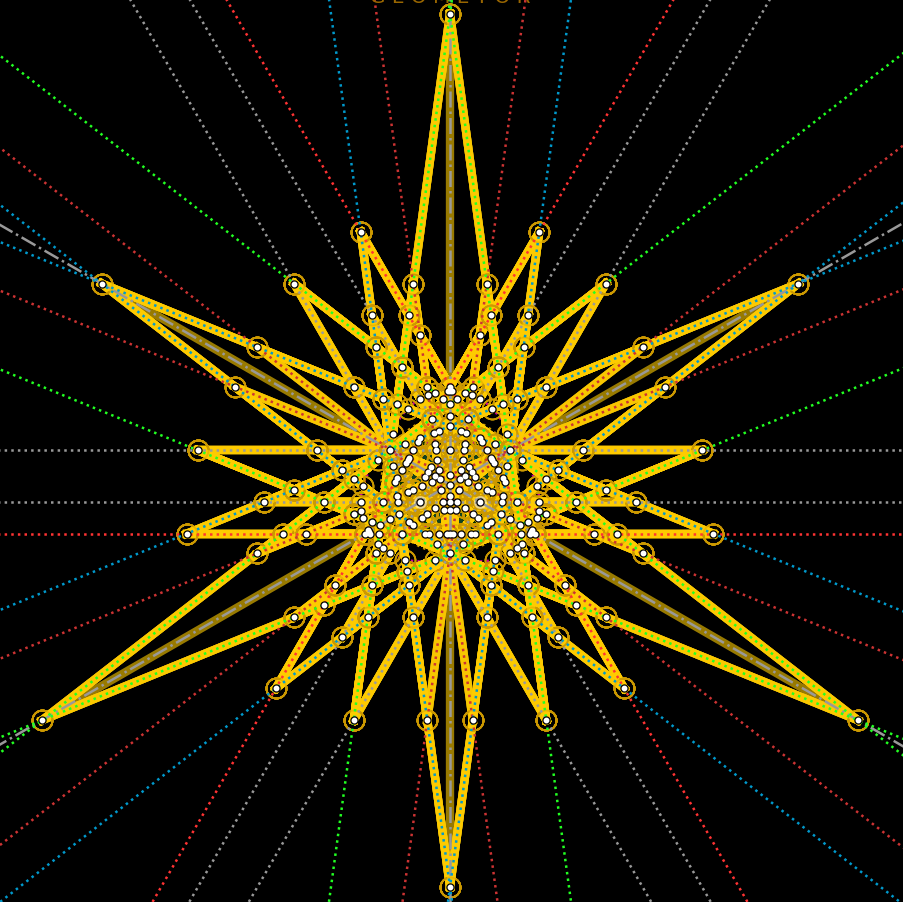
Tabulae XLVII–XLVIII: Pyramis Quadrangula Solida et Vacua (1509)
The Square Pyramid in Solid and Hollow Perspective by Leonardo da Vinci
Pyramis laterata quadrangula solida est corpus quinque basibus contentum, quarum una est quadrata et quatuor sunt triangulares…
The solid four-sided pyramid is a body contained by five bases, of which one is square and four are triangular…
—Luca Pacioli, De Divina Proportione, Cap. LXI (Venice, 1509)
The Paired Folios: Solidum and Vacuum
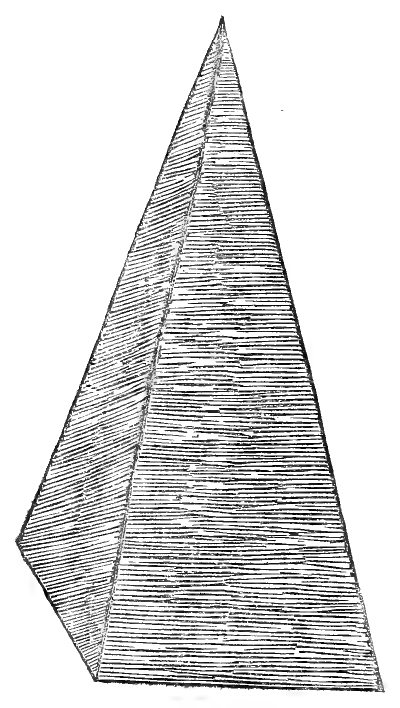
Tabula XLVII (Folio 0283): Pyramis Laterata Quadrangula Solida.¶ |
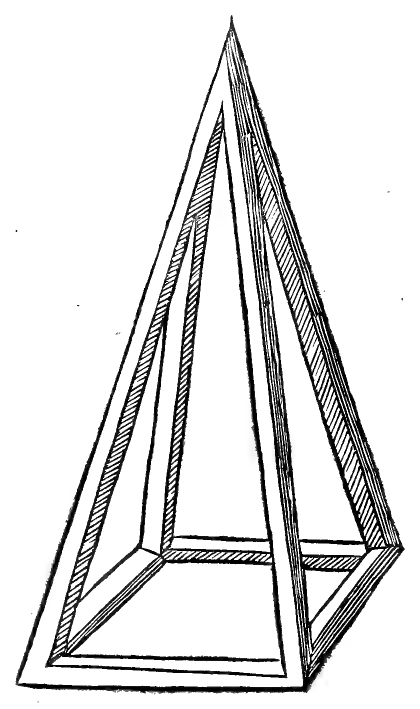
Tabula XLVIII (Folio 0287): Pyramis Laterata Quadrangula Vacua (\(g = 4\)).¶ |
Euclidean Architecture & Monumental Form
In Euclid’s Elements Book XI, the pyramid is defined as a solid figure contained by planes that are constructed from one plane to one point. Across architectural history, the square pyramid is the archetype of monumental geometry, seen in the Old Kingdom Great Pyramid of Giza and in Renaissance obelisk finials.
In Tabula XLVII, Leonardo positions the pyramid so that two lateral triangular faces and the square base are visible, with the apex pointing upward and the shading indicating directional sunlight from the upper left.
In Tabula XLVIII, the hollow carpentry framework strips the solid to reveal 5 window apertures (1 square floor and 4 triangular roofs) framed by 8 mitered wooden beams.
Topological Invariants of the Hollow Framework
By the Vacuate Manifold Theorem, the hollow square pyramid framework satisfies:
Base Solid Invariants: \(V = 5\), \(E = 8\), \(F = 5\) (1 square, 4 triangles)
Hollow Frame Vertices: \(V_{\text{vac}} = 2V + 4E = 2(5) + 4(8) = 42\)
Hollow Frame Edges: \(E_{\text{vac}} = 12E = 12(8) = 96\)
Hollow Frame Faces: \(F_{\text{vac}} = 6E = 6(8) = 48\) planar trapezoids
Euler Characteristic: \(\chi_{\text{vac}} = 42 - 96 + 48 = -6\)
Topological Genus: \(g = F - 1 = 5 - 1 = 4\)
Coordinate Field: Pure rational field \(\mathbb{Q}\) (or \(\mathbb{Q}(\sqrt{\phi})\) for the Kepler Golden Pyramid)
Canonical Solid Codex
For interactive 3D models, exact symbolic coordinates, face normals, and dihedral angles of square pyramids, consult the canonical pyramid codices: