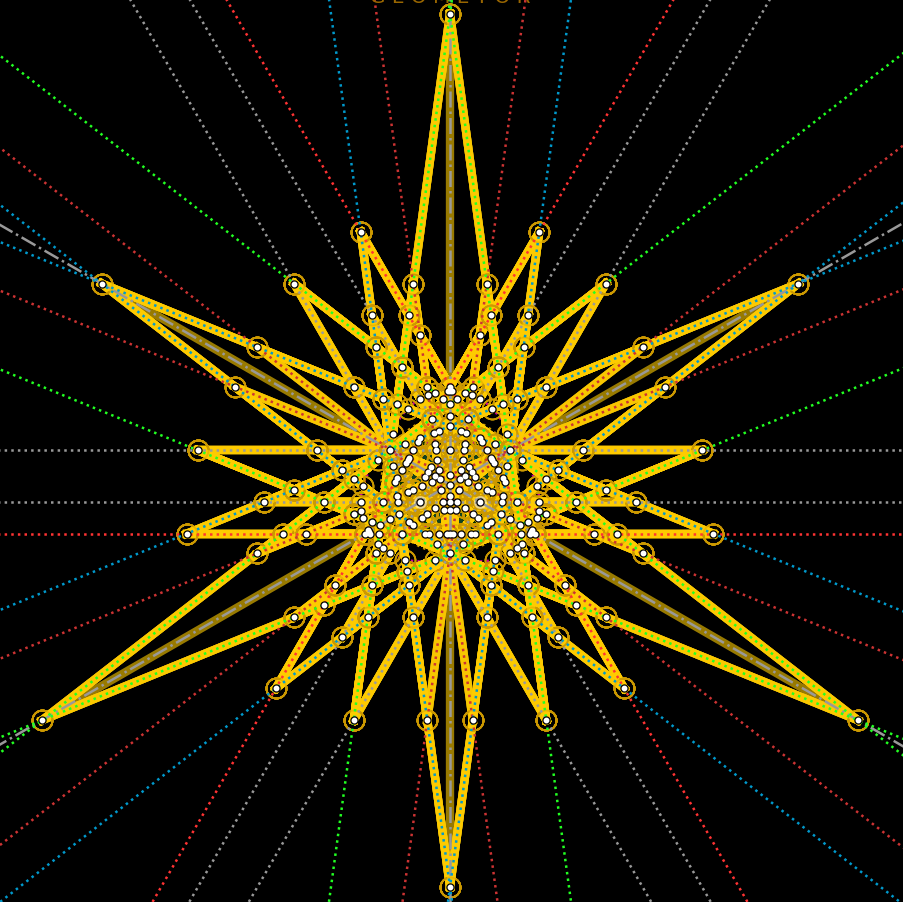
Tabulae XXXIII–XXXIIII: Dodecahedron Abscisum Elevatum Solidum et Vacuum (1509)
The Compound Elevated Icosidodecahedron in Solid and Hollow Perspective by Leonardo da Vinci
Dodecahedron abscisum elevatum solidum est corpus compositum super triginta duabus basibus abscisi dodecahedri habens totidem pyramides erectas…
The solid elevated truncated dodecahedron is a composite body upon the thirty-two bases of the truncated dodecahedron having as many pyramids erected…
—Luca Pacioli, De Divina Proportione, Cap. XLII (Venice, 1509)
The Paired Folios: Solidum and Vacuum
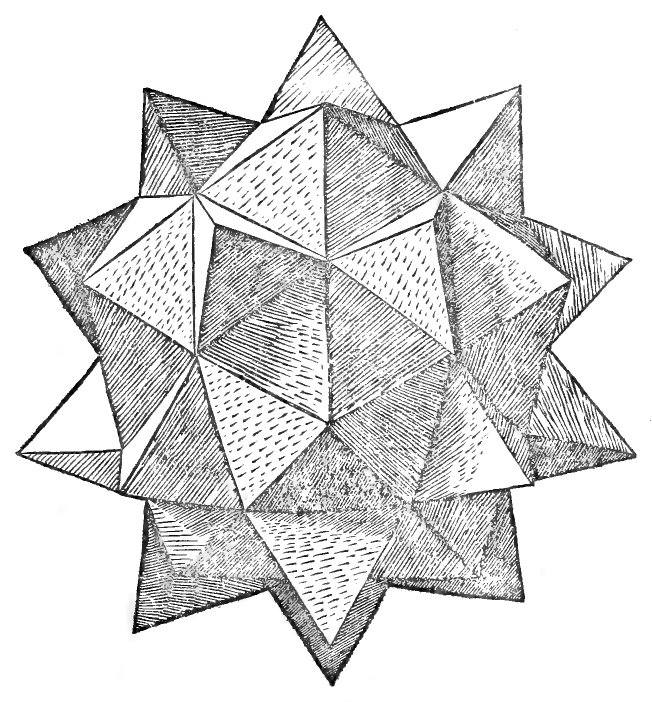
Tabula XXXIII (Folio 0255): Dodecahedron Abscisum Elevatum Solidum.¶ |
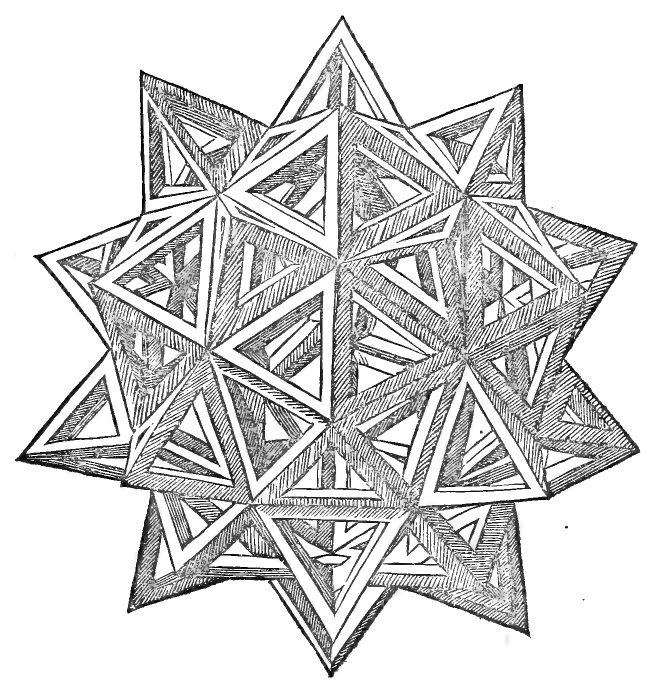
Tabula XXXIIII (Folio 0257): Dodecahedron Abscisum Elevatum Vacuum.¶ |
Monumental Stellation & The Climax of Regular Forms
The icosidodecahedron elevatum represents the most geometrically intricate star polyhedron illustrated in De Divina Proportione.
In Tabula XXXIII, Leonardo balances the shading across 120 triangular facets, maintaining clear volumetric coherence across thirty-two separate pyramidal clusters.
In Tabula XXXIIII, the vacuate model reaches the extreme limit of woodcut perspective illustration: an open carpentry network with 120 triangular window apertures and 180 mitered wooden rails, producing a closed 2-manifold surface of topological genus \(g = 119\).
Topological Invariants of the Hollow Framework
By the Vacuate Manifold Theorem, the hollow compound elevated icosidodecahedron satisfies:
Base Solid Invariants: \(V = 30 + 12 + 20 = 62\), \(E = 60 + 60 + 60 = 180\), \(F = 60 + 60 = 120\) triangular facets
Hollow Frame Vertices: \(V_{\text{vac}} = 2V + 4E = 2(62) + 4(180) = 844\)
Hollow Frame Edges: \(E_{\text{vac}} = 12E = 12(180) = 2160\)
Hollow Frame Faces: \(F_{\text{vac}} = 6E = 6(180) = 1080\) planar trapezoids
Euler Characteristic: \(\chi_{\text{vac}} = 844 - 2160 + 1080 = -236\)
Topological Genus: \(g = F - 1 = 120 - 1 = 119\)
Coordinate Field: Quadratic extension field \(\mathbb{Q}(\phi)\)
Canonical Solid Codex
For the complete interactive 3D model, exact symbolic coordinates over \(\mathbb{Q}(\phi)\), face normals, and dihedral angles, consult the canonical solid codex: