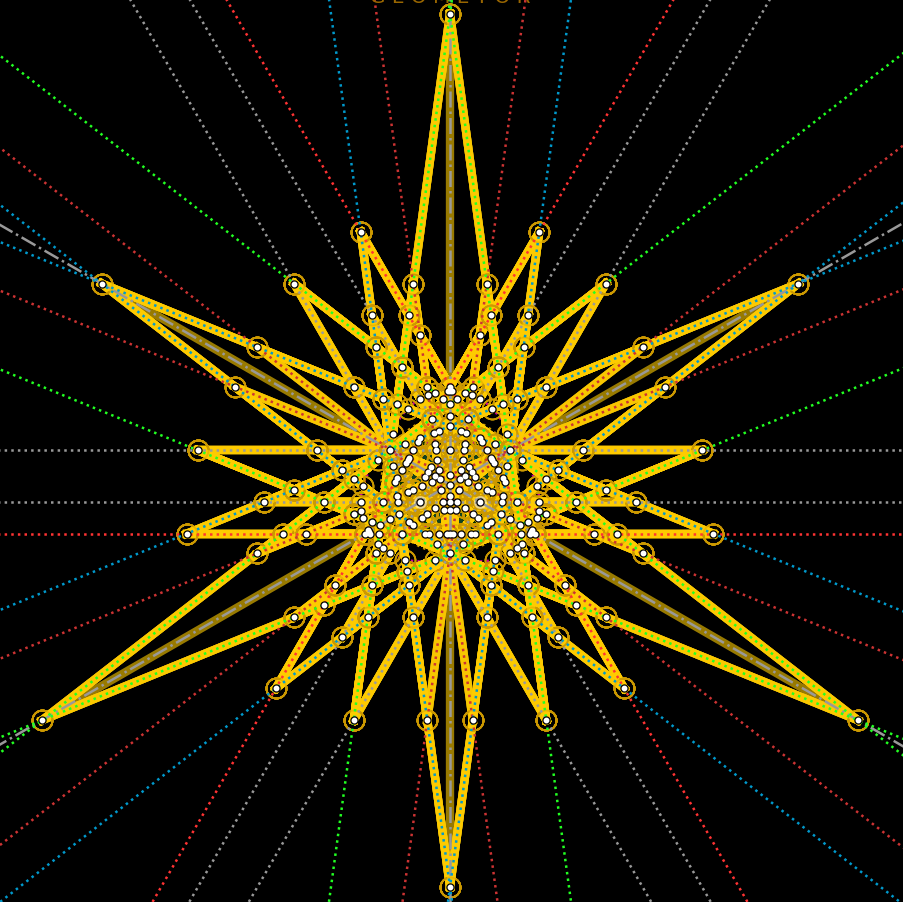
Tabulae XXXI–XXXII: Dodecahedron Elevatum Solidum et Vacuum (1509)
The Pentakis Dodecahedron in Solid and Hollow Perspective by Leonardo da Vinci
Dodecahedron elevatum solidum est quando super qualibet duodecim basium dodecahedri erigitur una pyramis pentagonalis…
The solid elevated dodecahedron is when upon each of the twelve bases of the dodecahedron a pentagonal pyramid is erected…
—Luca Pacioli, De Divina Proportione, Cap. XLI (Venice, 1509)
The Paired Folios: Solidum and Vacuum
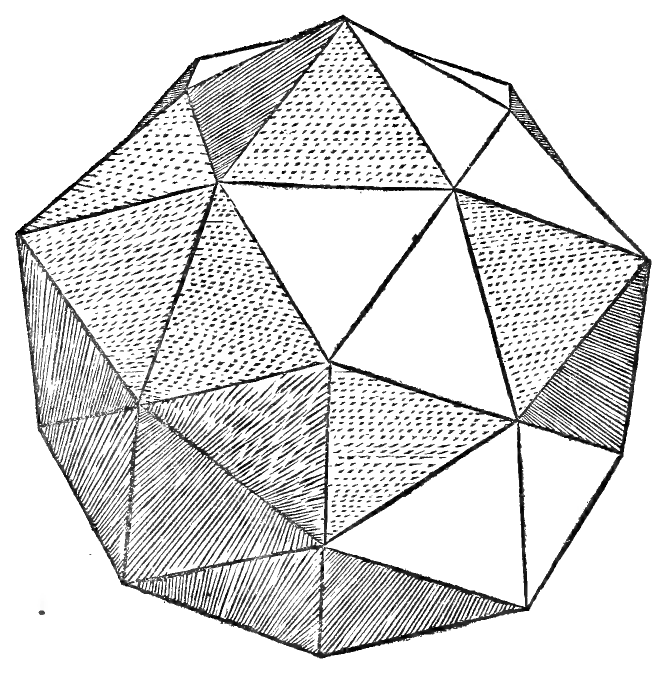
Tabula XXXI (Folio 0251): Dodecahedron Elevatum Solidum.¶ |
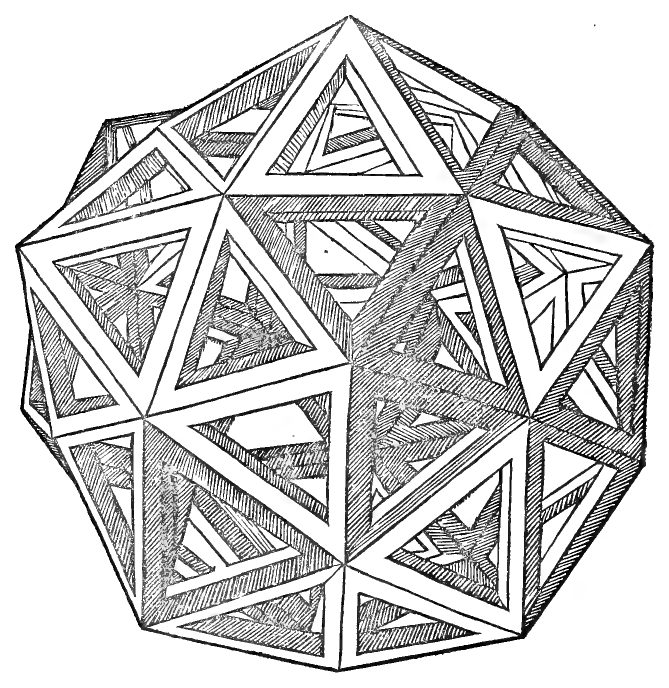
Tabula XXXII (Folio 0253): Dodecahedron Elevatum Vacuum.¶ |
Pentagonal Stellation & Geometrical Harmony
The pentakis dodecahedron represents the stellation of the dodecahedron and the Catalan dual of the truncated icosahedron (the fullerene dual).
In Tabula XXXI, Leonardo conveys the 12 radiating pyramidal clusters with dramatic chiaroscuro modeling, emphasizing the relief of each pentagonal roof.
In Tabula XXXII, the hollow vacuate framework features 60 triangular window apertures bordered by 90 mitered wooden rails. The complex network of converging lines illustrates the highest level of Renaissance perspective drawing, producing an open wooden cage of topological genus \(g = 59\).
Topological Invariants of the Hollow Framework
By the Vacuate Manifold Theorem, the hollow elevated dodecahedron framework satisfies:
Base Solid Invariants: \(V = 32\), \(E = 60\), \(F = 60\) triangular facets
Hollow Frame Vertices: \(V_{\text{vac}} = 2V + 4E = 2(32) + 4(60) = 304\)
Hollow Frame Edges: \(E_{\text{vac}} = 12E = 12(60) = 720\)
Hollow Frame Faces: \(F_{\text{vac}} = 6E = 6(60) = 360\) planar trapezoids
Euler Characteristic: \(\chi_{\text{vac}} = 304 - 720 + 360 = -56\)
Topological Genus: \(g = F - 1 = 60 - 1 = 59\)
Coordinate Field: Quadratic extension field \(\mathbb{Q}(\phi)\)
Canonical Solid Codex
For the complete interactive 3D model, exact symbolic coordinates over \(\mathbb{Q}(\phi)\), face normals, and dihedral angles, consult the canonical solid codex: