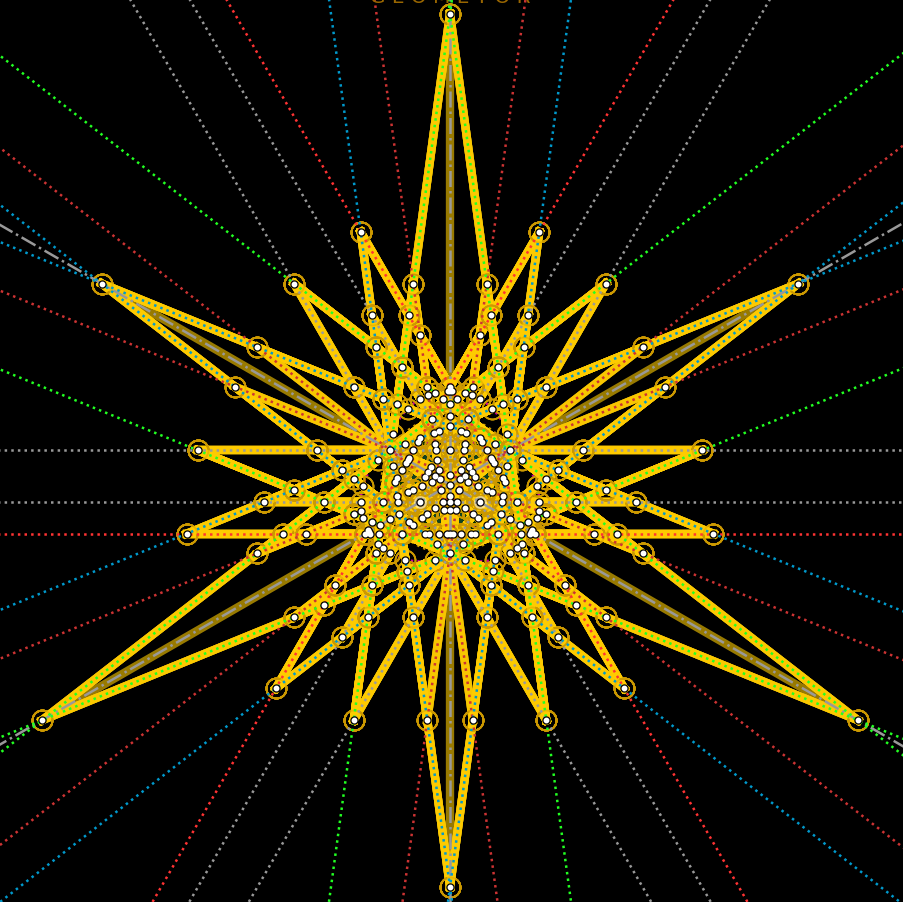
Tabulae III–IIII: Tetrahedron Abscisum Solidum et Vacuum (1509)
The Truncated Tetrahedron in Solid and Hollow Perspective by Leonardo da Vinci
Tetrahedron abscisum solidum est quando a quolibet angulo tetrahedri abscinditur portio unius tertiae partis uniuscuiusque lateris…
The solid truncated tetrahedron is when from each angle of the tetrahedron a portion of one-third part of each edge is cut away…
—Luca Pacioli, De Divina Proportione, Cap. XXVII (Venice, 1509)
The Paired Folios: Solidum and Vacuum
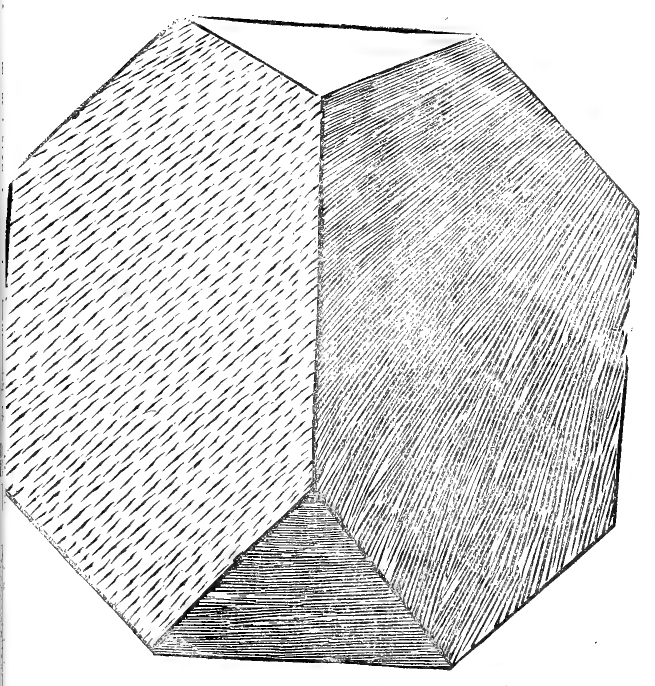
Tabula III (Folio 0191): Tetrahedron Abscisum Solidum.¶ |
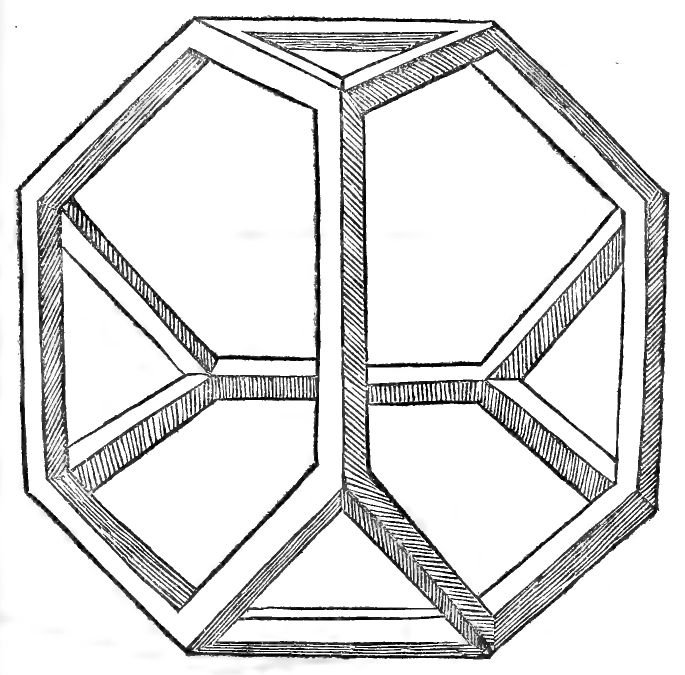
Tabula IIII (Folio 0193): Tetrahedron Abscisum Vacuum.¶ |
Archimedean Truncation & Wooden Carpentry
The truncated tetrahedron represents the simplest Archimedean semi-regular solid. In Pacioli’s Latin nomenclature, truncation is termed abscisio (from abscindere, to cut off).
In Tabula III, Leonardo renders the eight faces with clear textural differentiation: the hexagonal faces retain their broad diagonal hatching, while the smaller triangular corner facets present subtle chiaroscuro gradations.
In Tabula IIII, the hollow carpentry lattice creates a through-hole at every face: 4 triangular windows and 4 hexagonal windows. Looking through any hexagonal aperture reveals the inner faces of opposite wooden frame members.
Topological Invariants of the Hollow Framework
By the Vacuate Manifold Theorem, the hollow lattice satisfies:
Base Solid Invariants: \(V = 12\), \(E = 18\), \(F = 8\) (4 triangles, 4 hexagons)
Hollow Frame Vertices: \(V_{\text{vac}} = 2V + 4E = 2(12) + 4(18) = 96\)
Hollow Frame Edges: \(E_{\text{vac}} = 12E = 12(18) = 216\)
Hollow Frame Faces: \(F_{\text{vac}} = 6E = 6(18) = 108\) planar trapezoids
Euler Characteristic: \(\chi_{\text{vac}} = 96 - 216 + 108 = -12\)
Topological Genus: \(g = F - 1 = 8 - 1 = 7\)
Coordinate Field: Pure rational field \(\mathbb{Q}\)
Canonical Solid Codex
For the complete interactive 3D model, exact symbolic coordinates over \(\mathbb{Q}\), face normals, and dihedral angles, consult the canonical solid codex: