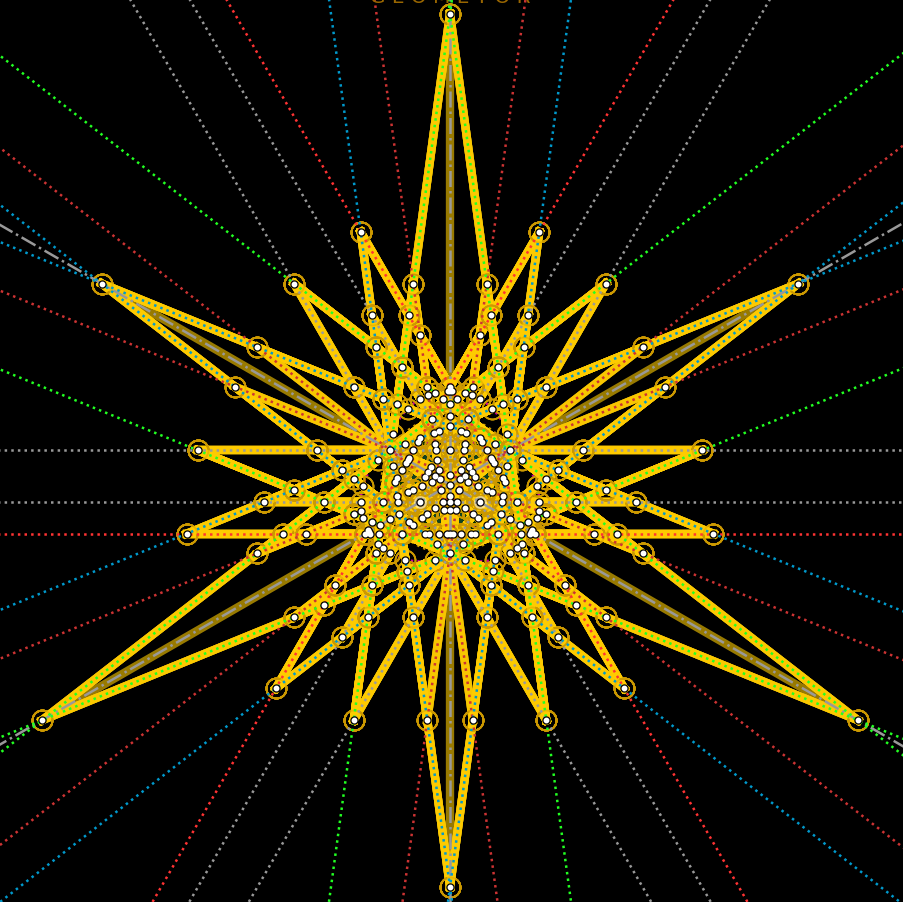
P-05 · Canonical Pyramids & Bipyramids
Herodotus’s Golden Triangle · Egyptian Seked 14:11 · Kepler Harmonics & Johnson Caps
Quae proportio, aequalis divisioni media et extrema ratione, in pyramidem quadratam translata, efficit ut quadratum altitudinis aequale sit areae uniuscuiusque trianguli.
Which proportion, equivalent to the division in extreme and mean ratio, when transferred to a square pyramid, causes the square of the altitude to equal the area of each triangular face.
—Johannes Kepler, Epistola ad Mästlinum (Tübingen, 1597)
Architectural Profiles and Rational Trigonometry
Unlike general polyhedra, pyramids are oriented manifolds defined by a polygonal base in a reference plane and an apex point at perpendicular altitude \(h\). The GEOMETOR architecture formulates their geometry through exact Rational Trigonometry:
Base Edge Quadrance (:math:`Q_b`): Squared base side length \(s^2\).
Slant Edge Quadrance (:math:`Q_e`): Squared distance from apex to base vertex \(h^2 + r_{\text{base}}^2\).
Slope Spread (:math:`S_{text{slope}}`): The squared sine of the face inclination:
\[S_{\text{slope}} = \frac{h^2}{h^2 + b^2}\]Primary Dihedral Spread (:math:`S_{text{dihedral}}`): The exact spread between adjacent triangular faces meeting at a lateral hip edge.
The Four Canonical Pyramids
The Kepler Golden Pyramid (P-05.01): Conceived by Johannes Kepler in 1597 and historically identified with Herodotus’s account of the Great Pyramid (Histories II.124). Its cross-section is the Kepler right triangle with side ratio \(1 : \sqrt{\phi} : \phi\). The altitude squared equals the area of each lateral triangular face: \(h^2 = (\sqrt{\phi})^2 = \phi = \text{Area}(\triangle)\). Its number field is the radical tower \(\mathbb{Q}(\sqrt{\phi})\).
The Egyptian Seked 14:11 Pyramid (P-05.02): The empirical architectural profile of the Great Pyramid of Giza (Khufu), documented in the Rhind Mathematical Papyrus (Problem 56) with a seked of \(5 \frac{1}{2}\) palms (rise 14, run 11). This strictly rational profile (\(\mathbb{Q}\)) achieves the classical quadrature of the circle: the perimeter of the base \(4 \times 2 = 8\) equals the circumference of a circle of radius \(h = \frac{14}{11}\) under the Archimedean approximation \(\pi \approx \frac{22}{7}\):
\[2 \pi h = 2 \times \frac{22}{7} \times \frac{14}{11} = 8 = \text{Perimeter}_{\text{base}}\]The Golden Square Bipyramid (P-05.03): Formed by reflecting the Kepler Golden Pyramid across its square base, creating an 8-face octahedral double pyramid with \(D_{4h}\) symmetry. It preserves Kepler’s primary dihedral spread \(3\phi - 4\) across all 12 edges.
The Regular Pentagonal Pyramid (Johnson J2, P-05.04): The equilateral pentagonal pyramid comprising 1 regular pentagon and 5 equilateral triangles. Cataloged by Norman Johnson (1966) as solid \(J_2\), it is the 6-vertex cap severed from the regular icosahedron in Euclid Elements XIII.16. Its 6 vertices embed directly in \(\mathbb{Z}[\phi]\) on the cutting plane \(y + \phi z = \phi\).