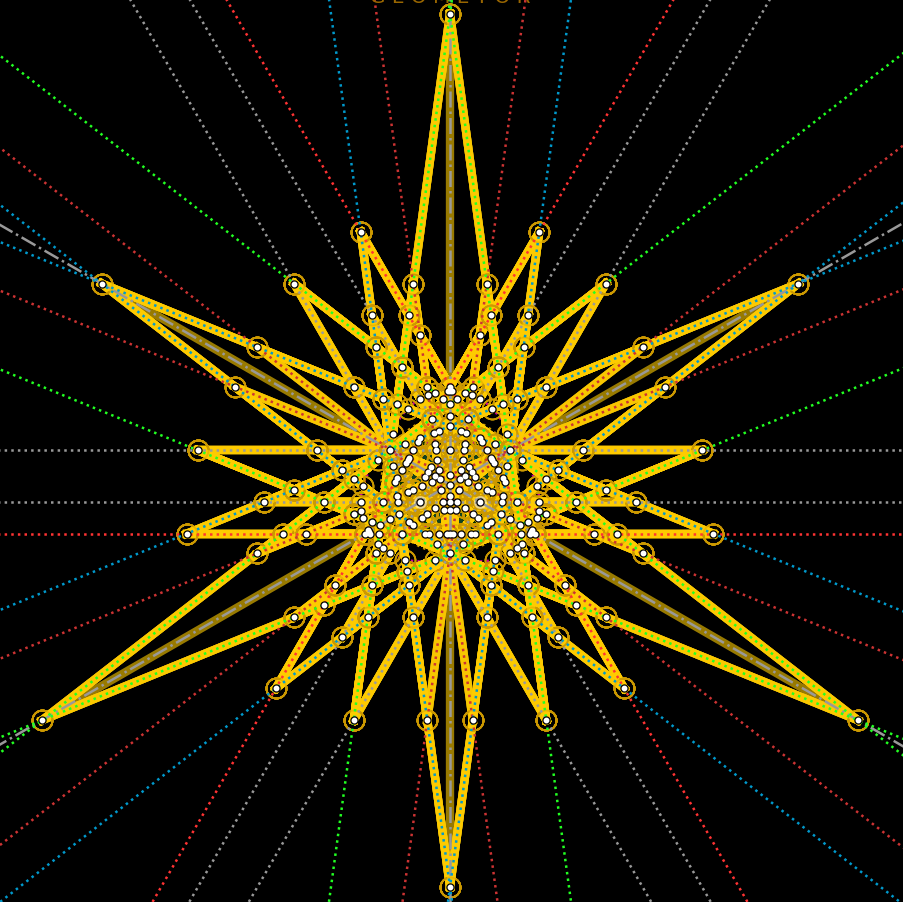
P-04 · Elevated Solids (Corpora Elevata)
Renaissance Stellations of Plato and Archimedes by Luca Pacioli & Leonardo da Vinci
Corpus elevatum dicitur quando super qualibet eius basi erigitur una pyramis… quae quidem pyramides omnes eiusdem altitudinis existunt et bases aequales habent.
An elevated body is said to be formed when upon each of its bases a pyramid is erected… which pyramids all exist of the same height and have equal bases.
—Luca Pacioli, De Divina Proportione, Cap. XXVIII (Venice, 1509)
The Renaissance Elevation Operator (Elevatio)
In constructive geometry, the elevation operator \(\operatorname{elevate}(S)\) erects a right pyramid of altitude \(h_k\) upon each \(k\)-gonal face of a base polyhedron \(S\) with edge length \(s\). To ensure that every lateral face of the erected pyramid forms an equilateral triangle of edge length \(s\), the pyramid altitude \(h_k\) must satisfy the exact Pythagorean relation:
where \(r_k = \frac{s}{2 \sin(\pi/k)}\) is the circumradius of the regular \(k\)-gon. For the regular faces encountered in Platonic and Archimedean solids:
Triangular Faces (:math:`k=3`): \(r_3 = \frac{s}{\sqrt{3}} \implies h_3 = s \sqrt{1 - \frac{1}{3}} = s \frac{\sqrt{6}}{3}\)
Square Faces (:math:`k=4`): \(r_4 = \frac{s}{\sqrt{2}} \implies h_4 = s \sqrt{1 - \frac{1}{2}} = s \frac{\sqrt{2}}{2}\)
Pentagonal Faces (:math:`k=5`): \(r_5 = \frac{s}{\sqrt{5 - \sqrt{5}}} \implies h_5 = s \sqrt{\frac{5 - \sqrt{5}}{10}}\)
Radical Cancellation & Algebraic Collapse (\(\mathbb{Z}\) and \(\mathbb{Q}\))
Remarkably, although the altitude formulas involve square roots, the resulting 3D coordinates undergo profound algebraic collapses:
Stella Octangula (Octahedron Elevatum, P-04.03): When equilateral pyramids of altitude \(h_3 = \frac{2}{\sqrt{6}}\) are erected on the 8 triangular faces of a regular octahedron with edge \(\sqrt{2}\), the apex displacement along the face normal \(\mathbf{n} = (\pm 1, \pm 1, \pm 1)\) cancels all square roots:
\[\mathbf{apex} = \mathbf{c}_f + \frac{h_3}{\|\mathbf{n}\|} \mathbf{n} = \left(\frac{1}{3}, \frac{1}{3}, \frac{1}{3}\right) + \frac{2}{3}(1, 1, 1) = (1, 1, 1) \in \mathbb{Z}^3\]The 8 apices together form the 8 integer vertices of a cube \((\pm 1, \pm 1, \pm 1)\). The resulting manifold is the Stella Octangula, the regular compound of two dual tetrahedra, living entirely in the integer ring \(\mathbb{Z}\)!
Tetrahedron Elevatum (P-04.01): Erecting pyramids on the 4 faces of a regular tetrahedron of edge \(\sqrt{8}\) produces 4 apices at \(\left(\pm \frac{5}{3}, \pm \frac{5}{3}, \pm \frac{5}{3}\right)\). All 8 vertices lie strictly in the rational field \(\mathbb{Q}\).
Cuboctahedron Elevatum (P-04.06): Erecting equilateral pyramids on the 8 triangular faces and 6 square faces of the Archimedean cuboctahedron generates apices at \(\left(\pm \frac{4}{3}, \pm \frac{4}{3}, \pm \frac{4}{3}\right)\) and \((\pm 2, 0, 0)\), placing the entire 26-vertex manifold within \(\mathbb{Q}\)!
Leonardo da Vinci’s Paired 1509 Woodcuts
In De Divina Proportione, Leonardo da Vinci illustrated each elevated body twice: first as a solid form (Solidum) featuring intricate chiaroscuro perspective and cast shadows, and second as a hollow framework (Corpus Vacuum) carved from mitered wooden beams. The hollow lattice framework reveals the internal polyhedral cavity while increasing the topological genus to \(g = F - 1\).