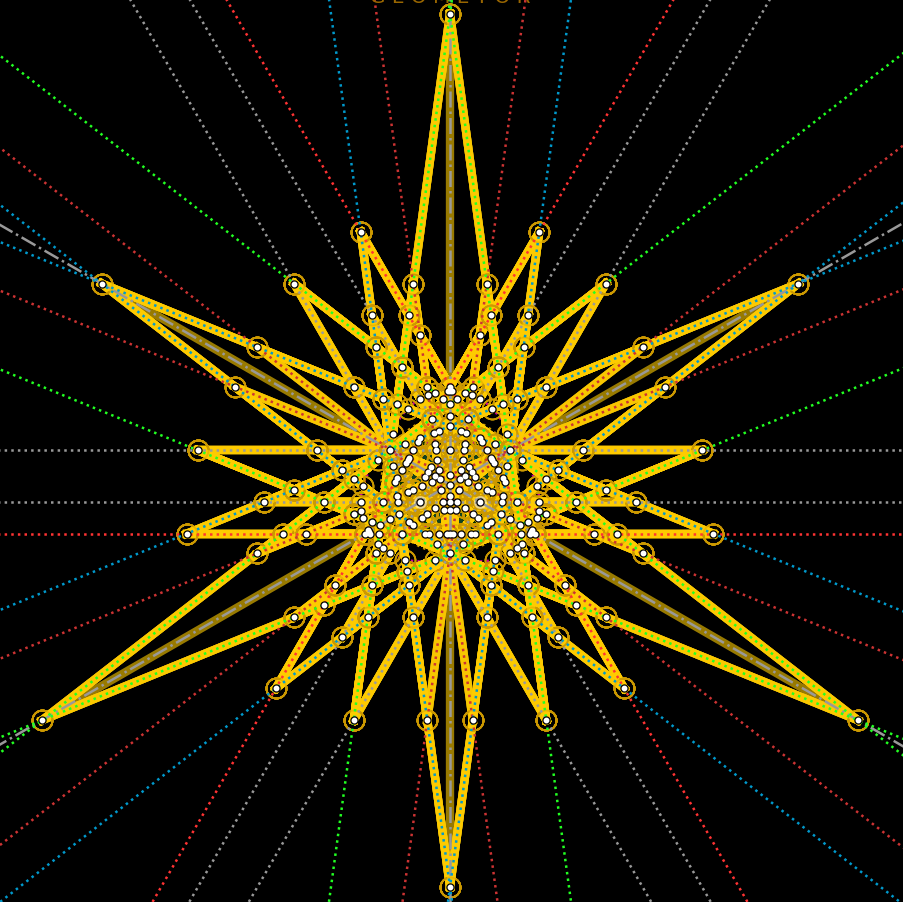
P-01 · The Five Platonic Solids
Euclidean Book XIII Constructions · Golden Ratio Coordinates · 3D Rational Trigonometry
No other figure can be constructed from equilateral and equiangular plane figures, except these five solids alone.
—Euclid of Alexandria, Elements Book XIII, Proposition 18a (Porism)
Quinque corpora regularia sunt: tetraedron, exaedron sive cubus, octaedron, icosaedron, et dodecaedron. Quorum quodlibet intra sphaeram comprehendi potest.
There are five regular solids: the tetrahedron, hexahedron or cube, octahedron, icosahedron, and dodecahedron. Every one of them can be comprehended within a sphere.
—Luca Pacioli, De Divina Proportione, Cap. I (Venice, 1509)
Axiomatic Foundation & Euclidean Canon
In Book XIII of the Elements, Euclid constructs the five regular convex polyhedra inside a given sphere and proves in the celebrated Porism to Proposition XIII.18 that no more than five regular convex solids can exist in Euclidean 3-space:
Proposition XIII.13 (G-Index:
G.592): Construction of the regular Tetrahedron inside a sphere (\(D^2 = \frac{3}{2} S^2\)).Proposition XIII.14 (G-Index:
G.594): Construction of the regular Octahedron inside a sphere (\(D^2 = 2 S^2\)).Proposition XIII.15 (G-Index:
G.595): Construction of the regular Hexahedron (Cube) inside a sphere (\(D^2 = 3 S^2\)).Proposition XIII.16 (G-Index:
G.597): Construction of the regular Icosahedron inside a sphere (\(S = \text{minor}\)).Proposition XIII.17 (G-Index:
G.600): Construction of the regular Dodecahedron inside a sphere (\(S = \text{apotome}\)).
In the GEOMETOR formulation, these five solids are modeled with zero floating-point numbers over the rational integer ring \(\mathbb{Z}\) and the golden algebraic field \(\mathbb{Q}(\phi)\), where \(\phi = \frac{1 + \sqrt{5}}{2}\) satisfies the canonical quadratic minimal polynomial \(\phi^2 - \phi - 1 = 0\).
Comparative Synthesis Ledger
Solid |
Greek |
Latin |
Element |
$\{p, q\}$ |
$V$ |
$E$ |
$F$ |
Spread $s$ |
$Q_{\text{in}} / Q_{\text{out}}$ |
Dual |
Vacuum $\chi, g$ |
|---|---|---|---|---|---|---|---|---|---|---|---|
Τετράεδρον |
Tetrahedron |
Fire |
$\{3, 3\}$ |
4 |
6 |
4 |
$8/9$ |
$1/9$ |
Self-dual |
$\chi = -4, g = 3$ |
|
Ἑξάεδρον |
Exahedron |
Earth |
$\{4, 3\}$ |
8 |
12 |
6 |
$1$ |
$1/3$ |
Octahedron |
$\chi = -8, g = 5$ |
|
Ὀκτάεδρον |
Octahedron |
Air |
$\{3, 4\}$ |
6 |
12 |
8 |
$8/9$ |
$1/3$ |
Hexahedron |
$\chi = -12, g = 7$ |
|
Εἰκοσάεδρον |
Icosahedron |
Water |
$\{3, 5\}$ |
12 |
30 |
20 |
$4/9$ |
$\frac{4\phi+3}{15}$ |
Dodecahedron |
$\chi = -36, g = 19$ |
|
Δωδεκάεδρον |
Dodecahedron |
Aether |
$\{5, 3\}$ |
20 |
30 |
12 |
$4/5$ |
$\frac{4\phi+3}{15}$ |
Icosahedron |
$\chi = -20, g = 11$ |
3D Rational Trigonometry Dihedral Spread Proof
In Norman Wildberger’s Rational Trigonometry, angles between intersecting planes are replaced by the planar spread \(s = \sin^2\theta\). Given two adjacent planar faces with unnormalized outward normal vectors \(n_1\) and \(n_2\), the spread is computed algebraically without transcendental trigonometric functions:
where \(Q(v) = v_x^2 + v_y^2 + v_z^2\) denotes the 3D vector quadrance.
A universal consequence of regular polyhedral geometry is that the dihedral spread of every Platonic solid is an exact rational number in \(\mathbb{Q}\):
Tetrahedron Dihedral Spread Proof
Let \(F_0 = (V_0, V_1, V_2)\) and \(F_1 = (V_0, V_3, V_1)\) with normal vectors \(n_0 = (1, 1, -1)\) and \(n_1 = (1, -1, 1)\).
Hexahedron (Cube) Dihedral Spread Proof
Adjacent square faces meet along Cartesian axes with normal vectors \(n_0 = (1, 0, 0)\) and \(n_2 = (0, 1, 0)\).
Octahedron Dihedral Spread Proof
Adjacent triangular faces have outward normals \(n_0 = (1, 1, 1)\) and \(n_1 = (1, -1, 1)\).
Note
The Tetrahedron and Octahedron share the exact same dihedral spread \(s = 8/9\), reflecting their mutual participation in the face-centered cubic lattice!
Icosahedron Dihedral Spread Proof
The outward normals to two adjacent equilateral triangular faces in golden coordinates satisfy \(\cos\theta = -\frac{\sqrt{5}}{3}\).
Dodecahedron Dihedral Spread Proof
The outward normals to two adjacent regular pentagonal faces satisfy \(\cos\theta = -\frac{1}{\sqrt{5}}\).
Polar Duality and Symmetry Groups
The five Platonic solids partition into three reflexive duality pairs governed by finite subgroups of \(O(3)\):
Self-Duality (:math:`T_d` Symmetry, Order 24): The Tetrahedron is self-dual (\(\{3, 3\}^* = \{3, 3\}\)). Connecting the four face centroids yields an inverted regular tetrahedron of edge quadrance \(Q = 8/9\).
Cubic Duality (:math:`O_h` Symmetry, Order 48): The Hexahedron (Cube) \(\{4, 3\}\) and the Octahedron \(\{3, 4\}\) are polar duals. The six face centroids of the cube form the vertices of an inscribed regular octahedron, and the eight face centroids of an octahedron form the vertices of an inscribed cube.
Icosahedral Duality (:math:`I_h` Symmetry, Order 120): The Icosahedron \(\{3, 5\}\) and the Dodecahedron \(\{5, 3\}\) are polar duals. The twelve face centroids of the dodecahedron form a regular icosahedron, and the twenty face centroids of the icosahedron form a regular dodecahedron. Both solids share the exact same inquadrance-to-circumquadrance ratio:
\[\frac{Q_{\text{in}}}{Q_{\text{out}}} = \frac{4\phi + 3}{15} = \frac{5 + 2\sqrt{5}}{15}\]
Leonardo da Vinci’s Structural Variations (1509)
In Luca Pacioli’s De Divina Proportione (1509), Leonardo da Vinci introduced four principal architectural variations for every regular solid:
Planum Solidum: An opaque body with solid planar facets, shaded with Renaissance woodcut hatching indicating a single upper-left light source (luce primaria).
Planum Vacuum: A hollow wooden armillary framework of beam width parameter \(\mu\), opening the faces to reveal internal spatial structure, opposite vertices, and dihedral joinery.
Abscisum (Truncatum): Vertices are cut off perpendicular to their radial vectors, yielding Archimedean semi-regular polyhedra.
Elevatum (Stellatum): Regular polygonal pyramids are erected on each face, producing Keplerian star polyhedra and triacontahedra.