X.115
From a medial straight line there arise irrational straight lines infinite in number, and none of them is the same as any of the preceding.
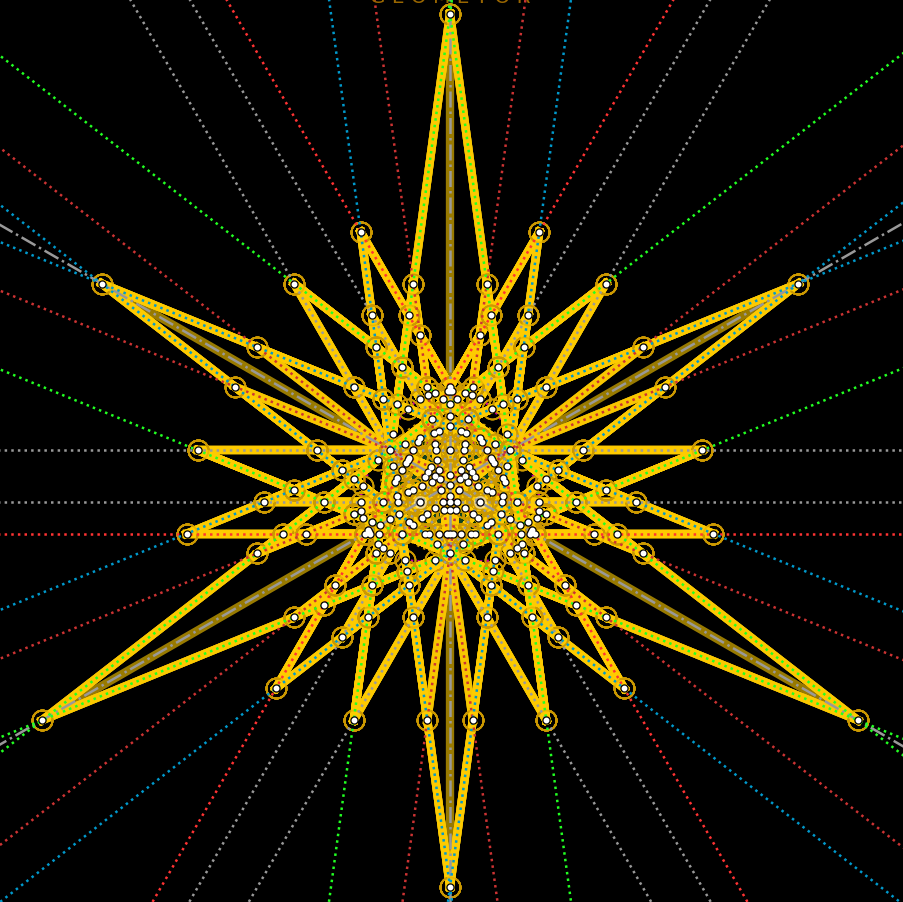
From a medial straight line there arise irrational straight lines infinite in number, and none of them is the same as any of the preceding.
- If an area be contained by an apotome and the binomial straight line the terms of which are commensurable with the terms of the apotome and in the same ratio, the side
of the area is rational.
The square on a rational straight line, if applied to an apotome, produces as, breadth the binomial straight line the terms of which are commensurable with the terms of the apotome and in the same ratio; and further the binomial so arising has the same order as the apotome.
The square on a rational straight line applied to the binomial straight line produces as breadth an apotome the terms of which are commensurable with the terms of the binomial and moreover in the same ratio; and further the apotome so arising will have the same order as the binomial straight line.
The apotome is not the same with the binomial straight line.
If from a medial area there be subtracted a medial area incommensurable with the whole, the two remaining irrational straight lines arise, either a second apotome of a medial straight line or a straight line which produces with a medial area a medial whole.
If from a medial area a rational area be subtracted, there arise two other irrational straight lines, either a first apotome of a medial straight line or a straight line which produces with a rational area a medial whole.
- If from a rational area a medial area be subtracted, the side
of the remaining area becomes one of two irrational straight lines, either an apotome or a minor straight line.
A straight line commensurable with that which produces with a medial area a medial whole is itself also a straight line which produces with a medial area a medial whole.
A straight line commensurable with that which produces with a rational area a medial whole is a straight line which produces with a rational area a medial whole.
A straight line commensurable with a minor straight line is minor.
A straight line commensurable with an apotome of a medial straight line is an apotome of a medial straight line and the same in order.
A straight line commensurable in length with an apotome is an apotome and the same in order.
The square on the straight line which produces with a medial area a medial whole, if applied to a rational straight line, produces as breadth a sixth apotome.
The square on the straight line which produces with a rational area a medial whole, if applied to a rational straight line, produces as breadth a fifth apotome.
The square on a minor straight line applied to a rational straight line produces as breadth a fourth apotome.
The square on a second apotome of a medial straight line applied to a rational straight line produces as breadth a third apotome.
The square on a first apotome of a medial straight line applied to a rational straight line produces as breadth a second apotome.
The square on an apotome applied to a rational straight line produces as breadth a first apotome.
- If an area be contained by a rational straight line and a sixth apotome, the side
of the area is a straight line which produces with a medial area a medial whole.
- If an area be contained by a rational straight line and a fifth apotome, the side
of the area is a straight line which produces with a rational area a medial whole.
- If an area be contained by a rational straight line and a fourth apotome, the side
of the area is minor.
- If an area be contained by a rational straight line and a third apotome, the side
of the area is a second apotome of a medial straight line.
- If an area be contained by a rational straight line and a second apotome, the side
of the area is a first apotome of a medial straight line.
- If an area be contained by a rational straight line and a first apotome, the side
of the area is an apotome.
Again, if the square on the whole be greater than the square on the annex by the square on a straight line incommensurable with the whole, then, if the whole be commensurable in length with the rational straight line set out, let the apotome be called a fourth apotome;
But if neither be commensurable in length with the rational straight line set out, and the square on the whole be greater than the square on the annex by the square on a straight line commensurable with the whole, let the apotome be called a third apotome.
But if the annex be commensurable in length with the rational straight line set out, and the square on the whole be greater than that on the annex by the square on a straight line commensurable with the whole, let the apotome be called a second apotome.
Given a rational straight line and an apotome, if the square on the whole be greater than the square on the annex by the square on a straight line commensurable in length with the whole, and the whole be commensurable in length with the rational straight line set out, let the apotome be called a first apotome.
To a straight line which produces with a medial area a medial whole only one straight line can be annexed which is incommensurable in square with the whole straight line and which with the whole straight line makes the sum of the squares on them medial and twice the rectangle contained by them both medial and also incommensurable with the sum of the squares on them.
To a straight line which produces with a rational area a medial whole only one straight line can be annexed which is incommensurable in square with the whole straight line and which with the whole straight line makes the sum of the squares on them medial, but twice the rectangle contained by them rational.
To a minor straight line only one straight line can be annexed which is incommensurable in square with the whole and which makes, with the whole, the sum of the squares on them rational but twice the rectangle contained by them medial.
To a second apotome of a medial straight line only one medial straight line can be annexed which is commensurable with the whole in square only and which contains with the whole a medial rectangle.
To a first apotome of a medial straight line only one medial straight line can be annexed which is commensurable with the whole in square only and which contains with the whole a rational rectangle.
To an apotome only one rational straight line can be annexed which is commensurable with the whole in square only.
- If from a straight line there be subtracted a straight line which is incommensurable in square with the whole and which with the whole makes the sum of the squares on them medial, twice the rectangle contained by them medial, and further the squares on them incommensurable with twice the rectangle contained by them, the remainder is irrational; and let it be called
that which produces with a medial area a medial whole.
- If from a straight line there be subtracted a straight line which is incommensurable in square with the whole, and which with the whole makes the sum of the squares on them medial, but twice the rectangle contained by them rational, the remainder is irrational: and let it be called
that which produces with a rational area a medial whole.
- If from a straight line there be subtracted a straight line which is incommensurable in square with the whole and which with the whole makes the squares on them added together rational, but the rectangle contained by them medial, the remainder is irrational; and let it be called
minor.
- If from a medial straight line there be subtracted a medial straight line which is commensurable with the whole in square only, and which contains with the whole a medial rectangle, the remainder is irrational; and let it be called a
second apotome of a medial straight line.
- If from a medial straight line there be subtracted a medial straight line which is commensurable with the whole in square only, and which contains with the whole a rational rectangle, the remainder is irrational. And let it be called a
first apotome of a medial straight line.
- If from a rational straight line there be subtracted a rational straight line commensurable with the whole in square only, the remainder is irrational; and let it be called
an apotome.
If two medial areas incommensurable with one another be added together, the remaining two irrational straight lines arise, namely either a second bimedial or a side of the sum of two medial areas.
If a rational and a medial area be added together, four irrational straight lines arise, namely a binomial or a first bimedial or a major or a side of a rational plus a medial area.
A straight line commensurable with the side of the sum of two medial areas is the side of the sum of two medial areas.
On a given straight line to describe a square.
A straight line commensurable with the side of a rational plus a medial area is itself also the side of a rational plus a medial area.
To construct, in a given rectilineal angle, a parallelogram equal to a given rectilineal figure.
A straight line commensurable with a major straight line is itself also major.
A straight line commensurable in length with a bimedial straight line is itself also bimedial and the same in order.
To a given straight line to apply, in a given rectilineal angle, a parallelogram equal to a given triangle.
A straight line commensurable in length with a binomial straight line is itself also binomial and the same in order.
The square on the side of the sum of two medial areas applied to a rational straight line produces as breadth the sixth binomial.
To construct, in a given rectilineal angle, a parallelogram equal to a given triangle.
The square on the side of a rational plus a medial area applied to a rational straight line produces as breadth the fifth binomial.
The square on the major straight line applied to a rational straight line produces as breadth the fourth binomial.
The square on the second bimedial straight line applied to a rational straight line produces as breadth the third binomial.
The square on the first bimedial straight line applied to a rational straight line produces as breadth the second binomial.
The square on the binomial straight line applied to a rational straight line produces as breadth the first binomial.
- If an area be contained by a rational straight line and the sixth binomial, the side
of the area is the irrational straight line called the side of the sum of two medial areas.
- If an area be contained by a rational straight line and the fifth binomial, the side
of the area is the irrational straight line called the side of a rational plus a medial area.
- If an area be contained by a rational straight line and the fourth binomial, the side
of the area is the irrational straight line called major.
- If an area be contained by a rational straight line and the third binomial, the side
of the area is the irrational straight line called a second bimedial.
The straight lines joining equal and parallel straight lines (at the extremities which are) in the same directions (respectively) are themselves also equal and parallel.
- If an area be contained by a rational straight line and the second binomial, the side
of the area is the irrational straight line which is called a first bimedial.
If four straight lines be proportional, the parallelepipedal solids on them which are similar and similarly described will also be proportional; and, if the parallelepipedal solids on them which are similar and similarly described be proportional, the straight lines will themselves also be proportional.
Through a given point to draw a straight line parallel to a given straight line.
If three straight lines be proportional, the parallelepipedal solid formed out of the three is equal to the parallelepipedal solid on the mean which is equilateral, but equiangular with the aforesaid solid.
- If an area be contained by a rational straight line and the first binomial, the side
of the area is the irrational straight line which is called binomial.
If there be two equal plane angles, and on their vertices there be set up elevated straight lines containing equal angles with the original straight lines respectively, if on the elevated straight lines points be taken at random and perpendiculars be drawn from them to the planes in which the original angles are, and if from the points so arising in the planes straight lines be joined to the vertices of the original angles, they will contain, with the elevated straight lines, equal angles.
Straight lines parallel to the same straight line are also parallel to one another.
To find the sixth binomial straight line.
A straight line falling on parallel straight lines makes the alternate angles equal to one another, the exterior angle equal to the interior and opposite angle, and the interior angles on the same side equal to two right angles.
To find the fifth binomial straight line.
To find the fourth binomial straight line.
If a straight line falling on two straight lines make the exterior angle equal to the interior and opposite angle on the same side, or the interior angles on the same side equal to two right angles, the straight lines will be parallel to one another.
To find the third binomial straight line.
If a straight line falling on two straight lines make the alternate angles equal to one another, the straight lines will be parallel to one another.
To find the second binomial straight line.
If two triangles have the two sides equal to two sides respectively, but have the base greater than the base, they will also have the one of the angles contained by the equal straight lines greater than the other.
Parallelepipedal solids which are on the same base and of the same height, and in which the extremities of the sides which stand up are not on the same straight lines, are equal to one another.
To find the first binomial straight line.
Parallelepipedal solids which are on the same base and of the same height, and in which the extremities of the sides which stand up are on the same straight lines, are equal to one another.
If two triangles have the two sides equal to two sides respectively, but have the one of the angles contained by the equal straight lines greater than the other, they will also have the base greater than the base.
On a given straight line and at a point on it to construct a rectilineal angle equal to a given rectilineal angle.
Out of three straight lines, which are equal to three given straight lines, to construct a triangle: thus it is necessary that two of the straight lines taken together in any manner should be greater than the remaining one.
On a given straight line to describe a parallelepipedal solid similar and similarly situated to a given parallelepipedal solid.
Again, if the square on the greater term be greater than the square on the lesser by the square on a straight line incommensurable in length with the greater, then, if the greater term be commensurable in length with the rational straight line set out, let the whole be called a fourth binomial;
On a given straight line, and at a given point on it, to construct a solid angle equal to a given solid angle.
If on one of the sides of a triangle, from its extremities, there be constructed two straight lines meeting within the triangle, the straight lines so constructed will be less than the remaining two sides of the triangle, but will contain a greater angle.
and if neither of the terms be commensurable in length with the rational straight line set out, let the whole be called a third binomial.
but if the lesser term be commensurable in length with the rational straight line set out, let the whole be called a second binomial;
Given a rational straight line and a binomial, divided into its terms, such that the square on the greater term is greater than the square on the lesser by the square on a straight line commensurable in length with the greater, then, if the greater term be commensurable in length with the rational straight line set out, let the whole be called a first binomial straight line;
If there be three plane angles of which two, taken together in any manner, are greater than the remaining one, and they are contained by equal straight lines, it is possible to construct a triangle out of the straight lines joining the extremities of the equal straight lines.
A major straight line is divided at one and the same point only.
If a point be taken outside a circle and from the point there fall on the circle two straight lines, if one of them cut the circle, and the other fall on it, and if further the rectangle contained by the whole of the straight line which cuts the circle and the straight line intercepted on it outside between the point and the convex circumference be equal to the square on the straight line which falls on the circle, the straight line which falls on it will touch the circle.
If two straight lines cut one another, they make the vertical angles equal to one another.
A second bimedial straight line is divided at one point only.
If a point be taken outside a circle and from it there fall on the circle two straight lines, and if one of them cut the circle and the other touch it, the rectangle contained by the whole of the straight line which cuts the circle and the straight line intercepted on it outside between the point and the convex circumference will be equal to the square on the tangent.
A first bimedial straight line is divided at one point only.
If with any straight line, and at a point on it, two straight lines not lying on the same side make the adjacent angles equal to two right angles, the two straight lines will be in a straight line with one another.
A binomial straight line is divided into its terms at one point only.
If in a circle two straight lines cut one another, the rectangle contained by the segments of the one is equal to the rectangle contained by the segments of the other.
If a straight line set up on a straight line make angles, it will make either two right angles or angles equal to two right angles.
If a straight line be at right angles to any plane, all the planes through it will also be at right angles to the same plane.
From a given circle to cut off a segment admitting an angle equal to a given rectilineal angle.
If two straight lines incommensurable in square which make the sum of the squares on them medial, and the rectangle contained by them medial and also incommensurable with the sum of the squares on them, be added together, the whole straight line is irrational; and let it be called the side of the sum of two medial areas.
To a given infinite straight line, from a given point which is not on it, to draw a perpendicular straight line.
If two straight lines be cut by parallel planes, they will be cut in the same ratios.
To draw a straight line at right angles to a given straight line from a given point on it.
On a given straight line to describe a segment of a circle admitting an angle equal to a given rectilineal angle.
- If two straight lines incommensurable in square which make the sum of the squares on them medial, but the rectangle contained by them rational, be added together, the whole straight line is irrational; and let it be called the
side of a rational plus a medial area.
To bisect a given finite straight line.
If a straight line touch a circle, and from the point of contact there be drawn across, in the circle, a straight line cutting the circle, the angles which it makes with the tangent will be equal to the angles in the alternate segments of the circle.
- If two straight lines incommensurable in square which make the sum of the squares on them rational, but the rectangle contained by them medial, be added together, the whole straight line is irrationaland let it be called
major.
If two straight lines meeting one another be parallel to two straight lines meeting one another, not being in the same plane, the planes through them are parallel.
To bisect a given rectilineal angle.
Planes to which the same straight line is at right angles will be parallel.
- If two medial straight lines commensurable in square only and containing a medial rectangle be added together, the whole is irrational; and let it be called a
second bimedial straight line.
If two triangles have the two sides equal to two sides respectively, and have also the base equal to the base, they will also have the angles equal which are contained by the equal straight lines.
From the same point two straight lines cannot be set up at right angles to the same plane on the same side.
- If two medial straight lines commensurable in square only and containing a rational rectangle be added together, the whole is irrational; and let it be called
a first bimedial straight line.
In equal circles equal circumferences are subtended by equal straight lines.
- If two rational straight lines commensurable in square only be added together, the whole is irrational; and let it be called
binomial.
Given two straight lines constructed on a straight line (from its extremities) and meeting in a point, there cannot be constructed on the same straight line (from its extremities), and on the same side of it, two other straight lines meeting in another point and equal to the former two respectively, namely each to that which has the same extremity with it.
To set up a straight line at right angles to a given plane from a given point in it.
In equal circles equal straight lines cut off equal circumferences, the greater equal to the greater and the less to the less.
To find two straight lines incommensurable in square which make the sum of the squares on them medial and the rectangle contained by them medial and moreover incommensurable with the sum of the squares on them.
From a given elevated point to draw a straight line perpendicular to a given plane.
To find two straight lines incommensurable in square which make the sum of the squares on them medial but the rectangle contained by them rational.
In isosceles triangles the angles at the base are equal to one another, and, if the equal straight lines be produced further, the angles under the base will be equal to one another.
If two straight lines meeting one another be parallel to two straight lines meeting one another not in the same plane, they will contain equal angles.
If two triangles have the two sides equal to two sides respectively, and have the angles contained by the equal straight lines equal, they will also have the base equal to the base, the triangle will be equal to the triangle, and the remaining angles will be equal to the remaining angles respectively, namely those which the equal sides subtend.
If two triangles having two sides proportional to two sides be placed together at one angle so that their corresponding sides are also parallel, the remaining sides of the triangles will be in a straight line.
To find two straight lines incommensurable in square which make the sum of the squares on them rational but the rectangle contained by them medial.
Straight lines which are parallel to the same straight line and are not in the same plane with it are also parallel to one another.
Given two unequal straight lines, to cut off from the greater a straight line equal to the less.
If two straight lines be parallel, and one of them be at right angles to any plane, the remaining one will also be at right angles to the same plane.
To find two medial straight lines commensurable in square only, containing a medial rectangle, and such that the square on the greater is greater than the square on the less by the square on a straight line commensurable with the greater.
To cut a given finite straight line in extreme and mean ratio.
If two straight lines be parallel and points be taken at random on each of them, the straight line joining the points is in the same plane with the parallel straight lines.
To place at a given point (as an extremity) a straight line equal to a given straight line.
To find two medial straight lines commensurable in square only, containing a rational rectangle, and such that the square on the greater is greater than the square on the less by the square on a straight line commensurable in length with the greater.
Similar segments of circles on equal straight lines are equal to one another.
To find two rational straight lines commensurable in square only and such that the square on the greater is greater is greater than the square on the less by the square on a straight line incommensurable in length with the greater.
On the same straight line there cannot be constructed two similar and unequal segments of circles on the same side.
If two straight lines be at right angles to the same plane, the straight lines will be parallel.
To a given straight line to apply a parallelogram equal to a given rectilineal figure and exceeding by a parallelogrammic figure similar to a given one.
On a given finite straight line to construct an equilateral triangle.
If a straight line be set up at right angles to three straight lines which meet one another, at their common point of section, the three straight lines are in one plane.
To a given straight line to apply a parallelogram equal to a given rectilineal figure and deficient by a parallelogrammic figure similar to a given one : thus the given rectilineal figure must not be greater than the parallelogram described on the half of the straight line and similar to the defect.
To find two rational straight lines commensurable in square only and such that the square on the greater is greater than the square on the less by the square on a straight line commensurable in length with the greater.
To find medial straight lines commensurable in square only which contain a medial rectangle.
If a straight line be set up at right angles to two straight lines which cut one another, at their common point of section, it will also be at right angles to the plane through them.
Of all the parallelograms applied to the same straight line and deficient by parallelogrammic figures similar and similarly situated to that described on the half of the straight line, that parallelogram is greatest which is applied to the half of the straight line and is similar to the defect.
If two planes cut one another, their common section is a straight line.
To find medial straight lines commensurable in square only which contain a rational rectangle.
To construct one and the same figure similar to a given rectilineal figure and equal to another given rectilineal figure.
If two straight lines cut one another, they are in one plane, and every triangle is in one plane.
If a straight line touch a circle, and from the point of contact a straight line be drawn at right angles to the tangent, the centre of the circle will be on the straight line so drawn.
A part of a straight line cannot be in the plane of reference and a part in a plane more elevated.
If a straight line touch a circle, and a straight line be joined from the centre to the point of contact, the straight line so joined will be perpendicular to the tangent.
The rectangle contained by medial straight lines commensurable in square only is either rational or medial.
From a given point to draw a straight line touching a given circle.
That, if a straight line falling on two straight lines make the interior angles on the same side less than two right angles, the two straight lines, if produced indefinitely, meet on that side on which are the angles less than the two right angles.
The rectangle contained by medial straight lines commensurable in length is medial.
The straight line drawn at right angles to the diameter of a circle from its extremity will fall outside the circle, and into the space between the straight line and the circumference another straight line cannot be interposed; further the angle of the semicircle is greater, and the remaining angle less, than any acute rectilineal angle.
If four straight lines be proportional, the rectilineal figures similar and similarly described upon them will also be proportional; and, if the rectilineal figures similar and similarly described upon them be proportional, the straight lines will themselves also be proportional.
A straight line commensurable with a medial straight line is medial.
Figures which are similar to the same rectilineal figure are also similar to one another.
The square on a medial straight line, if applied to a rational straight line, produces as breadth a straight line rational and incommensurable in length with that to which it is applied.
Of straight lines in a circle the diameter is greatest, and of the rest the nearer to the centre is always greater than the more remote.
To produce a finite straight line continuously in a straight line.
- The rectangle contained by rational straight lines commensurable in square only is irrational, and the side of the square equal to it is irrational. Let the latter be called
medial.
In a circle equal straight lines are equally distant from the centre, and those which are equally distant from the centre are equal to one another.
If a rational area be applied to a rational straight line, it produces as breadth a straight line rational and commensurable in length with the straight line to which it is applied.
To draw a straight line from any point to any point.
The rectangle contained by rational straight lines commensurable in length is rational.
If two circles touch one another externally, the straight line joining their centres will pass through the point of contact.
Parallel straight lines are straight lines which, being in the same plane and being produced indefinitely in both directions, do not meet one another in either direction.
On a given straight line to describe a rectilineal figure similar and similarly situated to a given rectilineal figure.
If there be two unequal straight lines, and to the greater there be applied a parallelogram equal to the fourth part of the square on the less and deficient by a square figure, and if it divide it into parts which are incommensurable, the square on the greater will be greater than the square on the less by the square on a straight line incommensurable with the greater.
The axis of the cylinder is the straight line which remains fixed and about which the parallelogram is turned.
If three straight lines be proportional, the rectangle contained by the extremes is equal to the square on the mean; and, if the rectangle contained by the extremes be equal to the square on the mean, the three straight lines will be proportional.
If two circles touch one another internally, and their centres be taken, the straight line joining their centres, if it be also produced, will fall on the point of contact of the circles.
If there be two unequal straight lines, and to the greater there be applied a parallelogram equal to the fourth part of the square on the less and deficient by a square figure, and if it divide it into parts which are commensurable in length, then the square on the greater will be greater than the square on the less by the square on a straight line commensurable with the greater.
If four straight lines be proportional, the rectangle contained by the extremes is equal to the rectangle contained by the means; and, if the rectangle contained by the extremes be equal to the rectangle contained by the means, the four straight lines will be proportional.
And the base is the circle described by the straight line which is carried round.
If a point be taken within a circle, and more than two equal straight lines fall from the point on the circle, the point taken is the centre of the circle.
Rectilineal figures are those which are contained by straight lines, trilateral figures being those contained by three, quadrilateral those contained by four, and multilateral those contained by more than four straight lines.
- If a point be taken outside a circle and from the point straight lines be drawn through to the circle, one of which is through the centre and the others are drawn at random, then, of the straight lines which fall on the concave circumference, that through the centre is greatest, while of the rest
the nearer to that through the centre is always greater than the more remote, but, of the straight lines falling on the convex circumference, that between the point and the diameter is least, while of the rest the nearer to the least is always less than the more remote, and only two equal straight lines will fall on the circle from the point, one on each side of the least.
The axis of the cone is the straight line which remains fixed and about which the triangle is turned.
To two given straight lines to find a mean proportional.
- If four straight lines be proportional, and the square on the first be greater than the square on the second by the square on a straight line commensurable with the first, the square on the third will also be greater than the square on the fourth by
the square on a straight line commensurable with the third.
- If on the diameter of a circle a point be taken which is not the centre of the circle, and from the point straight lines fall upon the circle, that will be greatest on which the centre is, the remainder of the same diameter will be least, and of the rest
the nearer to the straight line through the centre is always greater than the more remote, and only two equal straight lines will fall from the point on the circle, one on each side of the least straight line.
A diameter of the sphere is any straight line drawn through the centre and terminated in both directions by the surface of the sphere.
A diameter of the circle is any straight line drawn through the centre and terminated in both directions by the circumference of the circle, and such a straight line also bisects the circle.
To three given straight lines to find a fourth proportional.
To construct a dodecahedron and comprehend it in a sphere, like the aforesaid figures, and to prove that the side of the dodecahedron is the irrational straight line called apotome.
To construct a square equal to a given rectilineal figure.
To two given straight lines to find a third proportional.
To construct an icosahedron and comprehend it in a sphere, like the aforesaid figures; and to prove that the side of the icosahedron is the irrational straight line called minor.
If in a circle two straight lines cut one another which are not through the centre, they do not bisect one another.
A circle is a plane figure contained by one line such that all the straight lines falling upon it from one point among those lying within the figure are equal to one another;
The axis of the sphere is the straight line which remains fixed and about which the semicircle is turned.
To cut a given uncut straight line similarly to a given cut straight line.
In acute-angled triangles the square on the side subtending the acute angle is less than the squares on the sides containing the acute angle by twice the rectangle contained by one of the sides about the acute angle, namely that on which the perpendicular falls, and the straight line cut off within by the perpendicular towards the acutc angle.
If in a circle a straight line through the centre bisect a straight line not through the centre, it also cuts it at right angles; and if it cut it at right angles, it also bisects it.
To find two straight lines incommensurable, the one in length only, and the other in square also, with an assigned straight line.
- In obtuse-angled triangles the square on the side subtending the obtuse angle is greater than the squares on the sides containing the obtuse angle by twice the rectangle contained by one of the sides about the obtuse angle, namely that on which the
perpendicular falls, and the straight line cut off outside by the perpendicular towards the obtuse angle.
From a given straight line to cut off a prescribed part.
The squares on straight lines commensurable in length have to one another the ratio which a square number has to a square number; and squares which have to one another the ratio which a square number has to a square number will also have their sides commensurable in length. But the squares on straight lines incommensurable in length have not to one another the ratio which a square number has to a square number; and squares which have not to one another the ratio which a square number has to a square number will not have their sides commensurable in length either.
If on the circumference of a circle two points be taken at random, the straight line joining the points will fall within the circle.
To cut a given straight line so that the rectangle contained by the whole and one of the segments is equal to the square on the remaining segment.
If a straight line be bisected, and a straight line be added to it in a straight line, the square on the whole with the added straight line and the square on the added straight line both together are double of the square on the half and of the square described on the straight line made up of the half and the added straight line as on one straight line.
If a straight line be cut into equal and unequal segments, the squares on the unequal segments of the whole are double of the square on the half and of the square on the straight line between the points of section.
If in a circle which has its diameter rational an equilateral pentagon be inscribed, the side of the pentagon is the irrational straight line called minor.
A solid angle is the inclination constituted by more than two lines which meet one another and are not in the same surface, towards all the lines.
A sector of a circle is the figure which, when an angle is constructed at the centre of the circle, is contained by the straight lines containing the angle and the circumference cut off by them.
When a straight line set up on a straight line makes the adjacent angles equal to one another, each of the equal angles is right, and the straight line standing on the other is called a perpendicular to that on which it stands.
If a straight line be cut at random, four times the rectangle contained by the whole and one of the segments together with the square on the remaining segment is equal to the square described on the whole and the aforesaid segment as on one straight line.
And when the lines containing the angle are straight, the angle is called rectilineal.
If a straight line be cut at random, the square on the whole and that on one of the segments both together are equal to twice the rectangle contained by the whole and the said segment and the square on the remaining segment.
If the side of the hexagon and that of the decagon inscribed in the same circle be added together, the whole straight line has been cut in extreme and mean ratio, and its greater segment is the side of the hexagon.
And, when the straight lines containing the angle cut off a circumference, the angle is said to stand upon that circumference.
A plane angle is the inclination to one another of two lines in a plane which meet one another and do not lie in a straight line.
If an angle of a triangle be bisected and the straight line cutting the angle cut the base also, the segments of the base will have the same ratio as the remaining sides of the triangle; and, if the segments of the base have the same ratio as the remaining sides of the triangle, the straight line joined from the vertex to the point of section will bisect the angle of the triangle.
If a straight line be bisected and a straight line be added to it in a straight line, the rectangle contained by the whole with the added straight line and the added straight line together with the square on the half is equal to the square on the straight line made up of the half and the added straight line.
If in an equilateral and equiangular pentagon straight lines subtend two angles taken in order, they cut one another in extreme and mean ratio, and their greater segments are equal to the side of the pentagon.
An angle in a segment is the angle which, when a point is taken on the circumference of the segment and straight lines are joined from it to the extremities of the straight line which is the base of the segment, is contained by the straight lines so joined.
Into a given circle to fit a straight line equal to a given straight line which is not greater than the diameter of the circle.
A plane surface is a surface which lies evenly with the straight lines on itself.
A straight line is said to be fitted into a circle when its extremities are on the circumference of the circle.
An angle of a segment is that contained by a straight line and a circumference of a circle.
If a straight line be cut into equal and unequal segments, the rectangle contained by the unequal segments of the whole together with the square on the straight line between the points of section is equal to the square on the half.
A plane is said to be similarly inclined to a plane as another is to another when the said angles of the inclinations are equal to one another.
If a straight line be drawn parallel to one of the sides of a triangle, it will cut the sides of the triangle proportionally; and, if the sides of the triangle be cut proportionally, the line joining the points of section will be parallel to the remaining side of the triangle.
If a rational straight line be cut in extreme and mean ratio, each of the segments is the irrational straight line called apotome.
The inclination of a plane to a plane is the acute angle contained by the straight lines drawn at right angles to the common section at the same point, one in each of the planes.
The extremities of a surface are lines.
If a straight line be cut at random, the square on the whole is equal to the squares on the segments and twice the rectangle contained by the segments.
A segment of a circle is the figure contained by a straight line and a circumference of a circle.
The inclination of a straight line to a plane is, assuming a perpendicular drawn from the extremity of the straight line which is elevated above the plane to the plane, and a straight line joined from the point thus arising to the extremity of the straight line which is in the plane, the angle contained by the straight line so drawn and the straight line standing up.
If a straight line be cut at random, the rectangle contained by the whole and one of the segments is equal to the rectangle contained by the segments and the square on the aforesaid segment.
If a straight line be cut in extreme and mean ratio, and there be added to it a straight line equal to the greater segment, the whole straight line has been cut in extreme and mean ratio, and the original straight line is the greater segment.
And that straight line is said to be at a greater distance on which the greater perpendicular falls.
If a straight line be cut at random, the rectangle contained by the whole and both of the segments is equal to the square on the whole.
A rectilineal figure is said to be circumscribed about a circle, when each side of the circumscribed figure touches the circumference of the circle.
A straight line is a line which lies evenly with the points on itself.
And let the square on the assigned straight line be called rational and those areas which are commensurable with it rational, but those which are incommensurable with it irrational, and the straight lines which produce them irrational, that is, in case the areas are squares, the sides themselves, but in case they are any other rectilineal figures, the straight lines on which are described squares equal to them.
If a straight line be cut in extreme and mean ratio, the square on the whole and the square on the lesser segment together are triple of the square on the greater segment.
A plane is at right angles to a plane when the straight lines drawn, in one of the planes, at right angles to the common section of the planes are at right angles to the remaining plane.
In a circle straight lines are said to be equally distant from the centre when the perpendiculars drawn to them from the centre are equal.
A straight line is said to have been cut in extreme and mean ratio when, as the whole line is to the greater segment, so is the greater to the less.
A rectilineal figure is said to be inscribed in a circle when each angle of the inscribed figure lies on the circumference of the circle.
The extremities of a line are points.
If there be two straight lines, and one of them be cut into any number of segments whatever, the rectangle contained by the two straight lines is equal to the rectangles contained by the uncut straight line and each of the segments.
With these hypotheses, it is proved that there exist straight lines infinite in multitude which are commensurable and incommensurable respectively, some in length only, and others in square also, with an assigned straight line. Let then the assigned straight line be called rational, and those straight lines which are commensurable with it, whether in length and in square or in square only, rational, but those which are incommensurable with it irrational.
A straight line is at right angles to a plane, when it makes right angles with all the straight lines which meet it and are in the plane.
If a straight line be cut in extreme and mean ratio, the square on the lesser segment added to the half of the greater segment is five times the square on the half of the greater segment.
If the square on a straight line be five times the square on a segment of it, then, when the double of the said segment is cut in extreme and mean ratio, the greater segment is the remaining part of the original straight line.
Straight lines are commensurable in square when the squares on them are measured by the same area, and incommensurable in square when the squares on them cannot possibly have any area as a common measure.
A line is breadthless length.
A straight line is said to touch a circle which, meeting the circle and being produced, does not cut the circle.
If a straight line be cut in extreme and mean ratio, the square on the greater segment added to the half of the whole is five times the square on the half.
A rectilineal figure is said to be inscribed in a rectilineal figure when the respective angles of the inscribed figure lie on the respective sides of that in which it is inscribed.
Similar rectilineal figures are such as have their angles severally equal and the sides about the equal angles proportional.
Any rectangular parallelogram is said to be contained by the two straight lines containing the right angle.