I.12
To a given infinite straight line, from a given point which is not on it, to draw a perpendicular straight line.
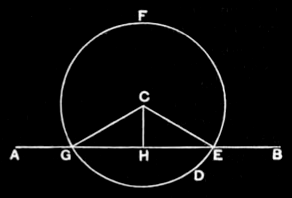
Let AB be the given infinite straight line, and C the given point which is not on it; thus it is required to draw to the given infinite straight line AB, from the given point C which is not on it, a perpendicular straight line.
- For let a point
Dbe taken at random on the other side of the straight lineAB, and with centreCand distanceCDlet the circleEFGbe described; [I.post.3]
I say that CH has been drawn perpendicular to the given infinite straight line AB from the given point C which is not on it.
For, since GH is equal to HE, and HC is common, the two sides GH, HC are equal to the two sides EH, HC respectively; and the base CG is equal to the base CE; therefore the angle CHG is equal to the angle EHC. [I.8] And they are adjacent angles.
But, when a straight line set up on a straight line makes the adjacent angles equal to one another, each of the equal angles is right, and the straight line standing on the other is called a perpendicular to that on which it stands. [I.def.10]
Therefore CH has been drawn perpendicular to the given infinite straight line AB from the given point C which is not on it.
Q. E. D.
Note
2. a perpendicular straight line
, κάθετον εὐθεῖαν γραμμἡν. This is the full expression for a perpendicular, κάθετος meaning let fall or let down, so that the expression corresponds to our plumb-line. ἡ κάθετος is however constantly used alone for a perpendicular, γραμμἡ being understood.