I.24
If two triangles have the two sides equal to two sides respectively, but have the one of the angles contained by the equal straight lines greater than the other, they will also have the base greater than the base.
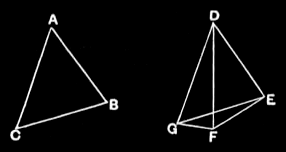
Let ABC, DEF be two triangles having the two sides AB, AC equal to the two sides DE, DF respectively, namely AB to DE, and AC to DF, and let the angle at A be greater than the angle at D;
I say that the base BC is also greater than the base EF.
- For, since the angle
BACis greater than the angleEDF, let there be constructed, on the straight lineDE, and at the pointDon it, the angleEDG equal to the angle
BAC; [I.23] letDGbe made equal to either of the two straight linesAC,DF, and letEG,FGbe joined.
Then, since AB is equal to DE, and AC to DG, the two sides BA, AC are equal to the two sides ED, DG, respectively; and the angle BAC is equal to the angle EDG; therefore the base BC is equal to the base EG. [I.4]
Again, since DF is equal to DG, the angle DGF is also equal to the angle DFG; [I.5] therefore the angle DFG is greater than the angle EGF.
Therefore the angle EFG is much greater than the angle EGF.
- And, since
EFGis a triangle having the angleEFG greater than the angle
EGF, and the greater angle is subtended by the greater side, [I.19] the sideEGis also greater thanEF.
But EG is equal to BC. Therefore BC is also greater than EF.
Therefore etc.
Q. E. D.
Note
10
I have naturally left out the well-known words added by Simson in order to avoid the necessity of considering three cases: Of the two sides DE, DF let DE be the side which is not greater than the other.
I doubt whether Euclid could have been induced to insert the words himself, even if it had been represented to him that their omission meant leaving two possible cases out of consideration. His habit and that of the great Greek geometers was, not to set out all possible cases, but to give as a rule one case, generally the most difficult, as here, and to leave the others to the reader to work out for himself. We have already seen one instance in I.7.