III.2
If on the circumference of a circle two points be taken at random, the straight line joining the points will fall within the circle.
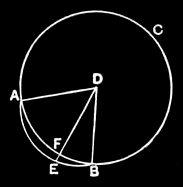
Let ABC be a circle, and let two points A, B be taken at random on its circumference; I say that the straight line joined from A to B will fall within the circle.
For suppose it does not, but, if possible, let it fall outside, as AEB; let the centre of the circle ABC be taken [III.1], and let it be D; let DA, DB be joined, and let DFE be drawn through.
Then, since DA is equal to DB,
the angle DAE is also equal to the angle DBE. [I.5]
And, since one side AEB of the triangle DAE is produced,
the angle DEB is greater than the angle DAE. [I.16]
But the angle DAE is equal to the angle DBE;
therefore the angle DEB is greater than the angle DBE.
And the greater angle is subtended by the greater side; [I.19]
therefore DB is greater than DE. But DB is equal to DF;
therefore DF is greater than DE,
the less than the greater : which is impossible.
Therefore the straight line joined from A to B will not fall outside the circle.
Similarly we can prove that neither will it fall on the circumference itself;
therefore it will fall within.
Therefore etc. Q. E. D.