I.27
If a straight line falling on two straight lines make the alternate angles equal to one another, the straight lines will be parallel to one another.
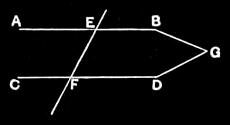
For let the straight line EF falling on the two straight lines AB, CD make the alternate angles AEF, EFD equal to one another;
I say that AB is parallel to CD.
For, if not, AB, CD when produced will meet either in the direction of B, D or towards A, C.
Let them be produced and meet, in the direction of B, D, at G.
Then, in the triangle GEF, the exterior angle AEF is equal to the interior and opposite angle EFG: which is impossible. [I.16]
Therefore AB, CD when produced will not meet in the direction of B, D.
Similarly it can be proved that neither will they meet towards A, C.
But straight lines which do not meet in either direction are parallel; [I.def.23] therefore AB is parallel to CD.
Therefore etc.
Q. E. D.
Note
1. falling on two straight lines,
εὶς δύο εὐθείας ἐμπίπτουσα, the phrase being the same as that used in I.post.5, meaning a transversal.
Note
2. the alternate angles,
αἱ ἐναλλὰξ γωνίαι. Proclus (p. 357, 9) explains that Euclid uses the word alternate (or, more exactly, alternately, ἐναλλάξ) in two connexions, (1) of a certain transformation of a proportion, as in Book V. and the arithmetical Books, (2) as here, of certain of the angles formed by parallels with a straight line crossing them. Alternate angles are, according to Euclid as interpreted by Proclus, those which are not on the same side of the transversal, and are not adjacent, but are separated by the transversal, both being within the parallels but one above
and the other below.
The meaning is natural enough if we imagine the four internal angles to be taken in cyclic order and
alternateangles to be any two of them not successive but separated by one angle of the four.
Note
9. in the direction of B, D or towards A, C,
literally towards the parts B, D or towards A, C,
ἐπὶ τὰ Β, Δ μέρη ἢ ἐπὶ τὰ Α Γ.