I.14
If with any straight line, and at a point on it, two straight lines not lying on the same side make the adjacent angles equal to two right angles, the two straight lines will be in a straight line with one another.
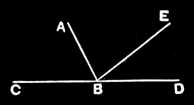
For with any straight line AB, and at the point B on it, let the two straight lines BC, BD not lying on the same side make the adjacent angles ABC, ABD equal to two right angles;
I say that BD is in a straight line with CB.
For, if BD is not in a straight line with BC, let BE be in a straight line with CB.
- Then, since the straight line
ABstands on the straight lineCBE, the angles
ABC,ABEare equal to two right angles. [I.13] But the anglesABC,ABDare also equal to two right angles; therefore the anglesCBA,ABEare equal to the anglesCBA,ABD. [I.post.4 and I.cn.1]
Let the angle CBA be subtracted from each; therefore the remaining angle ABE is equal to the remaining angle ABD, [I.cn.3] the less to the greater: which is impossible. Therefore BE is not in a straight line with CB.
Similarly we can prove that neither is any other straight line except BD. Therefore CB is in a straight line with BD.
Therefore etc.
Q. E. D.
Note
1. If with any straight line….
There is no greater difficulty in translating the works of the Greek geometers than that of accurately giving the force of prepositions. πρός, for instance, is used in all sorts of expressions with various shades of meaning. The present enunciation begins ἐὰν πρός τινι εὐθείᾳ καὶ τῷ πρὸς αὐτῆ σημείῳ, and it is really necessary in this one sentence to translate πρός by three different words, with, at, and on. The first πρός must be translated by with because two straight lines make
an angle
withone another. On the other hand, where the similar expression πρὸς τῇ δοθείση εὐθείᾳ occurs in I.23, but it is a question of constructingan angle (συστἡσασθαι), we have to say to construct
ona given straight line.Against would perhaps be the English word coming nearest to expressing all these meanings of πρός, but it would be intolerable as a translation.
Note
17
Todhunter points out that for the inference in this line I.post.4, that all right angles are equal, is necessary as well as the Common Notion that things which are equal to the same thing (or rather, here, to equal things) are equal. A similar remark applies to steps in the proofs of I.15 and I.28.
Note
24. we can prove.
The Greek expresses this by the future of the verb, δείξομεν, we shall prove,
which however would perhaps be misleading in English.