I.8
If two triangles have the two sides equal to two sides respectively, and have also the base equal to the base, they will also have the angles equal which are contained by the equal straight lines.
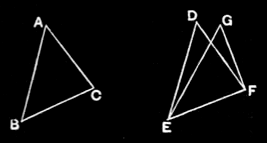
Let ABC, DEF be two triangles having the two sides AB, AC equal to the two sides DE, DF respectively, namely AB to DE, and AC to DF; and let them have the base BC equal to the base EF;
I say that the angle BAC is also equal to the angle EDF.
For, if the triangle ABC be applied to the triangle DEF, and if the point B be placed on the point E and the straight line BC on EF, the point C will also coincide with F, because BC is equal to EF.
- Then,
BCcoinciding withEF,BA,ACwill also coincide withED,DF; for, if the base
BCcoincides with the baseEF, and the sidesBA,ACdo not coincide withED,DFbut fall beside them asEG,GF, then, given two straight lines constructed on a straight line (from its extremities) and meeting in a point, there will have been constructed on the same straight line (from its extremities), and on the same side of it, two other straight lines meeting in another point and equal to the former two respectively, namely each to that which has the same extremity with it. But they cannot be so constructed. [I.7]- Therefore it is not possible that, if the base
BCbe applied to the baseEF, the sidesBA,ACshould not coincide withED,DF; they will therefore coincide, so that the angle
BACwill also coincide with the angleEDF, and will be equal to it.
If therefore etc.
Q. E. D.
Note
19. BA, AC.
The text has here BA, CA.
Note
21
fall beside them. The Greek has the future, παραλλάξουσι. παραλλάττω means to pass by without touching,
to miss
or to deviate.