X.10
To find two straight lines incommensurable, the one in length only, and the other in square also, with an assigned straight line.
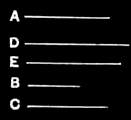
Let A be the assigned straight line; thus it is required to find two straight lines incommensurable, the one in length only, and the other in square also, with A.
Let two numbers B, C be set out which have not to one another the ratio which a square number has to a square number, that is, which are not similar plane numbers; and let it be contrived that,
as B is to C, so is the square on A to the square on D
—for we have learnt how to do this— [X.6.p.1] therefore the square on A is commensurable with the square on D. [X.6]
And, since B has not to C the ratio which a square number has to a square number, therefore neither has the square on A to the square on D the ratio which a square number has to a square number; therefore A is incommensurable in length with D. [X.9]
Let E be taken a mean proportional between A, D; therefore, as A is to D, so is the square on A to the square on E. [V.def.9]
But A is incommensurable in length with D; therefore the square on A is also incommensurable with the square on E; [X.11] therefore A is incommensurable in square with E.
Therefore two straight lines D, E have been found incommensurable, D in length only, and E in square and of course in length also, with the assigned straight line A.]