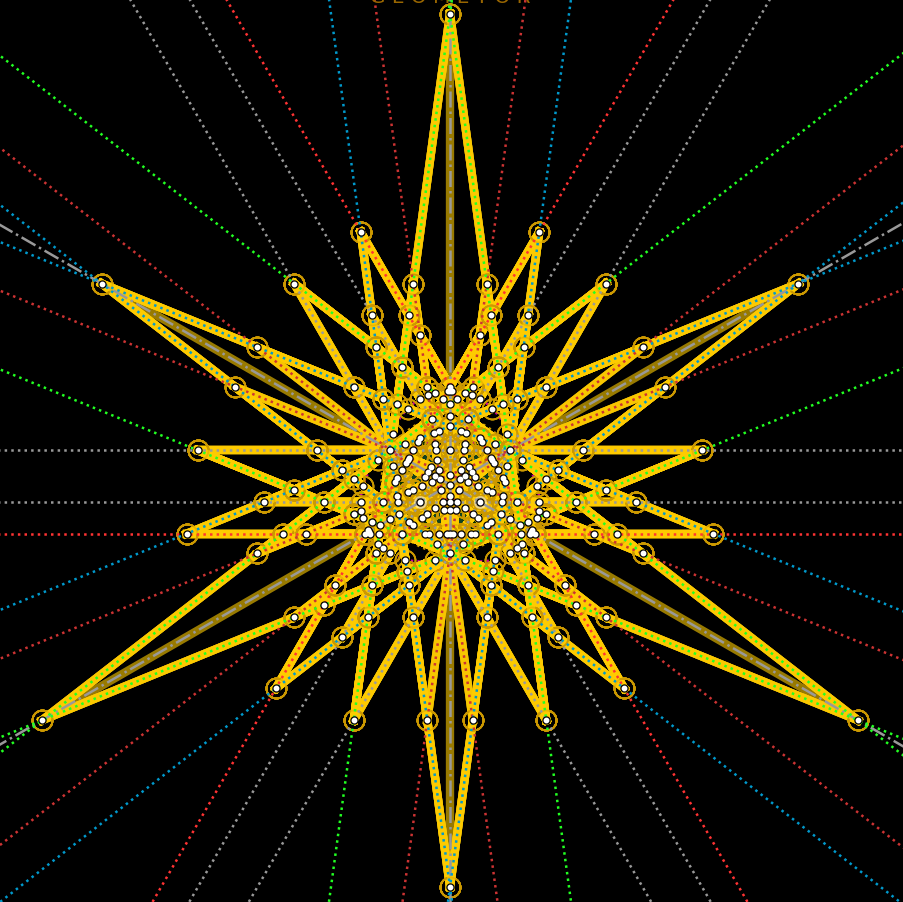
Content of type 'proposition'
Catoptrica Prop. 4: Variational Shortest-Path Proof of the Law of Reflection
In his Catoptrica—preserved in medieval Latin translation by William of Moerbeke (Schmidt 1900, pp. 324–329) and verbatim in the original Greek by Olympiodorus (Commentary on Aristotle’s Meteorology III.2, Schmidt 1900, pp. 368–372, Fig. 92)—Hero delivers the first variational extremum principle in the history of physics, sixteen centuries before Fermat’s Principle of Least Time (1662):
Props. I.1–I.7: Rectangles, Right/Isosceles Triangles & General Altitude Projections
Proposition I.1 (Oblong Rectangle, Schöne pp. 6–8): Given an oblong rectangular region \(AB\Gamma\Delta\) with \(AB = 5\) feet and \(B\Gamma = 3\) feet, dividing each side into unit-foot segments partitions the rectangle into \(5 \times 3 = 15\) orthogonal unit squares. Thus the area of every rectangle equals the product of two containing sides.
Props. II.1–II.10: Cones, Cylinders, Frusta & the Bomiskos Prismatoid
Propositions II.1–II.5 (Cones, Oblique Cylinders, Parallelepipeds, Prisms & Pyramids, Schöne pp. 94–108): Hero computes right and oblique cylinders (\(V = A_{\text{base}} \cdot h\)), cones (\(V = \frac{1}{3} A_{\text{base}} \cdot h\)), hexagonal and polygonal prisms, and pyramids on arbitrary triangular or polygonal bases, obtaining the perpendicular altitude \(h\) from the slant edge and circumradius (or base projection) via [I.47].
Props. III.1–III.3: Dividing Triangles from a Vertex, Parallel to Base & From a Side Point
(Diagram Mapping: Both **Proposition III.1* and Proposition III.2 act upon Hero’s canonical (13, 14, 15) triangle* ABC of area \(84\) with A = \((5, 12)\), B = \((0, 0)\), C = \((14, 0)\) ).
Prop. I.8: Synthetic Incircle Proof of Δ = √(s(s−a)(s−b)(s−c)) & Root Extraction
Proposition I.8 — Enunciation & Rule on (7, 8, 9) (Schöne p. 18; fol. 70v):
Props. II.11–II.15: Spheres, Dionysodorus’s Torus & Archimedes’ Method Vaults
Propositions II.11–II.12 (Spheres, Spherical Segments & Vaulted Basins, Schöne pp. 120–126): By Archimedes' Sphere and Cylinder I.34, the sphere is \(\frac{2}{3}\) of the circumscribing cylinder (\(\frac{\pi}{4} d^2 \cdot d\)), giving \(V_{\text{sphere}} = \frac{\pi}{6} d^3 \approx \frac{11}{21} d^3\). For a spherical segment of base radius \(r_b\) and sagitta (height) \(h\) (Prop. II.12), Hero applies Sphere and Cylinder II.2 to derive the intrinsic formula requiring no separate lookup of the full sphere’s radius:
Props. III.4–III.19: Trapezia, Quadrilaterals, Annuli & Exterior-Point Cuts
Extending Euclid's treatise On Divisions of Figures (Περὶ διαιρέσεων) to survey engineering, Hero solves sixteen increasingly intricate planar division problems:
Prop. I.9: Triangles with Irrational Sides
Proposition I.9 (Triangles with Irrational Sides, Schöne pp. 24–26): When one or more sides of a triangle are given only in square (quadrance, e.g., \(AB^2 = 20, BC^2 = 12\)), Hero extracts their approximate rational roots via the Proposition I.8 method and applies either the projection rule or Proposition I.8.
Props. II.16–II.20: Five Platonic Solids & Irregular Hydrostatic Displacement
Propositions II.16–II.19 — Volumes of the Five Regular Solids (Schöne pp. 132–138; fols. 97r–99r):
Props. III.20–III.23: Stereometric Divisions & Hero’s Cube-Root Algorithm (∛100 ≈ 4 9/14)
In the final four propositions of the Metrica, Hero ascends from two-dimensional area divisions (governed by duplicate ratios and square roots) to three-dimensional solid divisions (governed by triplicate ratios [XII.12] and cube roots):
Props. I.10–I.16: Trapezia, Rhombi & General Quadrilaterals
Having mastered every species of triangle in Propositions I.1–I.9, Hero points out a foundational distinction between triangles and four-sided figures: whereas three given sides uniquely determine the angles and area of a triangle ([I.8]), four given sides do not determine a quadrilateral unless either a right angle, a parallel relation, or a diagonal is also specified.
Props. I.17–I.25: Regular Polygons (3-gon to 12-gon) & Golden Section Pentagon Lemma
In Propositions I.17–I.25, Hero systematically computes the area \(A_n\) of every regular \(n\)-gon of given side \(a\) from the equilateral triangle (\(n = 3\)) through the regular dodecagon (\(n = 12\)), expressing each ratio \(A_n : a^2\) both by an exact geometric construction and by a close rational multiplier suitable for architectural and surveying calculations.
Props. I.26–I.33: Circles, Archimedes’ Plinthides, Annuli & Circular Segments
Proposition I.26 (Circle, Lost Archimedean Bounds & Concentric Annulus, Schöne pp. 66–70): Hero cites Archimedes' Measurement of a Circle: the circumference of a circle exceeds thrice its diameter by less than \(\frac{1}{7}\) and more than \(\frac{10}{71}\) (\(3\frac{10}{71} < \pi < 3\frac{1}{7}\)), and the circle’s area equals the right triangle of legs \(r\) and \(C\), giving \(A_{\text{circle}} \approx \frac{11}{14} d^2\). Crucially, Hero adds a unique citation of Archimedes’ otherwise lost treatise On Plinthides and Cylinders (Περὶ πλινθίδων καὶ κυλίνδρων), recording finer bounds equivalent to:
Props. I.34–I.39: Ellipse, Parabolic Segment via the Method & Curved Surfaces
Proposition I.34 (Area of an Ellipse, Schöne pp. 80–82): Given an ellipse cut obliquely from a cylinder or cone (Apollonius, Conics I.13) with major axis \(2a = 16\) and minor axis \(2b = 12\), Hero invokes Archimedes' On Conoids and Spheroids (Prop. 4): the ellipse has the same area as the circle whose diameter is the geometric mean \(\sqrt{(2a)(2b)}\) of its axes: