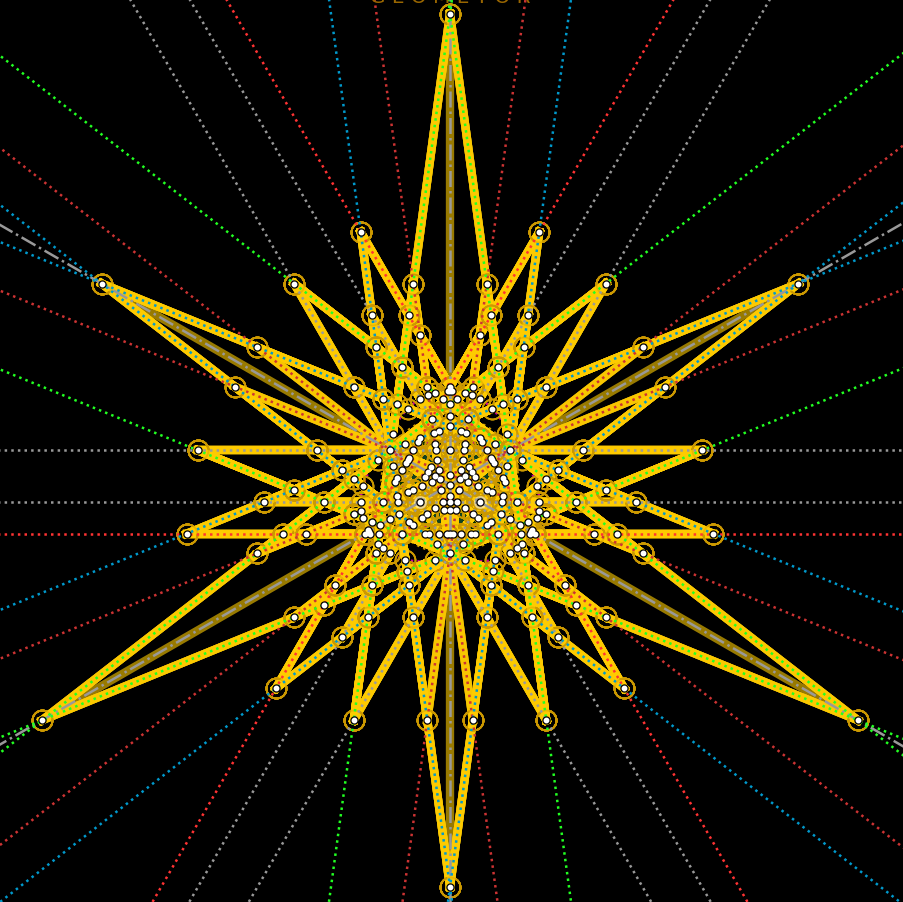
Metrica Book I — Scholarly Commentary, Historical Loci & Demonstrations
GEOMETOR Mathematical & Historical Commentary
The 1896 Constantinople Rediscovery & Archimedian Attribution of I.8: For over a millennium, Hero's Metrica was known only through fragmentary citations in Eutocius (In Archimedis Dim. Circ.), until Richard Schöne and Paul Tannery identified the complete three-book treatise in 1896 in the 11th-century Codex Constantinopolitanus Palatii Veteris no. 1 (fols. 67r–107v), edited by Hermann Schöne in 1903. Medieval Arabic geometer al-Bīrūnī reports that the triangle area theorem \(\Delta = \sqrt{s(s-a)(s-b)(s-c)}\) originated with Archimedes, while Metrica I.8 preserves its oldest extant Greek synthetic proof—duplicated verbatim in Hero’s Dioptra Ch. 30.
Fourth-Degree Magnitude (*Dynamodynamis*) Inside Greek Geometry: Classical Euclidean geometry restricts magnitudes to three homogeneous spatial dimensions (line, square, solid). At Schöne p. 20, lines 22–25, Hero boldly writes: “the rectangle \(\Gamma\Theta \cdot EH\) is the square root of \(\Gamma\Theta^2 \cdot EH^2\) “—multiplying a square by a square (a fourth-degree dynamodynamis, named explicitly at Metrica I.17, Schöne p. 48) inside a synthetic proof! This conceptual leap bridges classical geometric algebra (Elements Book II) and Diophantine symbolic algebra.
Archimedes’ Function / Wildberger’s Quadrea (:math:`mathcal{A} = 16Delta^2`): In Norman J. Wildberger's Rational Trigonometry (formalized in
geometor/wildbergerW.07), expanding \(16 s(s-a)(s-b)(s-c)\) in the side quadrances \(Q_a = a^2, Q_b = b^2, Q_c = c^2\) eliminates every square root:\[\mathcal{A}(Q_a, Q_b, Q_c) = (Q_a + Q_b + Q_c)^2 - 2(Q_a^2 + Q_b^2 + Q_c^2) = 16 s(s-a)(s-b)(s-c) = 16\Delta^2.\]On Hero’s two benchmark triangles:
For \((7, 8, 9)\), \((Q_a, Q_b, Q_c) = (49, 64, 81) \implies \mathcal{A} = 194^2 - 2(12738) = 11520 = 16 \times 720\).
For \((13, 14, 15)\), \((Q_a, Q_b, Q_c) = (196, 225, 169) \implies \mathcal{A} = 590^2 - 2(117562) = 112896 = 16 \times 7056 = (4 \times 84)^2\).
Quadratic Convergence of Hero’s Root Algorithm: Hero’s rule \(x_{k+1} = \frac{1}{2}\!\left(x_k + \frac{N}{x_k}\right)\) satisfies the exact algebraic error recurrence:
\[x_{k+1}^2 - N = \left(\frac{x_k^2 - N}{2 x_k}\right)^2 > 0.\]Every iterate \(k \ge 1\) is therefore a strict rational upper bound whose quadratic excess squares at every step: from \(x_0^2 - 720 = +9\) (\(x_0 = 27\)), step 1 gives \(\frac{9^2}{4 \cdot 729} = \frac{1}{36}\) (\(x_1 = \frac{161}{6}\)), and step 2 gives \(\frac{1}{4 \cdot 36 \cdot 25921} = \frac{1}{3{,}732{,}624}\) (\(x_2 = \frac{51841}{1932}\)), accurate to 8 significant decimal digits in two hand divisions!
Interactive GEOMETOR Demonstrations & Sister Concordance
Symbolic Proof Walkthrough: Heron’s Formula Synthetic Proof & Quadrea (Metrica I.8) — Executes
construct_heron_proof()ingeometor.model(B = (0, 0), C = (14, 0), A = (5, 12), incenter H = (6, 4) = X(1), cyclic circumcenter M = (7, -4) of squared radius 65).Exact Rational Stream: Iterative Square-Root Extraction on √720 (Metrica I.8) — Evaluates
heron_sqrt_convergents(720, steps=4)in exactsympy.Rationalarithmetic up to a 154-digit fraction.Concordance Loci in Unit I: - Metrica I, Prooemium (Schöne pp. 2–6) ↔
proclusFriedlein 64.16–65.7 - Metrica I, Props. 1–7 (Schöne pp. 6–18) ↔ [I.47], [II.12], [II.13] - Metrica I, Prop. 8 Proof (Schöne pp. 18–24) ↔etcX(1) &wildbergerW.07 - Metrica I, Prop. 8b √720 (Schöne pp. 18–20) ↔ Eutocius testimony
1. Euclid Elements XIII.1 & the Pentagon Lemma in \(\mathbb{Q}(\phi)\)
In Proposition I.18 (Schöne 1903, p. 50), Hero compresses Euclid's Book XIII theory of the regular pentagon and decagon into a remarkably direct right-triangle lemma. By reflecting right triangle \(AB\Gamma\) (\(\angle A = 36^\circ\)) across \(B\Gamma\) to form isosceles triangle \(AB\Delta\) with apex angle \(108^\circ\) (\(\frac{6}{5}\) of a right angle), Hero identifies \(AB = B\Delta\) as the side of a regular pentagon and \(A\Delta = 2 A\Gamma\) as its diagonal.
By [XIII.8], \(A\Delta : AB = AB : (A\Delta - AB) = \phi : 1\). Invoking [XIII.1]—if \(A\Delta\) is cut in extreme and mean ratio with greater segment \(AB\), then adding half the whole (\(A\Gamma = \frac{1}{2} A\Delta\)) yields \((AB + A\Gamma)^2 = 5\,A\Gamma^2\)—Hero avoids nested fourth-degree radicals until the very end of the numerical evaluation! In Rational Trigonometry (Wildberger 2005), the spread at \(A\) (\(36^\circ\)) lives purely in \(\mathbb{Q}(\sqrt{5})\):
See the executable construction in Universal Golden Gnomon & Dioptra Mountain Tunnel and geometor.heron.constructions.construct_pentagon_lemma.
2. Pre-Ptolemaic Chord Tables in Propositions I.22 & I.24
Because the regular \(9\)-gon (\(40^\circ\) central angle, requiring angle trisection) and regular \(11\)-gon (\(32\frac{8}{11}^\circ\) central angle) cannot be constructed with unmarked straightedge and compass, Hero explicitly cites “the books on chords in a circle” (τὰ περὶ τῶν ἐν κύκλῳ εὐθειῶν). As Thomas Heath (1921, Vol. II, pp. 259, 326) and Otto Neugebauer observed, Hero’s ratios—specifically \(d / a_9 \approx \frac{17}{6}\) (equivalent to a chord of \(40^\circ\) near \(\frac{6}{17} d \approx 0.3529 d\) vs. exact \(\sin 20^\circ = 0.3420 d\)) and \(d / a_{11} \approx \frac{25}{7}\) (\(\frac{7}{25} d = 0.2800 d\) vs. exact \(\sin\frac{\pi}{11} \approx 0.28173 d\), accurate to \(0.6\%\)!)—preserve precious pre-Ptolemaic trigonometric data prior to Claudius Ptolemy's Almagest I.10, pointing back to Hipparchus of Nicaea.
3. Archimedes’ Lost Plinthides and Cylinders (Prop. I.26)
In Proposition I.26 (Schöne 1903, p. 66; fol. 81v), Hero preserves our sole surviving ancient testimony to Archimedes' work On Plinthides and Cylinders (Περὶ πλινθίδων καὶ κυλίνδρων). In the Codex Constantinopolitanus, the manuscript numerals read \(\frac{211875}{67441}\) (\(\approx 3.141635\)) and \(\frac{197888}{62351}\) (\(\approx 3.17377\), slightly corrupted in a single Greek digit; Paul Tannery and Hermann Schöne showed that restoring a single numeral yields tight four-decimal bounds straddling \(\pi = 3.14159265\dots\)). This proves that Archimedes’ famous \(3\frac{10}{71} < \pi < 3\frac{1}{7}\) in Measurement of a Circle was merely a simplified didactic bound, whereas Archimedes had computed \(\pi\) far more tightly in Plinthides and Cylinders.
4. Surfaces in Book I vs. Volumes in Book II
Why do the curved 3D surfaces of the cylinder, cone, sphere, and spherical cap appear at the end of Book I (Props. I.36–I.39) rather than in Book II? Hero adheres strictly to the dimensional ontology enunciated in his Book I Prooemium: Book I measures two-dimensional surfaces (ἐπιφάνειαι), whether planar or curved in three-dimensional space, because every surface—even a sphere’s—is measured in homogeneous unit squares (\(S_{\text{sphere}} = 4\pi r^2\)), whereas Book II is reserved exclusively for three-dimensional solid capacities measured in unit cubes.