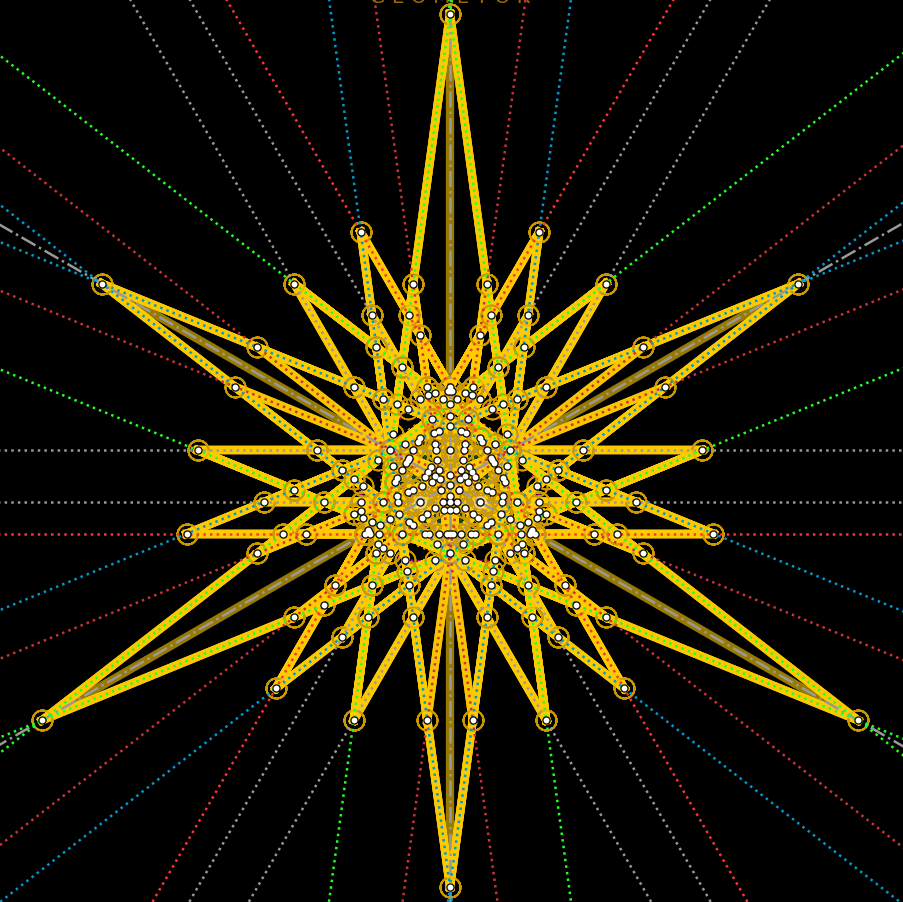
Liber I — De Maximo Absoluto¶
De Docta Ignorantia · Liber Primus — Nicholas of Cusa (1440)
Book I investigates the Absolute Maximum—that than which nothing can be greater—which transcends all comparative proportion and in which the superlative Minimum coincides. Through the mathematical transsumption of the straight line, triangle, circle, and sphere, Cusa demonstrates how geometric symbols serve as an incorruptible ladder to intellectual vision.
Capitula of Book I¶
Learned Ignorance, Polygon Exhaustion & the Coincidence of Maximum and Minimum
Intellectus igitur, qui non est veritas, numquam veritatem adeo praecise comprehendit, quin per infinitum praecisius comprehendi possit, habens se ad veritatem sicut polygonia ad circulum.
The intellect, therefore, which is not truth, never comprehends truth so precisely that it could not be comprehended infinitely more precisely, standing to truth as a polygon stands to a circle. — De Docta Ignorantia I.3 §2
Incorruptible Certitude & the Three-Step Method of Mathematical Transsumption
Primo necesse est figuras mathematicas finitas considerare cum suis passionibus et rationibus, et ipsas rationes correspondenter ad infinitas tales figuras transferre, post haec tertio adhuc altius ipsas rationes infinitarum figurarum transumere ad infinitum simplex absolutissimum etiam ab omni figura.
First we must consider finite mathematical figures with their properties and ratios, next transfer those ratios correspondingly to infinite figures of the same kind, and third transsume the ratios of those infinite figures still higher unto the Simple Infinite wholly absolved from every figure. — De Docta Ignorantia I.12 §1
Coincidence of Infinite Circle, Straight Line, Triangle & Sphere
Si esset linea infinita, illa esset recta, illa esset triangulus, illa esset circulus et esset sphaera; immo curvitas in ipsa maxima linea est rectitudo.
If there were an infinite line, it would be a straight line, a triangle, a circle, and a sphere; nay rather, within that maximal line itself curvature is rectitude. — De Docta Ignorantia I.13 §§1–2
The Infinite Line as Universal Essence & Most Adequate Measure
Ipsa igitur maxima linea est adaequatissima mensura omnium linearum, ita quod nec minor est, quia non exceditur ab aliqua, nec maior, quia nulla eam excedit.
Therefore the maximal line itself is the most adequate measure of all lines, being neither smaller—since it is not exceeded by any—nor larger, since none exceeds it. — De Docta Ignorantia I.16 §3
Transsumption of the Triangle: Divine Triunity & Exclusion of Quaternity
Cum enim incipis numerare trinitatem, tunc exis veritatem. Unitas igitur est trinitas; et econverso trinitas unitas.
For when you begin to count the Trinity, you step outside the truth. Unity, therefore, is Trinity, and conversely Trinity is Unity. — De Docta Ignorantia I.19 §1
The Infinite Sphere Where Center, Diameter & Circumference Coincide
Patet ergo centrum, diametrum et circumferentiam idem esse. Ex quo docetur ignorantia nostra incomprehensibile maximum esse, cui minimum non opponitur; sed centrum est in ipso circumferentia.
Clearly, therefore, center, diameter, and circumference are identical; thereby our ignorance is taught that the incomprehensible Maximum is that to which the Minimum is not opposed, and that within it the center is the circumference. — De Docta Ignorantia I.21 §3