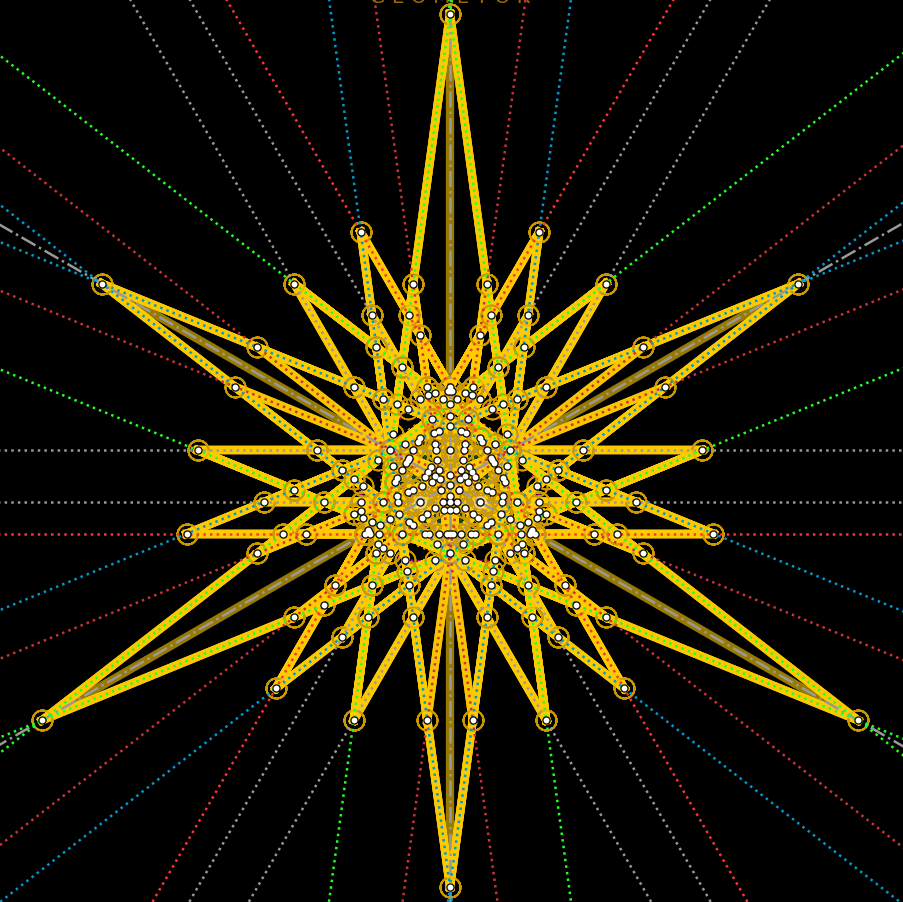
Transsumption of the Triangle: Divine Triunity & Exclusion of Quaternity — Critical Commentary & Notes
Exact Symbolic Reconstruction, Latin Philology & Canon Reception · DI I.18–20 (1440)
I. Why the Maximum Is Triune and Not Quaternary (DI I.19–20)
Capitulum XX supplies a purely topological-combinatorial proof of why polygonal resolution halts at three: in two-dimensional simplicial decomposition, the triangle (\(n = 3\)) is the unique minimal polygon (minima figura polygonia, qua minor esse nequit). Every \(k\)-gon for \(k \ge 4\) decomposes into \(k - 2\) triangles (cf. Euclid Elements I.32 and VI.20) and is therefore composite and strictly greater than the minimal polygon; hence a quadrangle cannot coincide with the simplest Minimum or serve as the universal measure of triangles. Moreover, Cusa enumerates the exact four-element dimensional basis of spatial measurement:
1D Length: Maximal Infinite Line
2D Rectilinear Breadth: Maximal Triangle
2D Circular Breadth: Maximal Circle
3D Depth: Maximal Sphere
IV. Executable Symbolic Verification
In accordance with GEOMETOR’s strict content/code separation for historical editions, executable geometor.model SymPy constructions, Rational Trigonometry proofs, and series-error audits for Transsumption of the Triangle: Divine Triunity & Exclusion of Quaternity live in src/geometor/cusa/ and the companion walkthrough Demos.