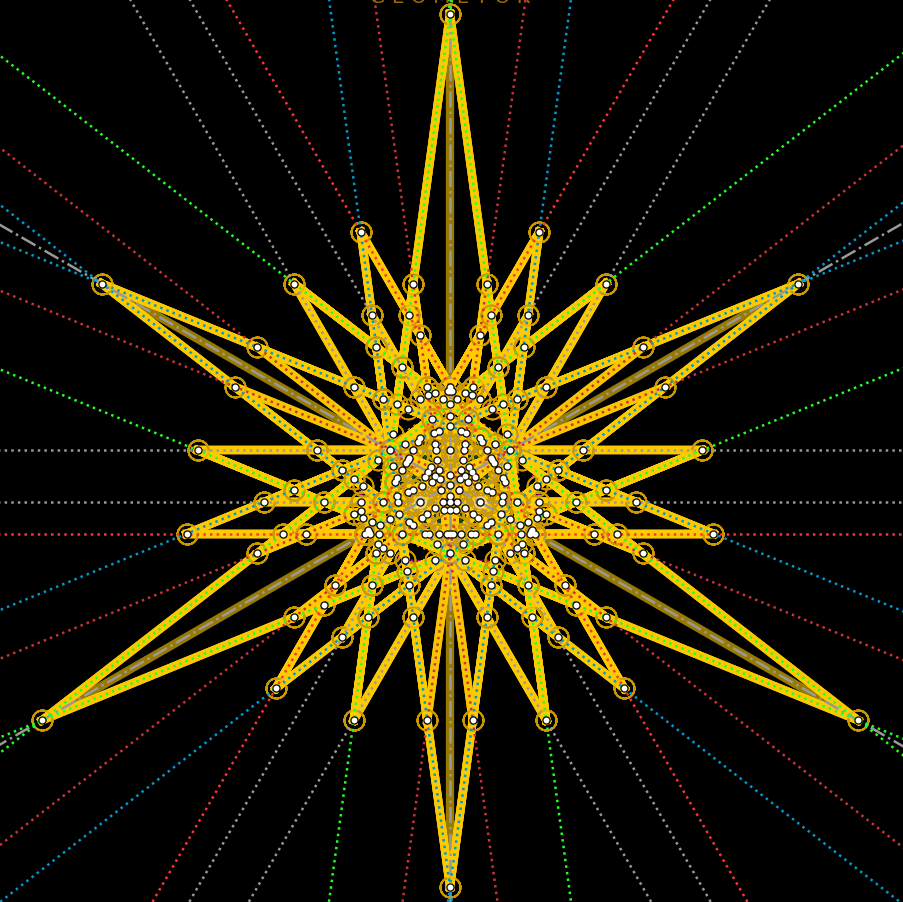
The Infinite Line as Universal Essence & Most Adequate Measure — Critical Commentary & Notes¶
Exact Symbolic Reconstruction, Latin Philology & Canon Reception · DI I.16–17 (1440)
I. Infinite Transfinite Equivalence & Geometric Measure (DI I.16–17)¶
Dedekind-Style Infinite Bijection (`DI I.16 §5`): Four centuries before Bolzano, Dedekind, and Cantor defined infinite sets by equipollence with proper subsets, Nicholas of Cusa argues that an infinite line composed of \(\infty\) one-foot segments and one composed of \(\infty\) two-foot segments are necessarily equal (cum infinitum non sit maius infinito), because every part of the infinite is convertible with the whole infinite.
Negative Theology & Non-Opposition (`DI I.16 §2`): The infinite line as universal measure escapes every contradiction. Because the Absolute Maximum admits neither exceeding nor exceeded, it transcends all contraries.
IV. Executable Symbolic Verification¶
In accordance with GEOMETOR’s strict content/code separation for historical editions, executable geometor.model SymPy constructions, Rational Trigonometry proofs, and series-error audits for The Infinite Line as Universal Essence & Most Adequate Measure live in src/geometor/cusa/ and the companion walkthrough Demos.