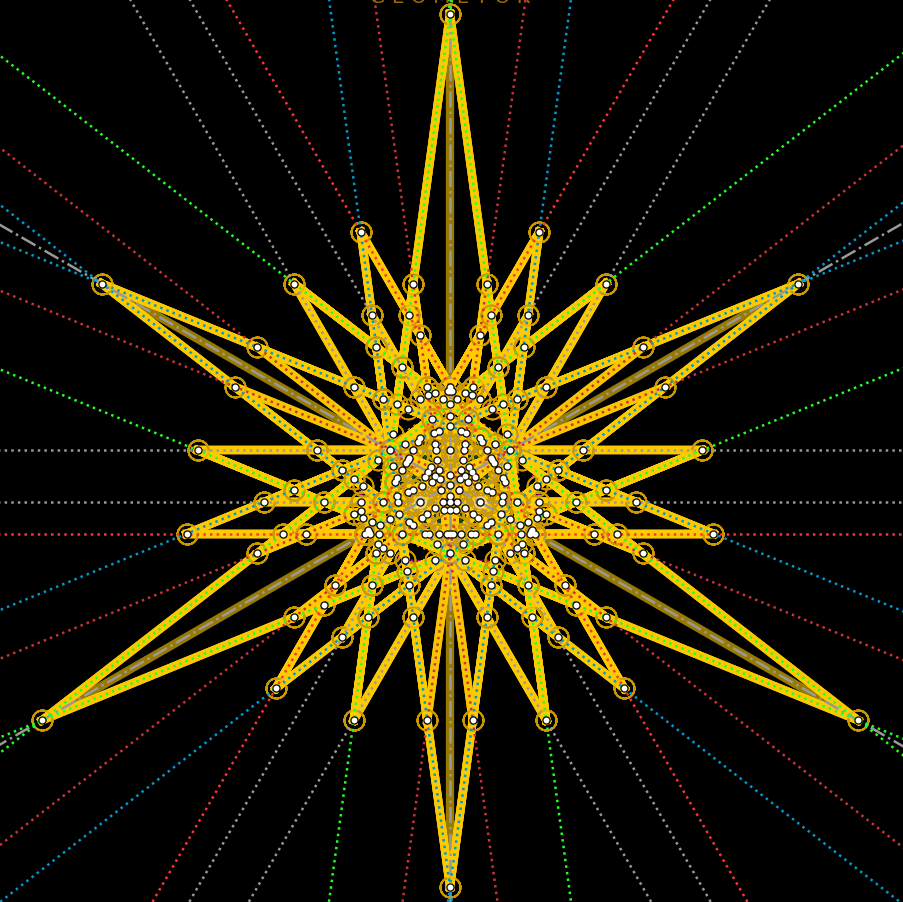
Transsumption of the Triangle: Divine Triunity & Exclusion of Quaternity¶
De Docta Ignorantia · Liber I, Capitula XVIII–XX (1440)
Cum enim incipis numerare trinitatem, tunc exis veritatem. Unitas igitur est trinitas; et econverso trinitas unitas.
For when you begin to count the Trinity, you step outside the truth. Unity, therefore, is Trinity, and conversely Trinity is Unity. — De Docta Ignorantia I.19 §1
Book I, Chapter 18 — How from the Same Principle We Are Guided to Understand Participation in Beingness¶
Original GEOMETOR Translation from the Latin · h I, nn. 52–54 · Paris 1514 fol. 7r–7v · Rotta 1913 pp. 38–40
f. DI I.18 §1Further still, our insatiable intellect, vigilantly and most sweetly stirred by what has gone before, asks how it may behold more clearly this participation in the one Maximum. Aiding itself once again by the example of infinite linear rectitude, it speaks as follows:
f. DI I.18 §2What is curved, because it admits of more and less, cannot be either maximal or minimal; nor is the curved as curved anything positive, since it is a falling away from the straight. The being that resides in the curved, therefore, comes from participation in rectitude, inasmuch as both the maximally curved and the minimally curved are none other than the straight. Hence the less curved a curve is—such as the circumference of a larger circle—the more it participates in rectitude: not by taking a fragment of it, since infinite rectitude has no parts, just as a finite straight line, the longer it is, seems to participate more largely in the infinity of the maximal infinite line. Now just as a finite straight line insofar as it is straight—into which minimal curvature resolves—participates in the infinite line by a simpler participation, whereas a curve participates not so simply and immediately, but mediately and at a remove through the medium of the rectitude in which it shares: so too certain beings participate more immediately in Maximal Beingness subsisting in itself, namely simple finite substances, whereas other beings participate in beingness not through themselves but through the medium of substances, namely accidents. Notwithstanding this diversity of participation, as Aristotle says, the straight is the measure both of itself and of the crooked; just as the infinite line is the measure of both straight and curved lines, so the Maximum is the measure of all things however diversely they participate.
f. DI I.18 §3Here opens the meaning of the saying that substance does not admit of more and less. This is true in the very way that a finite straight line, insofar as it is straight, admits neither more nor less; yet because it is finite, through diverse participation in the infinite line one finite line is larger or smaller in respect of another, and never are two found precisely equal. The curved, however, admits of more and less with regard to its participation in rectitude, and consequently through that participated rectitude it also admits of more and less in size like the straight. Hence it is that accidents are the nobler the more they participate in substance, and nobler still the nobler the substance in which they participate. Thus we see how there can exist only beings participating in the beingness of the First either through themselves or through others, just as only lines either straight or curved are found; and therefore Aristotle rightly divided everything in the world into substance and accident.
f. DI I.18 §4Of substance and accident alike, then, there is a single most adequate measure, namely the most simple Maximum itself; and although it is neither substance nor accident, from what has preceded it is manifestly plain that it more fittingly receives its name from the things participating in it immediately—substances—than from accidents. Hence greatest Dionysius calls it ‘more than substance’ or ‘supersubstantial’ rather than ‘superaccidental’; because to say ‘supersubstantial’ is greater than to say ‘superaccidental,’ it is more fittingly attributed to the Maximum. Yet ‘supersubstantial’ means ‘not substantial,’ since substance lies below it, while it stands above substance; thus negation suits the Maximum more truly, as we shall explain below concerning the names of God.
f. DI I.18 §5From what has been said above one might investigate much concerning the diversity and nobility of accidents and substances, for which this is not the place.
Book I, Chapter 19 — Transsumption of the Infinite Triangle to the Maximal Trinity¶
Original GEOMETOR Translation from the Latin · h I, nn. 55–58 · Paris 1514 fol. 7v–8r · Rotta 1913 pp. 40–42
f. DI I.19 §1Let us now be instructed in ignorance from what has been stated and proved, namely that the maximal line is the maximal triangle. The maximal line has been shown to be a triangle; and because a line is most simple, the most simple will be triune. Every angle of that triangle will be the line, since the whole triangle is the line; therefore the infinite line is triune. Yet there cannot be several infinites; therefore that trinity is unity.
f. DI I.19 §2Furthermore, since in geometry it is demonstrated that the angle opposite the greater side is greater, and here we have a triangle possessing none save infinite sides, its angles will be maximal and infinite. Hence no one angle is smaller than the others, nor are two greater than the third; rather, just as outside infinite quantity no quantity can exist, so outside one infinite angle no other angles can exist. Consequently each will be in the other, and all three will be one Maximum. Moreover, just as the maximal line is no more line than triangle, circle, or sphere, but in truth is all of them without composition, as has been shown, so in like manner the unqualified Maximum as linear Maximum may be called Essence; as triangular, Trinity; as circular, Unity; and as spherical, Actual Existence.
f. DI I.19 §3The Maximum, therefore, is triune essence, one in act; nor is essence other than trinity, nor trinity other than unity, nor actuality other than unity, trinity, or essence, even though it is most true that the Maximum is all these identically and most simply. Just as it is true that the Maximum exists and is one, so it is true that it is triune in such a manner that the truth of trinity does not contradict most simple unity, but is that unity itself.
f. DI I.19 §4Now this is possible in no other way than as can be attained through the likeness of the maximal triangle. Knowing from what precedes that true triangle and most simple line, therefore, we shall attain the Trinity in learned ignorance in the manner possible to man. For we observe that we do not find first one angle, next another, and third yet another, as in finite triangles, since one and another and another cannot exist within the unity of the triangle without composition. Instead, the One exists triply without numerical multiplication; wherefore most learned Augustine rightly said: ‘Once you begin to count the Trinity, you step outside the truth.’ In divine matters one must embrace contradictories within a simple concept so far as possible, anticipating them antecedently: for instance, in divine things one must not conceive distinction and indistinction as two contradictories, but conceive them antecedently in their most simple principle, where distinction is no other than indistinction; then one conceives clearly that trinity and unity are the same. Where distinction is indistinction, trinity is unity; and conversely, where indistinction is distinction, unity is trinity. So too with plurality of persons and unity of essence: where plurality is unity, trinity of persons is identical with unity of essence; and conversely, where unity is plurality, unity of essence is trinity in the persons.
f. DI I.19 §5All this appears clearly in our geometric example, where the most simple line is a triangle and conversely the simple triangle is linear unity. Here too we see why the angles of the triangle cannot be numbered as one, two, three, since each is in each—as the Son declares: ‘I am in the Father and the Father is in me.’ Again, the truth of a triangle requires three angles: here, then, there are most truly three angles, each one maximal, and all of them one Maximum. The truth of a triangle requires further that one angle not be another; and here likewise the truth of the unity of most simple essence requires that those three angles not be three separate things, but one—and this too holds true here. Join together antecedently, therefore, these things that seem opposed, as I said before, and you will have not ‘one and three’ or the reverse, but the Unitrine or Triune. And this is absolute truth.
Book I, Chapter 20 — Further on the Trinity, and Why a Quaternity or More Is Impossible in Divine Reality¶
Original GEOMETOR Translation from the Latin · h I, nn. 59–62 · Paris 1514 fol. 8r–8v · Rotta 1913 pp. 42–45
f. DI I.20 §1Furthermore, the truth of the Trinity, which is Triunity, requires that the triune be one, which is why it is called ‘triune.’ Now this enters into thought only in the way that distinct correlation unites and order distinguishes. Just as when we construct a finite triangle there is first one angle, second another, and third a third proceeding from both, and those angles bear a mutual correlation so that out of them there is a single triangle, so too infinitely in the infinite. Yet this must be conceived in such a way that priority is understood in eternity without posteriority contradicting it; otherwise priority and posteriority could have no place in the infinite and eternal. Hence the Father is not prior to the Son and the Son posterior; rather, the Father is prior in such wise that the Son is not posterior. The Father is the first Person without the Son being second afterward; just as the Father is first without priority, so the Son is second without posteriority, and the Holy Spirit in like manner third. Since more was said on this earlier, let this suffice.
f. DI I.20 §2Take careful note, however, regarding this ever-blessed Trinity, that the Maximum itself is triune and not fourfold or fivefold or more. Worthy of remark indeed is this truth, for any higherfoldness would clash with the simplicity and perfection of the Maximum. Every polygonal figure has the triangular figure as its simplest element, and the triangle is the minimal polygonal figure, than which none can be smaller. Now it has been proved that the unqualified Minimum coincides with the Maximum. Therefore as unity stands among numbers, so the triangle stands among polygonal figures; and just as every number resolves into unity, so all polygons resolve into the triangle. Hence the maximal triangle, with which the minimal triangle coincides, embraces all polygonal figures; for as maximal unity stands to every number, so the maximal triangle stands to every polygon. A quadrangular figure, by contrast, is manifestly not minimal, since a triangular figure is smaller than it. To the most simple Maximum, therefore, which can coincide solely with the Minimum, a quadrangular figure—which cannot exist without composition, being larger than the minimal—can in no wise belong. Indeed, to be maximal and to be quadrangular entails a contradiction: for a quadrangle could never serve as the adequate measure of triangular figures, since it would always exceed them. How then could that be the Maximum which was not the measure of all things? Nay, how could that be the Maximum which derived from another, was composite, and was consequently finite?
f. DI I.20 §3Now it is plain why out of the potency of the simple line there arises first—with respect to polygons—the simple triangle, next the simple circle, and next the simple sphere, and why one arrives at no figures other than these elemental ones, mutually disproportionate among finite magnitudes yet enfolding all figures within themselves. Just so, were we to conceive the measures of all measurable quantities, we would need first, for length, a maximal infinite line with which the minimum coincided; next, in like manner, for rectilinear breadth a maximal triangle; for circular breadth a maximal circle; and for depth a maximal sphere; nor could all measurable things be attained by any measures other than these four. And since all these measures would necessarily be infinite and maximal, with which the minimum coincided, and since there cannot be several maxima, we affirm that the single Maximum which must be the measure of all quantities is those four without which it could not be the maximal measure—even though, considered in itself apart from relation to measurable things, it is and can truly be called none of them, standing infinitely and disproportionately above them. Thus because the unqualified Maximum is the measure of all things, we call it those things without which we cannot understand it to be the universal standard. Although the Maximum stands infinitely above all trinity, we call it triune because otherwise we would not understand it to be the simple cause, standard, and measure of things whose unity of being is a trinity—just as among figures triangular unity consists in a trinity of angles—even though in truth, once this relation is set aside, both the name and our concept of trinity do not fit the Maximum at all, falling infinitely short of that maximal and incomprehensible truth.
f. DI I.20 §4We possess, accordingly, the maximal triangle as the simplest measure of all things subsisting triply—such as operations and actions subsisting triply in potency, object, and act; likewise acts of seeing, understanding, and willing, likenesses, unlikenesses, beauties, proportions, correlations, natural appetites, and all other realities whose unity of being consists in plurality, above all the being and operation of nature consisting in the correlation of agent, patient, and the common bond resulting from them.