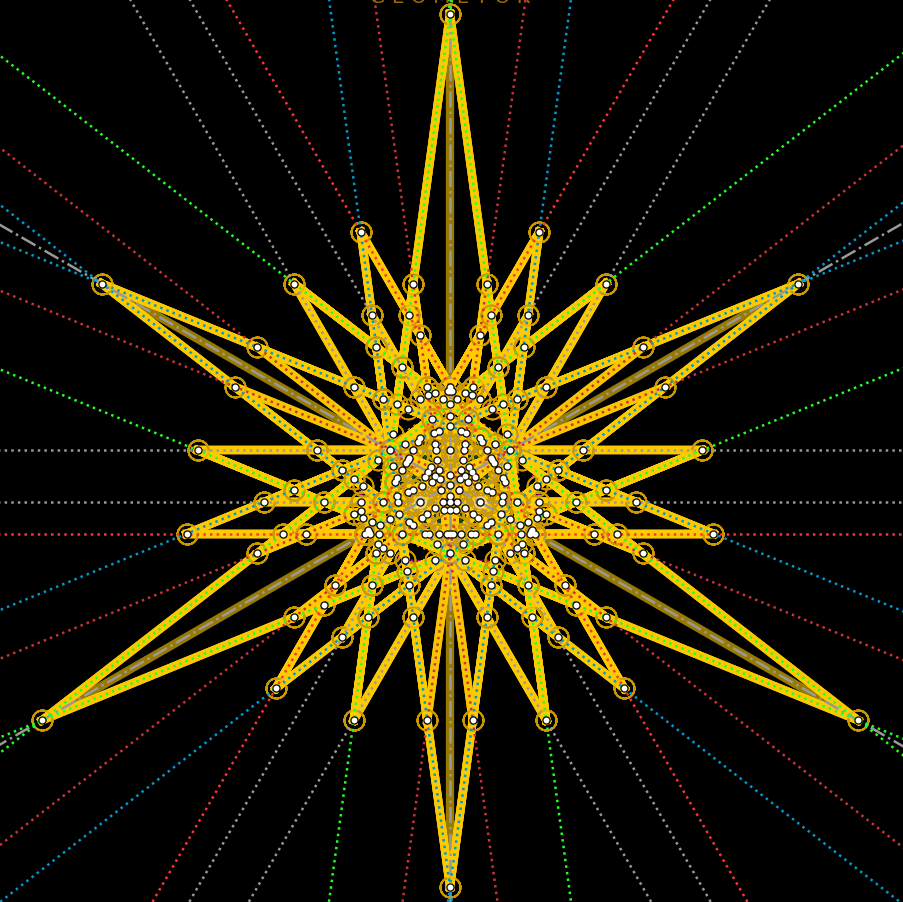
Incorruptible Certitude & the Three-Step Method of Mathematical Transsumption — Critical Commentary & Notes
Exact Symbolic Reconstruction, Latin Philology & Canon Reception · DI I.11–12 (1440)
I. Ontological Defense of Mathematical Objects (DI I.11)
In DI I.11, Cusa situates mathematical demonstration at the epistemological nexus between impermanent sensory particulars and transcendent intellectual realities:
Sensible Things in Continual Flux: Owing to the material principle of possibility, sensible bodies never attain fixed stability; no two physical lines or circles are ever perfectly equal in nature.
Incorruptible Certitude of Mathematical Entities: Mathematical figures, abstracted from sensory flux into pure imagination and intellect, preserve complete, incorruptible stability. Their properties are demonstrated apodictically through chains of necessary reasoning.
Refutation of Epicurean Atomism: Cusa notes that mathematical continuity refutes the indivisible physical atoms of Democritus and Epicurus: every continuous quantity is divisible in infinitum.
II. Philological Transmission & Collation
The text of Book I, Chapters 11–12 is collated across the 1514 Paris editio princeps (ed. Jacques Lefèvre d’Étaples), the 1565 Basel Opera, and Paolo Rotta’s 1913 Bari critical edition.
IV. Executable Symbolic Verification
In accordance with GEOMETOR’s strict content/code separation for historical editions, executable geometor.model SymPy constructions, Rational Trigonometry proofs, and series-error audits for Incorruptible Certitude & the Three-Step Method of Mathematical Transsumption live in src/geometor/cusa/ and the companion walkthrough Demos.