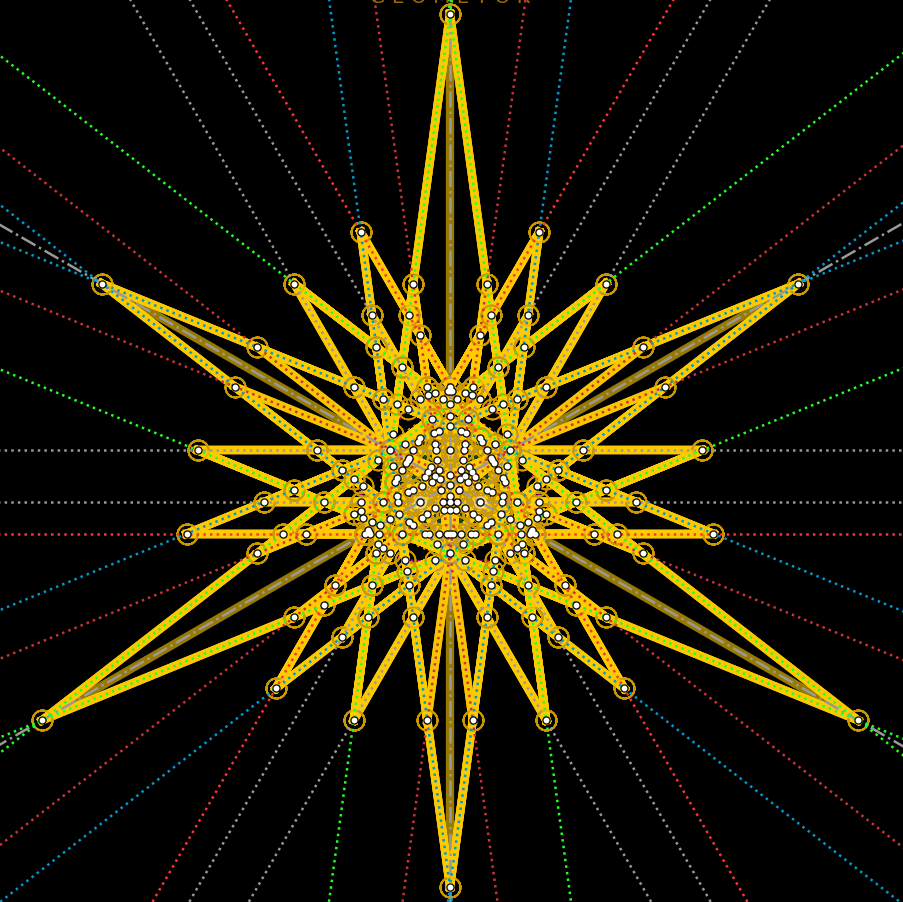
Transsumption of the Triangle: Divine Triunity & Exclusion of Quaternity — Structural Synopsis
Argumentative Architecture & Interactive Diagram Guide · DI I.18–20 (1440)
I. Argumentative Synopsis
Immediate vs. Mediate Participation (`DI I.18`): Finite straight lines participate in infinite rectitude more immediately (analogous to substances, which do not admit of more and less in their substantial ratio), whereas curves participate mediately through rectitude in varying degrees (analogous to accidents). Above both stands the supersubstantial Maximum.
Triunity & the Exclusion of Quaternity (`DI I.19–20`): Because the maximal line is the maximal triangle without numerical multiplication (“when you begin to count the Trinity, you step outside the truth,” Augustine), distinction and indistinction coincide in the Unitrine principle. Crucially, I.20 proves geometrically why divine reality cannot be quaternary or higher: the triangle is the minimal polygon into which all polygons resolve, whereas a quadrangle is composite and larger than the minimal, so it cannot coincide with the simplest Maximum or measure triangles adequately.