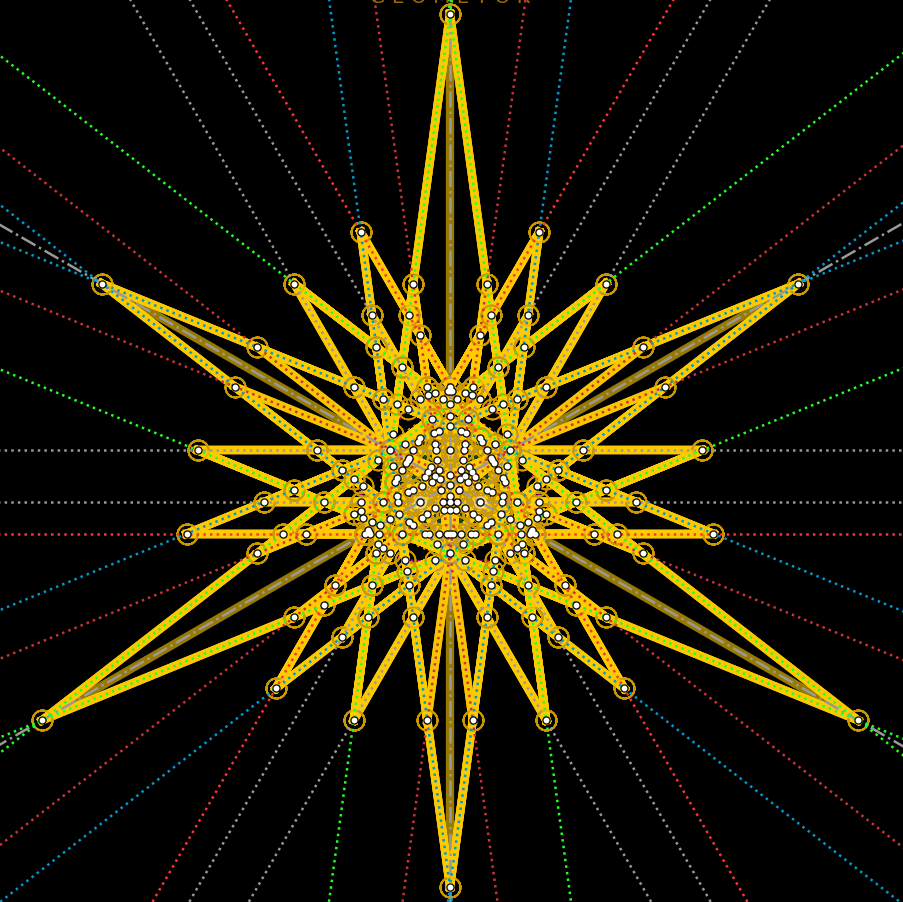
The Infinite Sphere Where Center, Diameter & Circumference Coincide¶
De Docta Ignorantia · Liber I, Capitula XXI–XXIII (1440)
Patet ergo centrum, diametrum et circumferentiam idem esse. Ex quo docetur ignorantia nostra incomprehensibile maximum esse, cui minimum non opponitur; sed centrum est in ipso circumferentia.
Clearly, therefore, center, diameter, and circumference are identical; thereby our ignorance is taught that the incomprehensible Maximum is that to which the Minimum is not opposed, and that within it the center is the circumference. — De Docta Ignorantia I.21 §3
Book I, Chapter 21 — Transsumption of the Infinite Circle to Unity¶
Original GEOMETOR Translation from the Latin · h I, nn. 63–66 · Paris 1514 fol. 8v–9r · Rotta 1913 pp. 45–47
f. DI I.21 §1We have offered a few remarks concerning the maximal triangle; let us in like manner subjoin some reflections concerning the infinite circle:
f. DI I.21 §2The circle is the perfect figure of unity and simplicity. Above it has already been shown that the triangle is a circle; thus trinity is unity. Now this unity is infinite, just as the circle is infinite; hence it is infinitely more one and more identical than any unity expressible or apprehensible by us. So great is the identity there that it precedes even all relative oppositions, since there ‘other’ and ‘diverse’ are not opposed to identity. Because the Maximum is of infinite unity, therefore, all attributes that belong to it are itself without diversity or otherness, so that its goodness is not one thing and its wisdom another, but the selfsame. For in it all diversity is identity; hence because its power is most one, it is also most strong and most infinite. So utterly one is its duration that within it the past is not other than the future, nor the future other than the present; rather they are one most unified duration, or eternity without beginning and end. So completely is beginning within it that within it even the end is the beginning.
f. DI I.21 §3All this the infinite circle displays: eternal without beginning or end, indivisibly most one and most capacious. Because that circle is maximal, its diameter too is maximal. And since there cannot be several maxima, that circle is so supremely one that its diameter is its circumference. Now an infinite diameter has an infinite midpoint; and the midpoint is the center. Clearly, therefore, center, diameter, and circumference are identical. Thereby our ignorance is taught that the incomprehensible Maximum is that to which the Minimum is not opposed, and that within it the center is the circumference.
f. DI I.21 §4You see how the whole Maximum exists most perfectly within everything simple and indivisible, because it is infinite center; outside all being, encompassing all things, because it is infinite circumference; and penetrating all things, because it is infinite diameter. Beginning of all things, because center; end of all things, because circumference; middle of all things, because diameter. Efficient cause, because center; formal cause, because diameter; final cause, because circumference. Bestowing being, because center; governing, because diameter; conserving, because circumference—and many similar truths besides.
f. DI I.21 §5Through the intellect you apprehend, accordingly, how the Maximum is neither identical with nor diverse from anything, and how all things are in it, from it, and through it, because it is circumference, diameter, and center—not that it is a circle or circumference, diameter, or center, but solely the most simple Maximum, investigated through these paradigms and found to encompass all things that are and are not, so that within it non-being is maximal being just as the Minimum is the Maximum. And it is the measure of every circulation from potency into act and back again from act into potency, of composition from principles down to individuals and resolution of individuals back into principles, of perfect circular forms and circular operations and motions returning upon themselves and to their beginning, and of all like things whose unity consists in a kind of circular perpetuity.
f. DI I.21 §6Much more concerning the perfection of unity might here be drawn from this circular figure, which for brevity’s sake I pass over, since anyone can readily work it out in keeping with what precedes. One thing only I admonish you to note well: how all theology is circular and grounded in a circle, to such a point that even the names of the attributes are verified of one another circularly—supreme justice is supreme truth, and supreme truth is supreme justice, and so for all the rest. From this, should you wish to extend your inquiry, countless theological truths hitherto hidden will become utterly manifest to you.
Book I, Chapter 22 — How the Providence of God Unites Contradictories¶
Original GEOMETOR Translation from the Latin · h I, nn. 67–69 · Paris 1514 fol. 9r–9v · Rotta 1913 pp. 48–50
f. DI I.22 §1That we may also experience how we are led to lofty understanding through what has preceded, let us apply our inquiry to the providence of God. Since from our earlier arguments it is manifest that God is the enfolding of all things, even of contradictories, nothing can escape His providence; for whether we do something or its opposite or nothing at all, the whole was enfolded within God’s providence. Nothing, therefore, will come to pass save in accordance with God’s providence.
f. DI I.22 §2Hence although God could have foreseen many things that He neither foresaw nor will foresee, and also foresaw many things that He could have refrained from foreseeing, nevertheless nothing can be added to or subtracted from divine providence. Take an analogy: human nature is simple and one; if a human being were born who was never expected to be born, nothing would be added to human nature, just as nothing would be subtracted from it were he not born, nor when those who have been born die—and this because human nature enfolds alike those who exist and those who neither exist nor ever will exist, though they could have existed. In the same way, even if something were to happen that will never happen, nothing would be added to divine providence, because it enfolds both the things that happen and those that do not happen yet can happen. Just as many things exist possibly in matter which will never come to pass, conversely whatsoever things will never come to pass yet can come to pass exist in God’s providence not possibly, but in act—without its following therefrom that those things exist in act in the unfolded world. Just as we say that human nature enfolds and embraces infinites—not only the human beings who have been, are, and will be, but those who can be though they never will be—and thus embraces mutable things immutably, as infinite unity embraces every number, so God’s infinite providence enfolds both the things that will happen and those that will not happen yet can happen, together with contraries, just as a genus enfolds contrary specific differences. And the things it knows it knows without difference of tenses: not future things as future nor past things as past, but eternally, and mutable things immutably.
f. DI I.22 §3Therefore divine providence is inevitable and immutable, and nothing can outstrip it; hence all things, when referred to providence itself, are rightly said to possess necessity, because in God all things are God, who is absolute necessity. Thus it is plain that things which will never come to pass exist in God’s providence in the manner aforesaid, even though they are not foreseen so as to happen. And God necessarily foresaw what He foresaw, since His providence is necessary and immutable, even though He could also have foreseen the opposite of what He foresaw. For when the enfolding is posited, the unfolded thing is not thereby posited, whereas when the unfolding is posited, the enfolding is posited. Although tomorrow I am free to read or not to read, whichever I do I do not evade providence, which embraces contraries; hence whatever I do will occur according to God’s providence.
f. DI I.22 §4Thus it is clear how, through the preceding principles teaching us that the Maximum precedes every opposition because it embraces and enfolds all things in every way, we apprehend what is true concerning God’s providence and like matters.
Book I, Chapter 23 — Transsumption of the Infinite Sphere to the Actual Existence of God¶
Original GEOMETOR Translation from the Latin · h I, nn. 70–73 · Paris 1514 fol. 9v–10r · Rotta 1913 pp. 50–52
f. DI I.23 §1It is fitting to add a few further speculations concerning the infinite sphere. In an infinite sphere we find three maximal lines—of length, breadth, and depth—concurring at the center. Yet the center of the maximal sphere equals the diameter and the circumference. Within the infinite sphere, therefore, the center equals those three lines; nay rather, the center is all of them, namely length, breadth, and depth. Hence the Maximum will most simply and infinitely be all length, breadth, and depth, which within it are one most simple, indivisible Maximum. As center, it precedes every breadth, length, and depth, and is likewise their end and their middle, because in an infinite sphere center, thickness, and circumference are identical. Just as the infinite sphere is wholly in act and most simple, so the Maximum is most simply and wholly in act; and just as the sphere is the act of line, triangle, and circle, so the Maximum is the act of all things. Every actual existence, accordingly, derives from it whatever actuality it possesses, and exists in act just insofar as it exists within that infinite act. Therefore the Maximum is the Form of forms and the Form of being, or Maximal Actual Beingness.
f. DI I.23 §2Hence Parmenides, reflecting with utmost subtlety, declared that God is He for whom to be anything that is, is to be everything that is. Just as the sphere is the ultimate perfection of figures, than which none is greater, so the Maximum is the most perfect perfection of all things, to such a degree that within it everything imperfect is most perfect—just as the infinite line is a sphere, curvature is rectitude, composition is simplicity, diversity is identity, otherness is unity, and so for all the rest. How indeed could any trace of imperfection reside where imperfection is infinite perfection and possibility is infinite act?
f. DI I.23 §3Seeing that the Maximum is like the maximal sphere, we now behold clearly how it is the sole, simplest, and most adequate measure of the entire universe and of all things existing within the universe, because within it the whole is no greater than the part, just as the infinite sphere is no greater than the infinite line. God, therefore, is the sole and simplest ratio of the whole universe; and just as the sphere arises after infinite revolutions, so God—like the maximal sphere—is the simplest measure of all revolutions. For all quickening, motion, and intelligence come from Him, in Him, and through Him, before whom a single revolution of the eighth sphere is no smaller than infinitely many revolutions, since He is the goal of all motions, in whom every motion comes to rest as in its end. For He is maximal rest, within which all motion is rest; and thus maximal rest is the measure of all motions, just as maximal rectitude is the measure of all circumferences and maximal presence—or eternity—is the measure of all times. In Him, therefore, all natural motions rest as in their goal, and every potency is perfected in Him as in infinite act; and because He is the beingness of all being and every motion tends toward being, the rest of motion is He Himself who is motion’s goal, namely the form and act of being.
f. DI I.23 §4Toward Him, accordingly, all beings strive. And because they are finite and cannot participate in that goal equally in comparison with one another, some participate in this goal through the mediation of others—just as the line is led into the sphere through the mediation of the triangle and the circle, the triangle through the mediation of the circle, and the circle into the sphere directly through itself.